There are several thousands of cryptocurrencies out there, known also as altcoins. These coins and tokens all have their own unique features and uses, for example, some are used to help decide the direction the creator company should take, others give you discounts or access to special features. The Coin Guide is a concise summary of the aims and technology behind a certain cryptocurrencies. Insight is crucial in this field. Many projects disguise their progress through complicated jargon, making it hard to distinguish those who are building something meaningful from those who are not.
Vortex DeFi ($VTX) aims to provide users a one-stop access to all leading decentralized finance (DeFi) platforms and protocols from a single web-based user interface.
Decentralized Finance (DeFi) has evolved from a niche subcategory to the biggest catalyst driving the cryptocurrency and blockchain field today. It’s primarily focused on the Ethereum network, which has the majority of the DeFi share. There are, however, a large number of core DeFi protocols, combinators, and countless forks. All of this can become confusing fast.
Fortunately, users don’t have to delve into the complex workings and nuances of these protocols, which can be overwhelming even for long-term users. Vortex DeFi is introduced to simplify the access and exposure to the sector. It has integrations with different protocols, which abstracts away the complexity in a simple and yet intuitive interface, to level the playing field and ensure greater participation.
Background
Vortex DeFi launched in Aug 2020 through a private investment round. It accrued interest and funding from X21 Digital, DuckDao, Moonrock Capital, Magnus Capital, Pluto Digital Assets PLC, Faculty Capital, A195 Capital, etc. A public sale will be held soon.
It has a multicultural team, led by CEO Rahul Singh and strategic advisor Lester Lim. The other prominent team members are technical lead Arun Sunil and product lead Shaz. All team members have previous experiences in market-leading companies and blockchain projects.
What is Vortex DeFi?
Vortex DeFi is a web-based DeFi management system or a comprehensive DeFi aggregative solution platform, serving as a bridge between Ethereum and Polkadot. It combines the functionality and power of core protocols in a sleek dashboard to allow users of all categories to engage in yield farming. The core services provided are NFT asset management, lending and borrowing, insurance, and exchange.
Vortex DeFi will also utilize the yEarn finance protocol to access and extract value from various lending protocols to enable automated profitable yield farming. The added advantage of cross-chain compatibility ensures that users don’t have to choose between two promising blockchains. Vortex DEFI also has several components, taking the guesswork and experimentation out of the process.
Vortex DEFI – Components
V-Swap
Being the Uniswap or Bancor equivalent of Vortex, V-Swap will offer an automated digital assets exchange on the Ethereum and Polkadot blockchain. It’s likely to offer liquidity aggregation from multiple sources, so a peer to peer exchange of tokens can be performed without a direct counterparty or orderbook.
V-Pay
It will offer a fiat gateway for users, so they can acquire and sell crypto assets from FIAT, in their cards or bank accounts. This is required for onboarding new users, as well as ensuring that they have a way for realizing their returns.
V-Yield
A yield aggregator as the name goes, V-Yield will combine yield from different sources and optimize them according to the best return rate. It will spare users from the trouble of manually finding sources and having the need to rotate them.
V-NFTs
An asset management, V-NFTs will allow users to manage their asset collection and swap them for each other. Given that NFTs are an illiquid asset class and their infrastructure is scattered, it’s hugely important to develop a unified interface.
V-Insure
DeFi protocols are rife with exploits and smart contract risks. Therefore, to onboard new users and even to retain existing ones, it’s necessary to grant them peace of mind by ensuring the protection of their funds. V-Insure will seek to insure user funds by seeking out integrations with multiple DeFi insurance protocols.
Vortex DEFI Native Token ($VTX)
The native token of the platform is Vortex DeFi Token ($VTX), ERC-20 token, which will be used to incentivize users. It has four purposes:
Liquidity pools (LP) rewards are distributed in VTX
Usage for staking on the platform.
Holding VTX tokens allows users to save on the platform fees
The team has announced plans to regularly buy tokens and burn them every quarter to reduce supply and increase the value of existing tokens.
All of these benefits and value accrual mechanisms will motivate users to hold tokens, in anticipation of rising demand and prices.
$VTX Token Metrics
The VTX token has a total supply of 100M $VTX and an initial circulating supply of $0.4M $VTX.
Funding Rounds
Private Sale (concluded): 32,500,000 VTX sold at 0.0276 USD per token.(25% TGE, 75% vesting over 120 days)
Public Sale (on 28 February 2021): 2,500,000 VTX to be sold at 0.04 USD per token. No vesting period.*
Advantages of Vortex DeFi
The platform offers users the advantages of a unified DeFi management dashboard, the ability to fuse several protocols together offering a seamless experience with abstracted complexity, powerful lend and earn functionality, automated rotation of funds for optimized returns, non-custodial function, and insurance against loss of funds.
Vortex DEFI will have integrations with several key DEFI protocols, including but not limited to Maker DAO, Compound, Kava, Idle, Aave, Yearn, Uniswap, Nexus Mutual, Curve. This will allow for a powerful user experience, which is likely to improve penetration of decentralized finance.
Vortex Vision
The team hopes that Vortex will become the top one-stop solution for a user’s DeFi needs and allow them to simplify their experience. Vortex hopes to make financial applications accessible and simple for all users, regardless of their technical expertise. It will also allow saving on transaction fees (gas) by batching and combining transactions.
Vortex can also enhance the decentralization level of DeFi protocols by ensuring broad participation and an increase in user activity. Furthermore, it will feature the DAAS (DeFi-As-A-Service) business model. Currently, the product is in development and more changes are expected as the platform launch draws near.
Conclusion
DEFI was founded on the principle of openness, equal opportunity, transparency, trustlessness, lack of centralized control, fast processing, and lego-like composability. It is generally presented as a superior alternative to the traditional financial system, which differs heavily from the principles of the crypto community and disallows these services to a large number of people.
On the other hand, DeFi is accessible to almost everyone with an internet connection and a personal computing device or smartphone. However, primitive user interfaces and experiences of the existing DeFi protocols were a problem. Thankfully, Vortex will overlap the strong functionality of these protocols with an amazing and simple interface.
Currently, there is a lack of dashboard-style platforms connected to multiple DEFI protocols, aggregating their services and offering a one-stop solution. All of this is about to change with the Vortex launch, which is likely to onboard a large number of new users as well as provide a novel interesting solution to the existing ones.
Decentralised Finance (DeFi) series: tutorials, guides and more
With content for both beginners and more advanced users, check out our YouTube DeFi series containing tutorials on the ESSENTIAL TOOLS you need for trading in the DeFi space e.g. MetaMask and Uniswap. As well as a deep dive into popular DeFi topics such as decentralized exchanges, borrowing-lending platforms and NFT marketplaces
More videos and articles are coming soon as part of our DeFi series, so be sure to SUBSCRIBE to our Youtube channel so you can be notified as soon as they come out!
Disclaimer: Cryptocurrency trading involves significant risks and may result in the loss of your capital. You should carefully consider whether trading cryptocurrencies is right for you in light of your financial condition and ability to bear financial risks. Cryptocurrency prices are highly volatile and can fluctuate widely in a short period of time. As such, trading cryptocurrencies may not be suitable for everyone. Additionally, storing cryptocurrencies on a centralized exchange carries inherent risks, including the potential for loss due to hacking, exchange collapse, or other security breaches. We strongly advise that you seek independent professional advice before engaging in any cryptocurrency trading activities and carefully consider the security measures in place when choosing or storing your cryptocurrencies on a cryptocurrency exchange.
Linear Finance ($LINA) understands that decentralized finance (DeFi) has opened new possibilities for derivative offerings and that many exchanges have the apparent problems of front-running, expensive gas fees, and liquidity issues. Linear Finance seeks to go around those issues with its cheap, quick, and transparent synthetic asset exchange platform. With Linear, users can simply make a synthetic asset that contains a portfolio of different underlying tokens based on the exposure that they are willing to take. This presents new yield-making opportunities for anyone based on their customized financial goals.
Check out our interview with Linear Finance!
https://www.youtube.com/watch?v=JcXsEwj5hpI
Background
Drey Ng and Kevin Tai, Co-founders of Linear Finance, built the project with a vision of an inclusive and more democratized access to investment opportunities. By their team’s expertise in different crypto initiatives and financial instruments, Linear made a cross-chain, Ethereum-based protocol that seeks to fulfill their vision.
With Linear, users can make their own portfolio exposures and manage them on their own. This initiative enables investors to easily invest, save, and earn efficient profits from their assets.
What is Linear Finance?
Linear Finance is a decentralized delta-one asset protocol where users can make, manage, and trade synthetic assets. This gives users exposure to different kinds of assets without having to actually own their underlying assets.
An additional feature that Linear Finance has introduced is a cross-chain compatible and decentralized protocol that can support a faster, more affordable, and secure exchange of synthetic assets.
Linear Finance’s platform is powered by its native token, LINA. It can be used for many purposes such as payments, staking, liquidity mining, governance, and investing in “Liquids.” Liquids are Linear’s synthetic assets composed of different underlying tokens or investment options.
LinearDAO
LinearDAO is the governance community who controls important platform designs and system parameters including pledge ration, LINA inflation reward and frequency, transactions fees, proposal implementation, and many more. Furthermore, they also regulate the profit and loss regarding liquidation.
Perks and Special Features
The project promises infinite liquidity and no slippage. Here are some of the perks users can find with Linear Finance:
Convenience: The protocol promises quick transactions with low transaction fees. Any kind of user can enjoy the platform as well, whether they are a market maker, staker, or trader.
Transparency: To prevent front-running, every transaction made within the exchange is made transparent to all users. This also reduces systemic risks on the part of each network participant.
Ethereum-based: Because it is built on the Ethereum network with cross-chain compatibility, it can work alongside other DeFi projects too.
User-tailored options: There are different exposure options that users can freely choose from, such as other tokens, commodities, or market indices.
The whole Linear platform is built on two different blockchains but they complement each other thanks to cross-chain compatibility. For users, they only need to open an Ethereum-based wallet and an EVM-compatible wallet.
Linear automatically links these two together through smart contracts. Here are some of the advantages of an infrastructure modeled around that concept. They are:
Maximized DeFi support: While LinearDAO and LINA tokens are based on Ethereum, its use of EVM and smart contracts make it easy for the platform to interact with other DeFi protocols.
Affordability: Buildr and Exchange function through smart contracts on top of EVM-compatible blockchains. This enables Linear to support the building and trading of Liquids at very minimal gas fees.
Fewer risks of front-running: The block time confirmation for other EVM-compatible blockchains are much faster than Ethereum. This allows users to create their own Liquids at more updated prices through the help of oracles. This way, the risk of users front-running the exchange becomes much lower.
LINA Token
LINA can be used for payments, staking, and governance participation. But mainly, LINA functions as the base collateral needed to mint Liquids through Buildr, the decentralized application (dApp) designed to manage synthetic assets.
To create Liquids, users have to “pledge” 100% of their digital assets, which also means collateralization. This is to ensure that Liquids are fully-backed by an underlying asset, saving the stability of the system from the volatility of synthetic assets. The pledge requirement can be reduced eventually if the LinearDAO deems it necessary.
Collateralization
Buildr takes a hybrid approach in terms of collateralization. For Liquids, users need to deposit a mixture of LINA and other cryptocurrency tokens to generate a synthetic asset. The ratio is 80:20, where at least 80% of the collateral must be in LINA and 20% can be in other cryptocurrencies.
Staking
Staking LINA offers users many incentives. These are the following rewards that users can receive by doing so:
Exchange Fee Reward: The transaction fees collected from users of the Linear.Exchange platform, currently set at 0.25%, is redistributed weekly to LINA stakers on a pro-rata basis. For non-LINA stakers, these rewards can also be provided too but it will depend on the decision of the community governance council.
Inflationary Reward: LINA has a starting inflation rate of 75% which decreases on a weekly basis. The inflation reward is given to LINA stakers on a pro-rata basis as well.
Yield Farming: Yield farmers help maintain Linear’s debt pool and the whole platform. For the first two years of the project, users who actively use the exchange can receive token bonuses. These token bonuses can then be deposited by yield farmers in other liquidity pools such as Balancer, Curve, and Uniswap.
In facilitating faster trade activities with almost unlimited liquidity, Linear is building their own exchange. As of now, Liquid is collaborating with other public blockchains to reduce transaction settlement timeframes to as quick as one second every transaction coupled with instant finality.
With a plan of partnering with oracles, Linear also believes that they can solve problems with front-running as they gain the capability of refreshing prices on a frequent and quick basis at much lower prices for the underlying assets.
Linear Finance ($LINA) token public sale
The token public sale took place on 14th September 2020. A total of 47,222,222 LINA tokens were sold in 2 rounds. The first round had 25mil tokens at $0.00400 per token. The second round, 22,222,222 tokens at $0.00450 per token.
The sale was 40 times oversubscribed and closed earlier than expected (it was supposed to last for 24 hours). Each participant in the sale had to purchase 500 USDT/USDC worth of LINA. Hence only 400 participants were able to get the allocation on a FIRST COME FIRST SERVED basis. This was determined by the time/date stamp on their Google Form submission. The first 200 users were allocated LINA tokens from round 1, and the remaining 200 participants from round 2. This was however subject to the registrants completing the KYC process in a period of 24 hours.
$LINA was first listed on Uniswap and reached more than 20x from public sale price (and around 60x from private sale round 1). It is now stabilized at around $0.005 (as at 3 November 2020).
Linear pre-staking platform
Immediately after listing, Linear Finance has launched its staking platform. Holders can participate in the 8 weeks pre-staking program and get rewarded. The APY has been around 600% for weeks and has now decreased around 370%. All the earnings will be claimable 6 months after mainnet launch but users can withdraw their staked funds at anytime.
Partnership announcements
In the weeks following the launch, Linear has announced partnerships with Nervos, Moonbeam and Hex Trust.
Nervos is an open source blockchain that offers security and trustlessness without compromising on scalability and performance with its unique layered architecture. The collaboration is focused on improving Linear’s cross chain capabilities and penetration of the Chinese market.
Moonbeam, an Ethereum ($ETH) compatible smart contract parachain, is a strategic partner to help set the feet into the Polkadot ($DOT) ecosystem and level up Linear’s interoperability. Finally, the partnership with Hex Trust as a custody partner, will give Linear the chance to offer secure, institutional grade custodial services for institutional investors.
A next announcement has revealed a new partnership with 3Commas, a cryptocurrency trading platform that helps users build automated trading bots. The investment is meant “to include future integration of the platforms and tools, streamlining operations and allowing for a greater range of features and offerings”.
Testnet is live
On 16th October 2020, the first testnet for Buildr has been released. Buildr is one of the core dApps of the Linear suite, where users can stake their $LINA (and soon more collaterals) to build ℓUSD, the base currency of Linear Exchange. Stakers are entitled to rewards and to a part of the transaction fees generated by the exchange. ℓUSD tokens can be minted to purchase synthetic assets within the exchange itself and can be moved to other protocols.
The last testnet update has just come out allowing users to purchase “Liquids” with ℓUSD on Linear.Exchange. Meanwhile, mainnet launch is allegedly happening in a couple of weeks.
If you want to read more and discover how to contribute to the testnet, please have a look at the articles here and here.
More than 222 million of $LINA tokens are staked, for a total value of more than USD$1 million.
New Partnership with Band Protocol
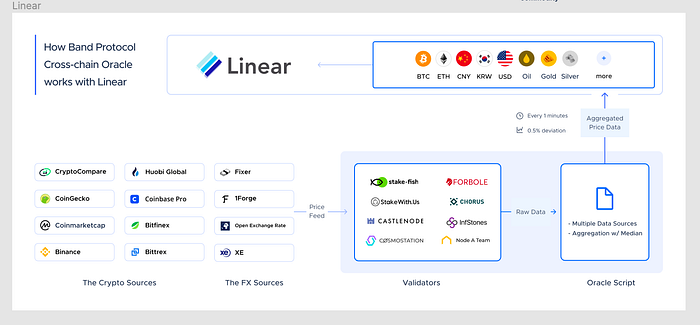
In this article dated November 16, Linear Finance has ufficially announced their partnership with Band Protocol, cross-chain decentralised oracle.
The biggest problem this collaboration is trying to solve is front running. As Drey Ng, Co-Founder at Linear Finance said: “Front running is a fundamental problem not just for current synthetic asset trading but all trading in general”. Not solving this problem would jeopardize all “the benefits of cross-chain compatibility (such as speed and cost), and a superior creative selection of synthetic assets”.
How Band Protocol Oracle works with Linear
Other reasons why Band Protocol was chosen are the minimized network risk., end-to-end customizability for real-time data and truly decentralized oracle mechanism. The partnership will start securing the Linear Protocol on Binance smart Chain, the first project’s cross-integration, where the BEP token has just been created (the common $LINA we see on exchanges is an ERC-20 token).
The team is now working on features to allow users to seamlessly swap chains.
Mainnet Buildr Launch and new staking program
The Linear Mainnet Buildr v1.0 went live on December the 21st, after months of extensive testing. The Buildr dApp is the heart of Linear’s decentralised application suite. Users can stake $LINA tokens to build ℓUSD and earn rewards. Here is a complete and detailed guide on how to use Buildr to the fullest.
All of the $LINA from the pre-staking program were migrated seamlessly to the mainnet and while previously earned rewards will be blocked until next June, new mainnet staking rewards will be locked for 1 year from launch. They will count towards the P-Ratio and can be used to build $LUSD. It is important to note that in order to be eligible for rewards, users are required build ℓUSD or any subsequent Liquids.
Binance Smart Chain’s Buildr v2.0 launch
As anticipated, Linear wants to bring Cross Chain compatibility and ease of use to Defi and Ethereum users. The team had, in fact, previously declared that “Linear was designed for all users (no matter how much LINA you hold) and transaction costs will not become a barrier to entry. Nobody will get left behind”.
The promise has been kept and Linear.Builder Mainnet v2.0 with full Binance Smart Chain (BSC) integration and swap has gone live on January the 15th, 2021. Users can now enjoy almost gasless fees when interacting with the platform.
The transaction was seamless and old stakers only have to connect to Buildr via MetaMask using the BSC Mainnet (they can also use Binance Chain Wallet) and they will see their Lina tokens and rewards already there. For new holders who would like to stake for the first time, there is an internal ERC-20 -> BEP20 swap whithin Buildr itself. More info and complete instructions can be found on the Medium article.
Be careful!: There are now two versions of the $LINA token. If you send the Etherum version to a BSC wallet or vice-versa (whether it is a custodial or non-custodial address) you will lose your tokens! If in doubt on what to do, contact the support team via the official channels which you can find on their Website.
Linear will be listed on Binance Innovation Zone
Binance has announced it will list Linear Finance’s $LINA token on its Innovation Zone. Trading for $LINA/$BTC, $LINA/$BUSD and $LINA/$USDT trading pairs will start at 12:00pm (UTC) on 18th March 2021.
Furthermore, Binance Launchpad is offering 21,084,000 LINA tokens for sale at at 0.00031044 BNB for 1 LINA. Subscription has already ended at 1:00p.m. (HKT) on 18th March 2021 and tokens will be sent to successful applicants at 6:00p.m. (HKT) on the same day.
Conclusion
With the rising gas prices in Ethereum, as well as the emerging trend of yield farming, the DeFi space is presented with new financial opportunities but is discouraged by its costs. Projects such as Linear is a promising addition to the space as it seeks to go around these problems.
With Linear as a platform to easily build and manage investments, users can now enjoy quick and affordable profit-building opportunities. And in recognition of the real purpose of decentralization, Linear appears to be on the right track after putting in the pipelines a roadmap for a planned transition to community governance.
Linear is certainly on the radar of a lot of renowned investors in this space. They have recently completed a USD$1.8m seed round with notable backers in the investment space such as NGC Ventures, Hashed, CMS Holdings, Genesis Block, Kenetic Capital, Alameda Research, Evernew Capital, Soul Capital, Moonrock Capital, Black Edge Capital and PANONY. According to Linear, this funding will go towards accelerating the development of their testnet and mainnet, as well as promoting their platform. It will certainly be exciting to see what the Linear Finance team will be releasing in the months to come.
Decentralised Finance (DeFi) series: tutorials, guides and more
With content for both beginners and more advanced users, check out our YouTube DeFi series containing tutorials on the ESSENTIAL TOOLS you need for trading in the DeFi space e.g. MetaMask and Uniswap. As well as a deep dive into popular DeFi topics such as decentralized exchanges, borrowing-lending platforms and NFT marketplaces
More videos and articles are coming soon as part of our DeFi series, so be sure to SUBSCRIBE to our Youtube channel so you can be notified as soon as they come out!
Disclaimer: Cryptocurrency trading involves significant risks and may result in the loss of your capital. You should carefully consider whether trading cryptocurrencies is right for you in light of your financial condition and ability to bear financial risks. Cryptocurrency prices are highly volatile and can fluctuate widely in a short period of time. As such, trading cryptocurrencies may not be suitable for everyone. Additionally, storing cryptocurrencies on a centralized exchange carries inherent risks, including the potential for loss due to hacking, exchange collapse, or other security breaches. We strongly advise that you seek independent professional advice before engaging in any cryptocurrency trading activities and carefully consider the security measures in place when choosing or storing your cryptocurrencies on a cryptocurrency exchange.
CertiK aims to provide a secure platform where blockchain infrastructure and decentralized applications can be developed. Its ecosystem consists of security layers that exist below the blockchain level, including the DeepSEA compiler, the CertiK Virtual Machine (CVM), and CertiKOS. Its native token, $CTK, has launched in Binance Launchpool on 27 October 2020. Below is a detailed overview of the CertiK ecosystem, including the CertiK chain.
The CertiK Foundation supports the CertiK platform. The organization champions trust in blockchain systems. Its efforts are displayed through the development of a secure network that can boost confidence in decentralized systems. Furthermore, the CertiK Foundation is lead by renowned computer professors.
What is CertiK?
CertiK is a decentralized smart contract platform powering Dapps. Additionally, it supports inter-chain communication and runs on the Certik Chain.
The system is primed for highly-specialized use cases. The protocol employs a PoS variation called delegated proof-of-stake (DPoS) and uses the Cosmos software development kit (SDK).
The CertiK Foundation has taken upon itself to restore the trust in distributed platforms by employing cutting-edge security technologies and techniques. A key milestone achieved by CertiK is the provision of provable trust in a decentralized platform. Apart from focusing on security, the network also addresses performance and token economics.
CertiK Token ($CTK)
The economic aspect of the platform relies on the platform’s native currency, CTK. CTK’s major offering is being a utility token. (Provigil) Therefore, it helps power the crucial aspects of the CertiK ecosystem.
For example, the token provides a mode of payment and settlement among the platform’s users.
However, the token does not give its holders the right to interact and does not act as an investment into CertiK Foundation. Being issued inside a PoS-powered system, the token carries various benefits to incentivize holders to participate in staking and securing the network.
Apart from being used on the CertiK protocol, CTK is a significant ingredient in the CertiK Chain. Here, the token is used to pay for transaction fees.
In return, the fees reward staking nodes on the chain. Also, the token is used to reward those who delegate their CTK holding to validator nodes.
The token’s first issuance was achieved through two private sales that sold a total of 38 million CTK tokens worth a cumulative $39,430,000. Apart from the private sale 1 & 2 (29.0% & 9.0% respectively), the token distribution allocated 1.5% of its total supply to Binance Launchpool, 10.0% to the CertiK team, 25% to the CertiK Foundation, 17.5% to the community pool, and 8.0% to the CertiKShield pool.
What is CertiK Chain?
CertiK Chain is a blockchain protocol powering the CertiK ecosystem. It is highly secure and has cross-chain interoperability. To effectively achieve its mission, the platform incorporates key components such as a security oracle and a CertiKShield pool.
The platform’s security oracle compresses audit reports to make them available on-chain. Basically, audit reports hold information as to the reliability of smart contracts. But, the reliability of smart contracts can be sabotaged by the data it uses to make decisions.
With these reports living outside blockchain platforms, it poses a security threat prompting CertiK to bring them on-chain through its security oracle. Consequently, the network can effectively verify the security of a smart contract.
Note that this component allocates scores depending on a smart contract’s latest audit report. The scores give an overview of a contract’s code reliability.
More than just scoring contracts, the security oracle can track and report unaudited smart contracts. A distributed security team handles such reports. Using the CertiK Oracle Combinator, results from the security team are aggregated into a single score that can be accessed online. And, of course, the security team is rewarded.
Luckily, this functionality is crucial in a decentralized finance (DeFi) setting where unaudited smart contracts are wreaking havoc. For example, by incorporating the CertiK’s security oracle, the responsibility of an audit is shifted from the contract creator to the contract users.
CertiKShield Pool
The CertiKShield pool is a unique component meant to minimize the risks emanating from the private nature of (most) cryptocurrencies. This may include losses from both avoidable and unavoidable circumstances such as house fires.
The shield works by providing a flexible pool of CTK tokens. Since the token uses on-chain governance mechanisms, it can be used to compensate losses sprouting from inaccessibility and/or theft.
In other words, this operates as an insurance platform. But, its decentralized nature allows it to receive inputs from all involved individuals before settling a claim.
The CertiKShield Pool is made up of collateral providers and shied purchasers. Collateral providers earn staking rewards while shield purchasers pay for requested protection.
CertiK Chain Architecture
The main components of the CertiK Chain are baked together in an architecture that can achieve provable trust. Apart from the security oracle and the shield pool, the network’s backbone comprises a virtual machine and the DeepSEA toolchain.
CertiK Virtual Machine (CVM)
The CVM effectively eliminates the errors that may be introduced when converting smart contract code from human-based language to machine language. Although these errors may be unknown to contract developers, they pose a severe security risk.
Being a security-first decentralized platform, the CVM relies on the output of DeepSEA, a certified compiler. The compiler’s output includes bytecode and mathematical proofs. The proofs can be used to isolate smart contracts’ code that doesn’t meet the security standards.
DeepSEA Toolchain
DeepSEA is a compiler and a programming language that’s hailed for its security. Notably, the CertiK-native tool is developed in conjunction with researchers from leading learning institutions such as Columbia and Yale University.
The toolchain can determine the complex correctness properties of smart contracts. As such, it enhances the security of the network and products built on top of it.
CertiK Governance
The CertiK protocol uses on-chain governance methods to enable community involvement in decision-making. However, to vote for proposals, CTK holders can either delegate their voting powers to validators or vote directly. Validator nodes ensure the smooth running of the platform through powering activities such as block production.
CertiK accommodates five types of proposals from its community:
Plain text: These are proposals that request modification of things like altering the number of incentives paid to validators.
Software upgrade: They lead to code modifications. They may include proposals to add new features.
Bounty: Examples of proposals in this category include those touching on creating chain artifacts and conducting security audits.
Community pool spend – They cater for the transfer of funds from a pool to an individual address, for instance, an individual developing a CertiK-specific product or upgrade.
Certifier: They are submitted by a certifier with a request to add or remove a certifier. Note that certifiers and validators vote on proposals.
Conclusion
In a space where malicious actors are always on the prowl for weaknesses in DeFi-focused smart contracts, CertiK provides the much-needed peace of mind. In addition, enabling a decentralized contract audit removes the need for DeFi users to solely rely on reports provided by the team, which, in some cases, are anonymous.
From the security oracle to the reimbursement pools, to DeepSEA, the network structurally achieves a security-first approach with provable trust.
Decentralised Finance (DeFi) series: tutorials, guides and more
With content for both beginners and more advanced users, check out our YouTube DeFi series containing tutorials on the ESSENTIAL TOOLS you need for trading in the DeFi space e.g. MetaMask and Uniswap. As well as a deep dive into popular DeFi topics such as decentralized exchanges, borrowing-lending platforms and NFT marketplaces
More videos and articles are coming soon as part of our DeFi series, so be sure to SUBSCRIBE to our Youtube channel so you can be notified as soon as they come out!
Disclaimer: Cryptocurrency trading involves significant risks and may result in the loss of your capital. You should carefully consider whether trading cryptocurrencies is right for you in light of your financial condition and ability to bear financial risks. Cryptocurrency prices are highly volatile and can fluctuate widely in a short period of time. As such, trading cryptocurrencies may not be suitable for everyone. Additionally, storing cryptocurrencies on a centralized exchange carries inherent risks, including the potential for loss due to hacking, exchange collapse, or other security breaches. We strongly advise that you seek independent professional advice before engaging in any cryptocurrency trading activities and carefully consider the security measures in place when choosing or storing your cryptocurrencies on a cryptocurrency exchange.
Litentry ($LIT) is a decentralized cross-chain identity aggregator, built on Substrate, that features an identity matching and identity staking mechanism.
In today’s world, personal data and identity are everything. Some companies in the conventional world make millions by selling user data. In the decentralized world, blockchain-based firms make losses.
For example, one user can create multiple accounts to take advantage of free airdropped tokens. Also, platforms powering decentralized finance (DeFi) have no way of tracking users’ credit history, making them charge higher collateral when issuing loans.
Fortunately, there’s a new way to keep track of identities in the distributed ecosystem securely. Powered by Litentry, we can see blockchain-focused platforms do more than just power token swaps. It’s now possible to scan through user’s deposit and withdrawal actions on Uniswap. Furthermore, a user’s activity can also be assessed on a community-governed blockchain.
Since the platform is so diverse, below, we look at the major highlights.
Background
Litentry is developed by a team of blockchain professionals based in Germany. Its founder was among the early contributors of Parity, a decentralized network. Notably, the project engineering team’s background is rooted in Ethereum.
The protocol is funded through a Web3 Foundation grant. On its Github page, the project lists eight team members with organization permission.
What is Litentry?
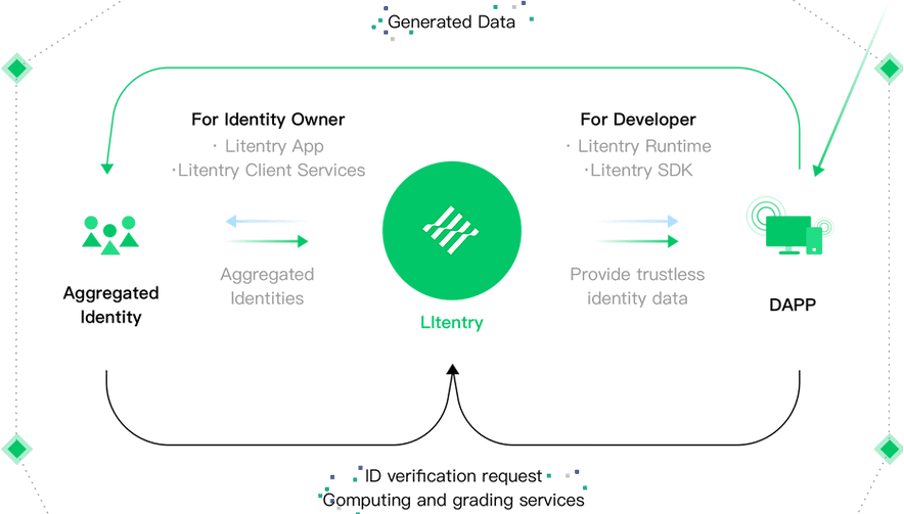
The project focuses on decentralized identity (DID), allowing user identities to be linked to multiple distributed protocols. Litentry acts as a DID aggregator where it collects, indexes, and distributes DIDs to blockchains.
More importantly, it performs all these activities in a decentralized and verifiable way. Notably, built on the Substrate network, the platform works towards the greater goal of eradicating identity redundancy in the Web3-powered application ecosystem.
The problem
In the current internet world, third parties take control of storing user passwords and data pertaining to their online activity. Unfortunately, internet users are coerced into accepting unfavorable terms and conditions, consequently lessening the grip on their personal data.
Litentry brings the change by returning the control of user data to the users by powering a user-focused internet using blockchain technology. As such, the revenue emanating from using users’ data gets the users to share in the profits. Before Litentry, these profits went to third parties managing the user data.
Key Features of the Litentry platform
Apart from using decentralized ledger technology (DLT), the platform has other critical features that help it bring the much-needed revolution to the blockchain sector. Key among them include:
Identity management – The platform is all about identities, and their management sits at the protocol’s core. This feature powers anonymous and independent identities emanating from applications and or services used by the user.
Distributed storage – After collecting the data, the protocol stores them in a decentralized manner to enhance access from all corners of the distributed world.
Identity staking – This is a unique feature. Just like staking tokens and earning rewards, Litentry enables users to stake their identities and be rewarded.
Decentralized contributors – Instead of creating multiple accounts to use different platforms or services, the project allows users to use one identity to interact with various services anonymously. Interestingly, the user doesn’t have to provide passwords or any other registration details.
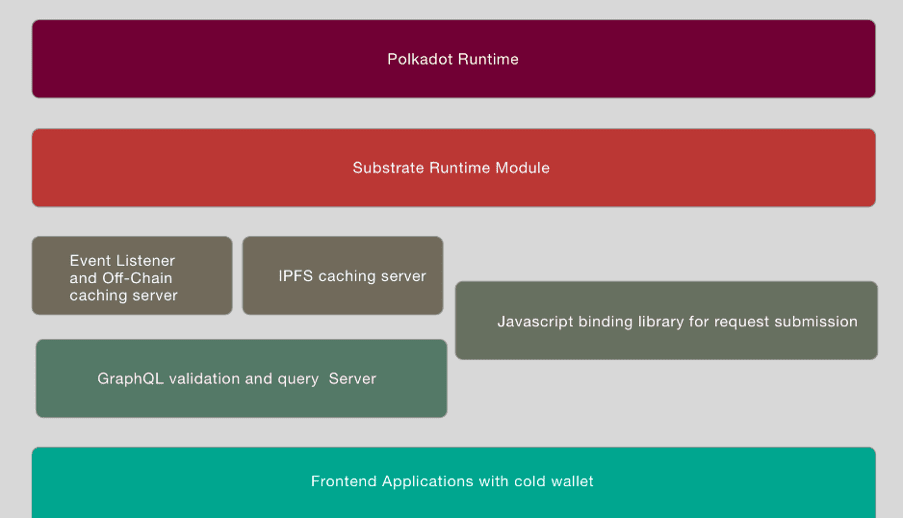
To bring all the above features to life, the protocol uses a layered architecture. On the top layer is the Litentry Runtime, which sits on Substrate. The Runtime layer is a Parachain of Polkadot and employs offline workers when generating identities.
The second layer is the User Side. Here, users flex their muscles when it comes to data under their control. Note that user data that comes from applications are anonymous, stored in a decentralized way, and cryptographically-separated.
On the Litentry Authenticator layer, we have the mobile data hub. The hub can be used to manage a user’s different identities. Additionally, the hub can be connected to various IoT devices that the user wants.
Next is the Litentry SDK enabling developers to fire up their creative juices to create completely decentralized applications and/or services. In addition, the Litentry IPFS data center offers users a chance to check the data attached to their identities.
The middleware layer comprises services such as off-chain catching and query servers. It is also made up of a client-side SDK library that helps connect front-end apps with decentralized networks.
Litentry Tokenomics
The incentive mechanism on the Litentry platform takes into account different participants such as an identity staker, validator, external storage, node, and data buyer.
Identity staker — This is the person who has an identity record and has a stake in the identities pool.
Identity validator — An identity staker becomes a validator of new blocks when their identity has been confirmed.
Storage — Stores all data about an identity in a decentralized manner.
Node — The node is a critical component of the Litentry platform. Its work is to perform functions such as invoking off-chain workers to validate identity correctness and connecting with external decentralized storages.
Data buyer — This is any entity on the blockchain that requests identity validation.
Data generator — These are entities generating data and can include applications, users, or services offering migration services.
Litentry’s base asset is called LIT. The network uses the asset to reward identity stakers in the identities pool. Two types of rewards the stakers get are the block reward and the matching fee.
Apart from stakers, validators are motivated to truthfully verify the correctness of data. On the other hand, data generators enjoy benefits from the Litentry Foundation in the form of grants.
External storage operators earn a section of the fee paid by users interfacing with the service. Others who are incentivized using LIT tokens are nodes.
Those who pay using LIT tokens include identity buyers. Observe that these entities only have access to the winning identity or identities during an identity matching process.
Conclusion
The identity problem is two-pronged; users can create multiple entities to defraud a company. On the other hand, malicious actors aggregate user data and sell it to the highest bidder without profiting the real data owners.
Fortunately, Litentry uses a layered approach to comprehensively tackle the problem to the benefit of both identity owners and decentralized platforms. Here’s to another promising project with a unique approach to solving some of the most crucial problems that often go overlooked.
Decentralised Finance (DeFi) series: tutorials, guides and more
With content for both beginners and more advanced users, check out our YouTube DeFi series containing tutorials on the ESSENTIAL TOOLS you need for trading in the DeFi space e.g. MetaMask and Uniswap. As well as a deep dive into popular DeFi topics such as decentralized exchanges, borrowing-lending platforms and NFT marketplaces
More videos and articles are coming soon as part of our DeFi series, so be sure to SUBSCRIBE to our Youtube channel so you can be notified as soon as they come out!
Disclaimer: Cryptocurrency trading involves significant risks and may result in the loss of your capital. You should carefully consider whether trading cryptocurrencies is right for you in light of your financial condition and ability to bear financial risks. Cryptocurrency prices are highly volatile and can fluctuate widely in a short period of time. As such, trading cryptocurrencies may not be suitable for everyone. Additionally, storing cryptocurrencies on a centralized exchange carries inherent risks, including the potential for loss due to hacking, exchange collapse, or other security breaches. We strongly advise that you seek independent professional advice before engaging in any cryptocurrency trading activities and carefully consider the security measures in place when choosing or storing your cryptocurrencies on a cryptocurrency exchange.
China’s national digital currency DCEP (Digital Currency Electronic Payment, DC/EP) will be built with Blockchain and Cryptographic technology. This revolutionary cryptocurrency could become the world’s first Central Bank Digital Currency (CBDC) as it is issued by the state bank People’s Bank of China (PBoC). The goal and objectives of the currency are to increase the circulation of the RMB and its international reach – with eventual hopes that the RMB will a global currency like the US Dollar. China has recently established an initiative to push forward Blockchain adoption, with the goal of beating competitors like Facebook Libra – a currency that Facebook CEO Mark Zuckerberg claims will become the next big FinTech innovation. China has made explicit that Facebook Libra poses a threat to the sovereignty of China, insisting that digital currencies should only be issued by governments and central banks. DCEP is not listed on cryptocurrency exchanges and will not be for speculation of value.
The significance of DCEP is that it’s designed as a replacement for the Reserve Money (M0) system, cutting back the cost and friction of bank transfers. It is suggested that DCEP will alleviate the risks of offline paper money transactions such as anonymous counterfeiting, money laundering and illegal financing. This is because regulators can better monitor digital currency transactions, which some consider will greatly improve financial and monetary supervision. DCEP can also reduce the costs involved in maintaining and recycling banknotes and coins.
Basically, DCEP is poised to become a digital version of the RMB.
Furthermore, the issuance of DCEP is conducive to promoting the internationalization of the RMB and reshaping the current cross-border payment system. This is because prior to the RMB Cross-Border Inter-Bank Payments System (CIPS) going live in early October 2015, RMB cross-border clearing and settlement was mainly done through CHIPS (Clearing House Interbank Payments System) or SWIFT (Society for Worldwide Interbank Financial Telecommunication). However, some consider that both the CHIPS and SWIFT systems have fatal flaws. Firstly, CHIPS is a US company. Whilst SWIFT, in particular, is seen as a cause for concern to the Chinese because due to its foothold in the international banking system, it is almost essential to use SWIFT for inter-bank transfers across countries. Thus whoever controls SWIFT’s data center will have access to information on almost every cross-border remittance, which some in China posit is the US. This is because whilst SWIFT claims to be a neutral international organization, 12 of the 25 directors are either from the US and her allies. Also, its transactional data were found to have been supplied to the US. Hence it is thought that China is being held back by the US via the SWIFT system, and so, in internationalizing the RMB- China requires its own worldwide banking system- i.e. DCEP.
Hence the Chinese consider that it is a requirement to form a new currency clearing network.
According to Chinese media, DCEP is seen as the “3rd Wave” aimed at the US.
A mandate to adopt Blockchain
China has established a countrywide initiative to push forward Blockchain Adoption. President Xi Jinping has mandated that the ‘country’s development of blockchain technology should be sped up ‘ on Oct 24th in front of the Political Bureau. This speech has also been echoed by Li Wei, head of the People’s Bank of China. In April of 2020, China launched the Blockchain Service Network to unify all the Blockchain related projects in the Nation.
China has adopted the “Blockchain, not Cryptocurrency”, whereby the benefits of Blockchain is highlighted. On the other hand, cryptocurrencies that are native to Blockchain are suppressed as Cryptocurrency Exchanges and ICOs are banned in the country.
History and development of DCEP
Development of DCEP started in 2014 with the establishment of a research institute dedicated to digital currencies and looking at how to improve the Chinese Yuan system with blockchain technology. However during 2014 to 2018, the development process slowed down, probably because the decentralised nature of Bitcoin or blockchain is incompatible with the nature of the Renminbi as a legal national currency. Things rapidly picked up towards the end of 2019 however and this was directly attributable to Facebook preparing to launch Libra, particularly as partner members of the Libra Association and the currencies which Libra was to be backed by had consciously rejected China. Hence, feeling the heat of the competition, China’s central bank felt immense pressure to urgently speed up in the global competition towards a digital currency.
Former Vice-chair of the PBoC’s National Council for Social Security Fund announced on 22nd June 2020 that China had already completed the backend infrastructure of DCEP.
Uses for DCEP
DCEP will be the only legal digital currency in China
DCEP is a currency created and sanctioned by the Chinese Government. It is not a 3rd party stable coin such as Tether’s cryptocurrency token “CNHT” which is also pegged to the RMB in a 1:1 ratio. DCEP is the only legal digital currency in China (cryptocurrencies such as Bitcoin are not legal tender in China).
Huang Qifan (Chairman of the China International Economic Exchange Center) said they have been working on DCEP for five to six years now and is fully confident it can be introduced as the country’s financial system. It’s currently being rolled out, with the People’s Bank of China issuing the currency. According to a speech by Huang at the China Finance 40 Forum, “DCEP can achieve real-time collection of data related to money creation, bookkeeping, etc, providing useful reference for the provision of money and the implementation of monetary policies.”
DCEP is not for speculation
China has made it explicitly clear that its National Digital Currency is not for speculation. Mu Changchun, Head of the People’s Bank of China digital currency institute made it as “a digital form of the yuan” and that “The currency is not for speculation. It is different to Bitcoin or stable tokens”. This is to the disappointment of the online community in China, where some netizens commented “So there will be no fun in it” on Sina.com.
It is also not possible to mine DCEP or stake on the DCEP network.
Cross-border payments with m-CBDC Bridge
China has joined forces to explore cross-border payments for digital currencies alongside Hong Kong, Thailand, the United Arab Emirates (UAE), and the Bank of International Settlements (BIS).
According to a joint statement in February 2021, the People’s Bank of China and the UAE’s central bank are taking part in the Multiple Central Bank Digital Currency (m-CBDC) Bridge project initiated by the Hong Kong Monetary Authority and Bank of Thailand in 2019.
The m-CBDC Bridge project will explore the capabilities of distributed ledger technology, through the development of a proof-of-concept prototype. The project ultimately aims to facilitate cross-border, multi-currency, real-time transactions around the clock.
This move aligns with China’s long-term ambition to use DCEP to boost the use of RMB in international payments. While the project is currently an alliance between just Beijing, Hong Kong, Bangkok, and Abu Dhabi, it is strongly supported by the BIS, an organisation owned by 63 central banks.
The announcement also comes mere weeks after China’s joint venture with SWIFT, the dominant network facilitating international payments between banks. The new entity, Finance Gateway Information Service, was registered in Beijing on January 16 with €10 million (US$12 million) as incorporation capital, according to the National Enterprise Credit Information Publicity System, the Chinese government’s enterprise credit information agency.
Special features of DCEP
DCEP is a Centralized Currency
DCEP is a digital currency that is run on a centralized private network – the Central Bank of China has complete access and control of the currency. This is a huge contrast to Bitcoin, which has an open decentralized network where there is no centralized leader. In the case with DCEP, the Central bank of China has the ability to create or destroy DCEP.
NFC Contact based payment
According to Official Sina Blockchain, DCEP will have NFC based payment options that don’t require devices to be online during the transfer. This will be poised as a direct replacement of paper money, as DCEP will be usable in areas without internet coverage. In addition, DCEP doesn’t require the mobile device to be bound to a bank account – meaning the unbanked population will also have access to the digital currency.
With DCEP’s tap payment feature people can transfer money simply by tapping two phones together, without the use of the Internet. So DCEP is not exactly like blockchain either, rather it is their own variant.
China Construction Bank launches DCEP wallet
On 29th August 2020, China Construction Bank (CCB) had a soft launch of the DCEP wallet. Users of one of China’s big four state-owned commercial banks found a DCEP wallet feature was available inside their mobile app. Users were even able to navigate to the digital yuan wallet and activate it through registering their mobile phone numbers.
Finally, users can send/receive digital currency to others by inputting their unique wallet ID or the phone number associated with the bank account.
CCB DCEP wallet
However, CCB has disabled the DCEP wallet feature from public access, but not before it gained huge attention. Users searching for this wallet now will only get an error message saying that the function is not yet officially available to the public.
Tencent to be a major partner of DCEP
Tencent’s Meituan Dianping has been in talks with the research wing of the PBoC on real-world uses for DCEP. Meituan Dianping boasts billions of dollars in daily transactions on their mobile app platform offering services such as food delivery (similar to UberEats), B&B bookings (similar to AirBnb), ride hailing services, bike sharing, grocery shopping and more. Basically for those in China, all your daily necessities can be met on the Meituan ecosystem.
The PBoC’s research wing is also in talks with another Tencent-backed company, Bilibili Inc. which provides video streaming services. So whilst the specifics of the partnership are yet to be finalised, it is likely that such cooperation is going to be huge for the mass use of DCEP in China.
According to Caijing magazine, the pilot institutions for DCEP will be the 4 major state-owned banks i.e. China Construction Bank, the Agricultural Bank of China, Bank of China and the Industrial and Commercial Bank of China. This initial deployment will serve as an official production test for the currency system, where the network and security will be validated. In the second phase, DCEP will be distributed to large fintech companies such as Tencent and Alibaba to be used in WeChat Pay and AliPay respectively.
DCEP will operate on a two-tiered system
The issuance and distribution of DCEP will be based on a two-tiered system.
The first tier would be transactions between the PBoC and intermediaries. These intermediaries would be financial institutions (e.g. the 4 major state-owned banks i.e. China Construction Bank, the Agricultural Bank of China, Bank of China and the Industrial and Commercial Bank of China) and non-financial institutions such as Alibaba, Tencent and UnionPay. Here, the PBoC would issue DCEP to the intermediaries.
The second tier would be between the above-mentioned intermediaries and participants in the retail market such as companies (e.g. retail stores) and individuals. In this tier, the intermediaries that have received DCEP will distribute it to retail participants so that it would circulate through the market e.g. through people purchasing items at stores etc.
The main difference in the issuance and distribution of DCEP compared to traditional cash however is the fact that DCEP would be transferred through electronic wallets, rather than bank accounts.
The central government has mandated that all merchants who accepted digital payments (such as Apple Pay, AliPay and WeChat) pay must accept DCEP. This will give DCEP a large nationwide acceptance in China, with every merchant obligated to participate or face a potential loss of their business license. This will make DCEP the most accepted digital currency in the world.
DCEP red packets to be launched for Chinese New Year
China’s DCEP app has launched a red packet gifting feature in time for the Chinese New Year on 22nd January 2023. The app will allow users to send the red packets i.e. “hongbao” containing DCEP to others. This is based on the Chinese New Year tradition of gifting lucky money during the annual festival. In fact, WeChat Pay and Alipay already have this feature for gifting CNY. However, it is the first time that e-CNY will be gifted in such a way, with hopes that this will further pave the way for the mass adoption of DCEP.
DCEP can be used to pay expressway tolls
On 28th December 2022, Chongqing Expressway Group announced it has completed the installation of equipment to accept DCEP for expressway tolls. From 30th December 2022, DCEP can be accepted as payment for tolls on the Chongqing Expressway. Users will need to download the e-CNY app and then simply present the payment QR code at the toll booth.
PBoC’s financial statistics reports now include DCEP/e-CNY
On 10th January 2023, the PBoC released its annual Financial Statistics Report for 2022. What is worth noting is that for the first time, the PBoC included statistics on DCEP/e-CNY. The Report states that as of the end of December 2022, the amount of digital currency in circulation was 13.61 billion yuan. This equates to around 0.13% of the total balance of yuan (13.61 trillion yuan) in circulation at the end of 2022.
Are people in China using DCEP?
According to a report on 28th December 2022, there has been over US$14 billion worth of DCEP transactions since its launch in 2020. Meanwhile, 261 million users have already set up an e-CNY wallet. However, this is considered low adoption since around 903.6 million people use mobile payments in China, according to a 2021 UnionPay report.
DCEP scams
Mere hours after DCEP has been announced, various (potentially scam) Chinese exchanges have listed IOUs or knock-offs clones of DCEP. It’s important to know that DCEP is currently only distributed to banks working with the PBoC and will not be available for the public. If you want to find out what are reputable exchanges, check out our top cryptocurrency exchanges guide. It is strongly recommended NOT to trade DCEP until it is officially released as there is no guarantee exchanges have access to the digital currency.
Knock-off clones of DCEP are already trading in (potentially) scam exchanges.
How to buy DCEP?
Currently, DCEP is only available to other banks working with the People’s Bank of China. This will eventually open up to the general public in 2020. There are currently no cryptocurrency exchanges that trade DCEP.
Implications of DCEP?
Is DCEP a challenge to the US monetary system?
The overwhelming view appears to be yes, both from the Chinese and the US perspective. According to statistics from the World Bank, 1.7 billion adults around the world use cash because they don’t have bank accounts. However, two-thirds of this population own a mobile phone, which can be used to make monetary transactions. This is what’s been happening in China, where mobile payments such as Alipay or WeChat Pay have more than 1.7 billion customers across China. Currently, the two online payment companies handle more payments monthly than Paypal did in the whole of 2017 (i.e. USD $451 billion). It’s very common in China to see street vendors accepting Alipay or WeChat pay.
Alipay and WeChat being accepted at an ATV rental shop
With the mobile wallet payment infrastructure in place, their cooperation with the PBoC could be the answer to distributing DCEP overseas. This would fit China’s “Belt and Road Initiative”, the aim of which is to build a new trade route connecting Asia with Europe and Africa. The idea is that with DCEP being used by mobile wallets, populations along the Belt and Road can be connected, bypassing existing financial infrastructures completely and giving an opportunity for the unbanked to pay for online purchases and build their savings.
In the US, the government does not see a demand for digital currencies. In a letter from the Chairman of the Federal Reserve, Jerome Powell, he took the view that many of the challenges a digital currency intends to solve do not apply to the US. In his view, the US payments landscape is already highly competitive and innovative, with plenty of digital payments options for consumers. Powell also commented, echoing the sentiments of those US lawmakers opposing Libra, that a digital payment where you would know and be able to track each and every payment would be unattractive for the US.
Whilst the House Committee on Financial Services also sees Libra as potentially raising national security concerns, observers consider the challenge from China is not being taken seriously. Because on the other hand, China is worried that Libra will reinforce the dominance of the US Dollar and is therefore working on fast-tracking the launch of DCEP. And it is likely that China will outrun the threat from Libra.
From a wider perspective, some take the view that DCEP can be used as a weapon against the US in an economic war. This is because as DCEP becomes accepted across the Belt and Road, China will have the power of total surveillance and control over the economic activity of potentially half the world’s population. DCEP will allow China to track everyone’s spending and transactions, and can seize or lock customers’ digital assets in their mobile wallets. We’ve already seen this in China, where together with its “social credit system”, millions of individuals have already been barred from purchasing airline tickets using their mobile wallets.
Appearance on Chinese television debate show “Tiger Talk”
On 29th August 2020, I appeared on China’s Phoenix Television show “Tiger Talk” (一虎一席談). Tiger Talk is one of Phoenix TV’s longest-running shows, each week they feature a debate on a major societal issue or event, and would invite experts, academics and guests to participate in the discussion. I was invited by Phoenix Television as an overseas analyst to discuss the topic of the week, namely, “DC/EP: China’s release of digital currency, will it shake the US Dollar’s hegemony?”. You can watch the episode here.
Guest appearance on Tiger Talk
Implications of DCEP on Bitcoin and cryptocurrencies
In the first instance, it should always be borne in mind that DCEP and Bitcoin/cryptocurrencies are vastly different. Key differences are that DCEP does not necessarily use blockchain technology and that it is a centralised currency under the control of a centralised authority. Learn more about the differences between DCEP, Libra, Bitcoin and Cash.
However, the large scale promotion of DCEP on national television in August 2020 is certainly bracing and preparing Chinese citizens for a digital version of the RMB. The gradual rollout of DCEP will also get the average citizen accustomed to the actual usage of digital currencies.
As a result, many people are excitedly speculating on the possibility of a bridge between DCEP and various existing blockchain projects- with some projects proclaiming they will be the first project to launch on DCEP. However it must be borne in mind that we do not know the full technical details of DCEP, so we do not know how this bridge between blockchain and DCEP will work, if at all. Also, the fact is that China is currently very hostile towards cryptocurrencies, this is mostly due to a number of cryptocurrency scams- such as Plus Token. As a result, the Chinese government have closed several bank accounts found to be involved in cryptocurrency transfers and banned all ICOs, several major cryptocurrency exchanges such as Binance and OKEx and some Over the Counter desks. Hence a lot of cryptocurrency circles and discussions occur underground, such as in private WeChat groups.
In a confusing twist, however, the CCP’s official media outlets 参考消息, Xinhua and CCTV have been pushing out headlines that crypto assets are the best-performing asset year to date. Dovey Wan, Founding Partner of Primitive Ventures has observed that the real intent behind this media push is difficult to interpret, but so far the Chinese cryptocurrency community see this as a signal that crypto has reached its top. Meanwhile, on the Western front on Twitter, people have been seeing this as a bull signal. Currently, without any further moves or news in China about DCEP or on the cryptocurrency front, we can only wait and see what China’s next move will be.
Hmm this is an interesting propaganda vibe from CCP’s official media outlets as “参考消息”, Xinhua and CCTV2
the headline “cryptoasset is the best performing asset YTD” was featured on all avenues, news paper, online media and TV
Will DeFi push governments to finally adopt CBDCs?
Decentralised Finance (DeFi) can be considered the cryptocurrency and blockchain star of 2020, having revived the cryptocurrency market and bringing some much-needed revival and positivity. But what is DeFi? In short, DeFi attempts to bring traditional banking to developing industries, but with a twist: it would be open-source, decentralised, cheap and will cut out the middlemen. (Xanax)
So what can central banks and government do to maintain their dominant status quo whilst benefitting from the technology that DeFi can bring? An answer could be to create a CBDC. In a Forbes article, the author suggests that CBDC would be a positive move for governments since it tokenises money whilst allowing users to enjoy the advantages of cheaper, faster transactions.
The article also touches upon our coverage of DCEP and discusses China’s progress in testing DCEP contrasted with the progress of introducing a CBDC in the US. It suggests that governments and institutions, however, will need to be quick to catch up as new DeFi solutions in payments, mortgage, insurance etc. are being created weekly, and this legion of fintech innovators are growing. These innovators challenge the status quo, and with the mounting advantages of DeFi, there may soon be a real contender vying for the attention of citizen-consumers.
FAQs
Is DCEP backed by Gold?
The simple answer is u0022Nou0022. On a recent episode of Kitco News, journalist Max Kaiser claimed that China will launch a gold-backed cryptocurrency, with the intention of destroying the USD as a reserve currency. He added that China has already amassed as much as 20,000 tons of gold. However this is mere speculation – China has no plans to return to the Gold Standard nor issue gold-backed cryptocurrencies.
Will DCEP be interoperable with other Cryptocurrencies
There are many plans to build gateways that allow the swapping of DCEP to other cryptocurrencies. Projects such as Algorand have stated they want to support DCEP and build possible bridges to swap these currencies. However, as the technical details of DCEP have not been fully revealed, such bridges have not been built yet.
Who can issue e-CNY?
There are 7 Chinese commercial banks that can provide e-CNY. They are: ICBC, Agricultural Bank of China, Postal Savings Bank of China China Construction Bank, Bank of China, Bank of Communications, and China Merchant’s Bank. There are also 2 online banks that can provide e-CNY i.e. WeBank (WeChat Pay) and MyBank (Alipay).
Which Chinese Cities can sign up and use the e-CNY app?
Currently, there are 12 cities and areas in China which can sign up and use the e-CNY app. They are Shenzhen, Suzhou, Beijing Xiong’an, Chengdu, Shanghai, Hainan, Xi’an, Changsha, Dalian, Qingdao, and Zhangjiakou.
Can tourists or non- Chinese locals use DCEP?
No, DCEP is not fully rolled out yet and is only available in select cities in China.
Is China using DCEP?
According to a report on 28th December 2022, there have been over US$14 billion in transactions since the launch of DCEP in 2020 and October 2022. Meanwhile, 261 million users have already set up an e-CNY wallet. However, this is considered low adoption since, according to a 2021 UnionPay report, around 903.6 million people use mobile payments in China.
When will China officially launch DCEP e-CNY?
Whilst there is ongoing DCEP/e-CNY testing on in increasing scale, there is no official announcement as to when and how China will fully roll out DCEP/e-CNY.
Disclaimer: Cryptocurrency trading involves significant risks and may result in the loss of your capital. You should carefully consider whether trading cryptocurrencies is right for you in light of your financial condition and ability to bear financial risks. Cryptocurrency prices are highly volatile and can fluctuate widely in a short period of time. As such, trading cryptocurrencies may not be suitable for everyone. Additionally, storing cryptocurrencies on a centralized exchange carries inherent risks, including the potential for loss due to hacking, exchange collapse, or other security breaches. We strongly advise that you seek independent professional advice before engaging in any cryptocurrency trading activities and carefully consider the security measures in place when choosing or storing your cryptocurrencies on a cryptocurrency exchange.
First started as an internet meme from 2 software engineers Billy Markus and Jackson Palmer to mock crazy fans of cryptocurrency, Dogecoin has now officially become a part of the big family. It’s actually one of the top crypto currencies at the moment – not bad for something that started out as a joke.
Just like other cryptocurrencies, Dogecoin is powered by a decentralized finance system called blockchain technology. The attraction of cryptos is that it is not under any private corporations, multinational enterprises or the government’s control. Crypto currencies are free from any regulations set by any government and bank institutions.
Moreover, Dogecoin cannot be found in a single particular computer system. It is built on top of a huge network of computers or nodes that confirm the transactions. This system of peer-to-peer exchange and transfer of information makes the whole structure almost impossible to hack and bring down.
Cryptocurrency has limited supply, hence the hype. This limit of supply is meant to make sure that their prices will not get too low, which is what happens for fiat currency like the USD if the government keeps on printing the money without proper control or monitoring.
Before we get to Dogecoin mining, you have to know that mining cryptocurrencies is not the same as mining coal or petroleum underground like they do in the Middle East. The mining being discussed here is digital mining through complex mathematical algorithms. In a simpler context, it is like the process of creating a new coin by solving a puzzle, but just in a more technical way involving very complex algorithms .
Since the ledger — blockchain technology — of the transactions need to be maintained, not a lot of people will spend time mining. Instead, they will just buy the coins outright from the crypto markets. .
In the early days of crypto, it was possible to use your own laptop pc to solve any of the blocks in the chain and earn yourself a coin for your efforts. Each confirmation of a transaction will place a new block for the Doge network, for which there will be a reward for the miners in the form of more Dogecoins.
Every cryptocurrency has different mining systems. Here is a comparison of Dogecoins and Bitcoin, the leading cryptocurrency in the world.
Dogecoin
Bitcoin
Algorithm
Scrypt coin
SHA-256
Block Time
1 minute!
10 minutes
Difficulty
2,798,252
3,511,060,552,899
Reward
10,000 DOGE
12.5 BTC
Notes:
Algorithm: Rules for mining new currency aka hashing algorithm
Block time: Average time for a new block checked and added to the chain. It varies across time.
Difficulty: Difficulty level to mine a new block of currency. It varies across time.
Reward: Amount of new currency rewarded for each new block mined. It varies across time.
How to mine Dogecoin?
There are 3 ways to mine Dogecoin: solo mining, pool mining and cloud mining. We’ll explain one by one to see what the difference is between them.
Solo mining
You are mining on your own. It means you need to spend more money on the most modern and updated equipment and pricey utility fees by yourself. However you get to keep all the rewards to yourself .
In some cases, people have spent a whopping $500,000 for just building the mining gear alone. This is not including the electricity bills that are usually enormous for an operation of that size. If you’re not careful, the electricity bills could eat into your profits without you realizing.
Pool mining
It’s like a group project. You have less work to do but you need to share the pride and achievement. At Dogecoin mining, you will have an easier time earning coins, but the rewards have to be shared.
Before joining a pool, check out their calculation for the payouts of each member and consider the extra pool fees needed. There are few options online for pool mining. So do research about all of the options before you join the pool.
Cloud mining
Pay for a group to mine for you. This is for those that prefer not to invest too much effort and time for mining Dogecoin. You can rent machines from a data center and ask them to mine for your behalf. This way might be the most costliest among the 3 options, since it is time-locked and the price might drop during the agreement. Furthermore, electricity bills and other costs need to be covered too.
Things needed to mine Dogecoin
Other than the electricity itself, there are 3 things needed to mine Dogecoin which are hardware, software and a crypto wallet.
Hardware
Any Windows, Mac OS or Linux system is needed to start mining. Basic machines like CPU can be used but it will take a long time to succeed. Also, your computer will end up overheated or getting damaged.
GPU mining is recommended, especially those with graphic cards. Alternatively, you also can use Scrypt ASIC miner which is dedicated mainly for crypto like Dogecoin.
Software
The software will differ depending on the hardware you use. Here are the softwares recommended for different hardwares:
CPU: CPUminer
GPU: EasyMiner, CGminer, CudaMiner
Scrypt ASIC: MultiMiner
Be careful to select the legit mining software, or else the fake ones will harm your PC and investment. So double check before downloading.
Crypto wallet
Digital wallet is not enough to secure your Dogecoin if you are serious about mining it. Since you have invested so much in this process, why not secure it further by having a cold crypto wallet?
You don’t have to worry about being hacked and keep your profits safe.
Conclusion
We don’t know whether Dogecoin will go up in price again or plummet to oblivion. Will Elon Musk put more trust in it or is it just for clout? That’s up to you to discover.
However when mining Dogecoin, one should always balance the costs to run the mine and the potential returns before deciding whether it is a good option.
Disclaimer: Cryptocurrency trading involves significant risks and may result in the loss of your capital. You should carefully consider whether trading cryptocurrencies is right for you in light of your financial condition and ability to bear financial risks. Cryptocurrency prices are highly volatile and can fluctuate widely in a short period of time. As such, trading cryptocurrencies may not be suitable for everyone. Additionally, storing cryptocurrencies on a centralized exchange carries inherent risks, including the potential for loss due to hacking, exchange collapse, or other security breaches. We strongly advise that you seek independent professional advice before engaging in any cryptocurrency trading activities and carefully consider the security measures in place when choosing or storing your cryptocurrencies on a cryptocurrency exchange.
Radix DLT is a layer 1 distributed system to power the needs of the decentralised finance (DeFi) ecosystem. As DeFi continued to gain traction, the top blockchain networks supporting the market were already overstretched. As it turns out, scalability appears to be a hard nut to crack and hence projects like Radix DLT are formed.
The motivation behind the Radix protocol’s creation is to save the $71 billion lost every year caused by unnecessary friction in the conventional financial system and allow those at the lower and higher levels of finance to make ground by powering a strong DeFi ecosystem.
Check out our video which explains the scaling problems currently faced by Ethereum, and how Radix attempts to solve it.
Taking DeFi to the NEXT LEVEL ? – Radix DLT Protocol overview
Background
The Radix team believes that using distributed ledger technology (DLT) to build a permissionless network will ease the development and accessibility of innovative financial applications. With these applications, we could finally bring down the guarded walls of traditional financial markets.
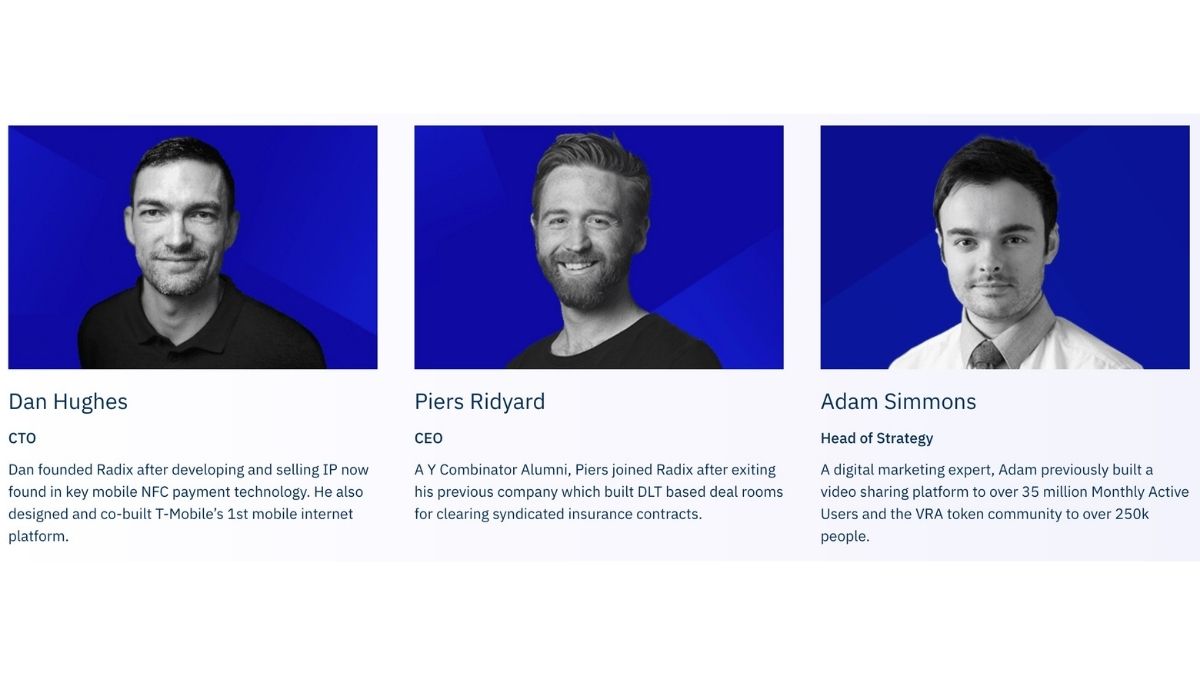
The project was founded by Dan Hughes, who also happens to be its CTO. Hughes’s former work includes the design of T-Mobile’s first mobile internet platform.
Other team members include the organization’s CEO, Piers Ridyard, as well as CPO, Albert Castellana. The project is being supported by the Radix Foundation.
What is Radix DLT?
The team behind Radix DLT defines the project as the “first layer 1 protocol specifically built to serve DeFi.” The protocol seeks to remove the inefficiencies found in open finance (OpFi) both in the current and future settings. Hughes and his team want to achieve this through:
Re-engineering the consensus mechanism used in popular blockchain systems.
Employing decentralized virtual machines.
Activating on-ledger code.
Building DeFi-bound components and applications.
Incentivizing developers who drive the growth of the new-found financial breakthrough.
Having its developers at the core of driving growth for innovative financial products, Radix provides its support by building highly-secure smart contracts, fast and interoperable OpFi decentralized applications (dApps), engaging and rewarding a distributed developer community, and guarding DeFi composability when scaling dApps on public blockchains.
Radix network
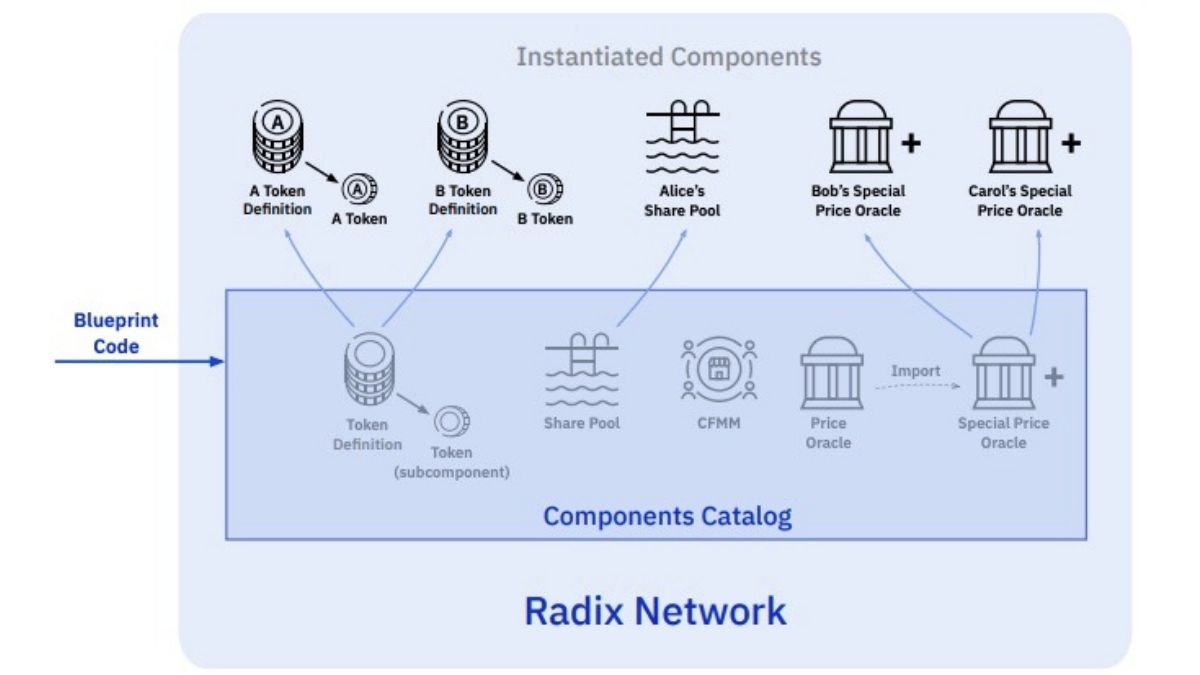
The network is made up of Cerberus (a consensus mechanism), Radix Engine (a development environment), Radix Component Catalog, and developer royalties.
Cerberus
At the heart of the protocol is Cerberus, a re-engineered consensus mechanism which uses a sharded Byzantine fault-tolerant (BFT) solution. This approach enables the system to be parallelized across multiple nodes without losing message complexity and responsiveness.
The sharding concepts allows unlimited network splits or shards. Each shard can represent anything on the platform. By allowing unlimited shards, Cerberus shifts focus from global ordering to partial ordering.
With global ordering, transactions are stored in a predefined chronological order. Partial ordering, at a very basic level, is the opposite of agreed chronological ordering. However, partial ordering has to differentiate between related and unrelated events or transactions when recording them on the blockchain.
Using a “braiding” mechanism, Cerberus uses a new BFT-style system to sign interactions between nodes handling different shards before committing transactions.
Radix Engine
This is Radix’s specialized application layer that powers the interaction between a smart contract’s code with the actual blockchain. The layer powers the project’s virtual machine (VM), which in turn, powers the partial ordering system.
Furthermore, the Radix VM handles concurrency to drive DeFi applications further.
Radix Component Catalog
In other blockchain systems, a developer’s work becomes an active smart contract after being pushed to the system’s users. For Radix, the component catalog handles apps before being registered as “active” on the platform.
In other words, the catalog contains templates ready for use to create additional active components. The new template-based products are called instantiated components.
Developer Royalties
The Radix system uses developer royalties to encourage developers to contribute. However, the project takes a different approach by employing distributed self-incentives such as those found in proof-of-work systems called mining rewards.
Radix Token ($XRD)
The platform has a native token, XRD, which is used to pay for transaction fees. Note that these fees are paid to node runners.
A transaction fee is charged for token creation, messaging, and anything else that requires a change of the ledger state. The fee is burnt upon validation of the operation.
Furthermore, the platform’s tokens have a controlled unlocking mechanism that spans 365 days. With each unlocking, the Radix Foundation’s amount of XRD reduces while those in the public domain increases.
E-Radix (eXRD) Token Sale and tokenomics
Radix Token Sale began on 8th October 2020 and a total of 642mil E-RADIX tokens were available to purchase at $0.039 per token.
There will be an Initial Supply of 4.41 billion E-RADIX as both locked and unlocked tokens. The following chart shows the proposed distribution of the Initial Supply tokens.
Radix proposed distribution
The unlocking mechanism for E-RADIX tokens will start on 17th November 2020. Of the Initial Supply of 4.41 billion E-RADIX tokens, 4.2 Billion tokens will be distributed and of which 99% will be locked and 1% unlocked.
These locked tokens are subject to a price-based unlocking schedule which will allow holders to withdraw the tokens at certain price milestones as follows:
This E-RADIX token is an ERC-20 token. When the RADIX ledger is instantiated, this E-RADIX token will be exchangeable 1:1 for RADIX (XRD) tokens. As mentioned in their key milestones article, the Team are on track for the Radix main net to go live in Q2 2021.
On the mainnet, Radix will create a further 5.19 billion RADIX tokens which will also follow the same unlocking schedule as the E-RADIX tokens mentioned above.
How to withdraw your unlocked E-RADIX (eXRD) and RADIX (XRD) tokens
As mentioned in the previous section, E-RADIX and RADIX tokens are subject to a price-based unlocking schedule. However, to claim these tokens you will need to withdraw them from the unlocking smart contract.
This involves visiting their Radix tokens unlocking website and connecting the wallet that you used to purchase the E-RADIX tokens. If that wallet address has an allocation of EXRD in the unlocking smart contract, you will see details of your total allocation together with the amount which is unlocked and can be withdrawn. Then all that is required is to click the “withdraw” button and follow the steps to withdraw the eXRD.
Make sure to check back when an unlocking event occurs because it will mean you can withdraw more tokens!
For a detailed walkthrough on how to claim your unlocked tokens, click here.
Staking Radix Token
With OpFi, staking, yield farming, and liquidity mining are common occurrences. Radix powers this DeFi subset by allowing users to lock their XRD to earn network emissions and be involved in decision making.
Network emissions are periodically generated tokens that are spread across active staking nodes while considering the amount of staked tokens. Emissions make up for 2.5% of the yearly inflation rate.
There are two approaches to locking tokens:
A user can lock XRD and become a node runner on the network; or
a user can lock Radix tokens and delegate his stake to another node runner, also called a staking node. A staking node has the power to validate transactions.
Radix’s consensus mechanism limits the stake weight per node to 33% to prevent node runners from having absolute power over the transaction validation process.
Network Subsidy
The network subsidy is an additional amount of tokens distributed to transaction validators. The tokens are unlocked by the Radix Foundation every 24 hours and are expected to run for 10 years. However, to earn the subsidy tokens, a staking node has to consistently meet specific factors on responsiveness, bandwidth, and computing power.
Other Radix token categories are the public token grant to support community contributors, the Radix team token grant to support the team, and the stable token reserve that supports stable coins on the network.
Conclusion
The projected growth of the DeFi market requires creating new distributed systems that, if possible, have unlimited scalability. Radix is one such project. With a key focus in leading the migration from centralized finance (CeFi), the project provides hope to the future of OpFi.
From a re-designed consensus mechanism to decentralized self-incentives for developers, the project is keen on ensuring that DeFi overshadows CeFi.
The Radix token supply approach is another key component of the network that shifts from the traditional approach of major blockchain-based systems that power OpFi protocols.
Decentralised Finance (DeFi) series: tutorials, guides and more
With content for both beginners and more advanced users, check out our YouTube DeFi series containing tutorials on the ESSENTIAL TOOLS you need for trading in the DeFi space e.g. MetaMask and Uniswap. As well as a deep dive into popular DeFi topics such as decentralized exchanges, borrowing-lending platforms and NFT marketplaces
More videos and articles are coming soon as part of our DeFi series, so be sure to SUBSCRIBE to our Youtube channel so you can be notified as soon as they come out!
Disclaimer: Cryptocurrency trading involves significant risks and may result in the loss of your capital. You should carefully consider whether trading cryptocurrencies is right for you in light of your financial condition and ability to bear financial risks. Cryptocurrency prices are highly volatile and can fluctuate widely in a short period of time. As such, trading cryptocurrencies may not be suitable for everyone. Additionally, storing cryptocurrencies on a centralized exchange carries inherent risks, including the potential for loss due to hacking, exchange collapse, or other security breaches. We strongly advise that you seek independent professional advice before engaging in any cryptocurrency trading activities and carefully consider the security measures in place when choosing or storing your cryptocurrencies on a cryptocurrency exchange.
We’ve been closely following the events involving SushiSwap and its founder “Chef Nomi”. This article will not be making any comments or conclusions on Chef Nomi’s actions or how SushiSwap is or should be run. This article is simply an explainer on what SushiSwap is and how to use the platform. As with all yield farming projects, SushiSwap involves a huge amount of risk. Anyone intending to participate in yield farming should do full research and consider carefully the risks involved beforehand.
What is SushiSwap ($SUSHI)?
SushiSwap is the newest decentralised finance (DeFi) liquidity pool platform. With SushiSwap, people can add their tokens into the liquidity pools and earn. In this article, we’ll have a look at the Sushi Swap platform and how to participate in the liquidity pool. Anyone can participate.
Sounds interesting? Let’s dive into it.
Summary
SushiSwap is a platform that allows anyone to provide liquidity. In return, the person gets rewarded with token(s) and SUSHI tokens.
As of September 4, 2020, there are 1 billion dollars of locked liquidity.
Possibility of very high APY (up to 1,000%) on some liquidity pools. You can check the current yields on SushiBoard.
Why is SushiSwap so popular?
Sushi Swap markets itself as an “improved and community-friendly” Uniswap. Unlike a traditional exchange like Binance where they employ market makers, SushiSwap is a community-oriented platform where users provide liquidity. In return, they get rewarded. Indeed, the users are the market makers.
SUSHI token
SUSHI tokens are given as rewards for liquidity mining. The token allows its holders to participate in the governance of the platform and entitles them to a portion of the fees paid to the protocol by traders. For the governance of the platform, SUSHI holders can submit a SushiSwap Improvement Proposal (SIP) which token holders can vote on with their tokens.
Of course, some people also speculate on the prices of SUSHI and the token can be traded on major exchanges such as Binance, FTX and OKEx exchanges.
Advantages of SushiSwap
There is no KYC (Know Your Customer) policy. This means anyone can trade and contribute to the liquidity pools. The platform is permissionless, meaning anyone can contribute millions of dollars without asking for permission.
Earn tokens from Sushi Swap. SUSHI is Sushi Swap’s native token. When you contribute to the liquidity pool, you earn sushi tokens. You can exchange SUSHI for ETH.
Sushi Swap model: 0.25% go directly to the active liquidity providers and 0.05% get converted back to SUSHI and is rewarded to sushi holders.
Sounds interesting? Let’s visit Sushi Swap’s home page.
SushiSwap beginners guide
When you first arrive on Sushi Swap’s home page, you’ll see this:
Click on “Unlock Wallet” or “See The Menu”, either way you will need to connect your ETH wallet in order to this platform.
Sushi Swap has the option to use MetaMask, WalletConnect or many other non-custodial wallets. Pick the one of your choice.
Connect wallet
Give permission for Meta Mask or Wallet Connect to connect to Sushi Swap. Once you’re connected, you’re ready to add your tokens into the liquidity pools. (hummingbirddental.ca)
You’re presented with various liquidity pools (LPs). Each liquidity pool has a different annual percentage yield (APY).
In this example, I’ll contribute to the ETH-USDT pool. I add my USDT into the liquidity pool. In return, I’ll get a percentage of USDT and SUSHI tokens. Think of Sushi Swap as a “community revenue share” model.
To contribute to the liquidity pool, click “Approve USDT-ETH UNI-V2 LP” and give your Meta Mask permission to move your tokens into the liquidity pool.
Now what? You wait. The “SUSHI earned” box should populate with your earned SUSHI. You can withdraw your SUSHI token anytime by clicking on “Harvest”.
2020 roundup and new roadmap!
Many things have happened within the Sushiswap ecosystem in the last months: it is now time for a quick recap and to look at what the future will bring to this project!
The number of all the partnerships finalized by the protocol is countless, but one of the most important ones, if not the most important, is certainly the merger with Yearn. The news also sparked controversies: Sushiswap was still considered a sort of “copycat” of Uniswap by some, and when Andre Cronje (Yearn’s father) wrote an article on how it is difficult to build in Defi and how conversely it is easy for anyone to just copy other people’s code, this wasn’t seen as really coherent. The collaboration was born to allow the two teams to cooperate on Deriswap.
Nevertheless, Sushiswap has been evolving so much that, according to Mira Christanto (one of Messari’s data analysts) they have “put their past behind” and, not being backed by Venture Capitals, they can move faster than competitors. January has seen a real growth in Sushiswap’s TVL (now at $2.1 billion), mostly at the expense of Uniswap’s.
Among the important milestones in 2020, we find Onsen, the new Sushiswap liquidity mining incentivization program which replaces the old Menu of the week. It brings communities together into the ecosystem and allows voted tokens to become accredited and participate in the mining program. The website also has a new layout of and a lite version.
2021 Roadmap
As the new year has already begun, it is also interesting to have a look at what Sushiswap is working on for 2021. The team released a long and detailed roadmap in early January. Notable upgrades are the following:
Mirin will be the new upgraded version of Sushiswap’s V3 protocol. It will include many new features like franchised pools, double yield, dynamic yield rebalancing, and many more as you can read here.
Bentobox (which should have launched in January) was born in the team’s mind as a new Lending Platform. While they were was working on its code though, it became something more. In simple terms, it will be a single vault that holds all tokens for any protocols and future extensions. It will support several oracles and it will also benefit all the $SUSHI holders.
Miso (Minimal Initial Sushi Offering) will be a sort of token launchpad, designed to drive new projects’ launches on the platform. It will include crowd sale options, IDOs (Initial Dex Offering), auctions, and more. We could think of it as something similar to Binance’s launchpad.
As Ethereum fees are and will keep growing in the next future until ETH2 will be a reality, most platforms are studying alternative solutions for their users such as Layer 2 possibilities. Unlike Uniswap, which is working on Optimistic Rollups, Sushiswap decided to move in sync with the greater Yearn ecosystem and thus will probably offer Zk-rollups options.
Together with all these big news, Sushiswap is also planning to move to a new domain as the old one, in their view, is not enough to describe the diversity of the platform anymore. A transition to a fully decentralized governance structure is also planned by the end of 2021. Last but not least, Sushiswap has created a proposal page for people to express their ideas on what they would like to see on the platform. Everyone can be a chef is the place where you can voice your opinion if you like to suggest new ideas.
FAQs
Is it risky to provide liquidity to SushiSwap?
The pool could get hacked if the code isn’t audited. There have been cases of hackers draining funds from smart contracts. It helps if the code is audited by a reputable firm. In the case of SushiSwap, it has been given a “security review” (not an audit) by Quantstamp. 10 issues were identified but they do not appear to be fatal. Subsequently, Peckshield had completed an audit on SushiSwap. They found no critical or high severity issues relating to business logistics but 2 high severity opsec issues that need to be fixed through extra care with deployment.
What is the reward model of Sushi Swap?
0.25% go directly to the active liquidity providers and 0.05% gets converted back to sushi and is distributed to active SUSHI holders.
Decentralised Finance (DeFi) series: tutorials, guides and more
With content for both beginners and more advanced users, check out our YouTube DeFi series containing tutorials on the ESSENTIAL TOOLS you need for trading in the DeFi space e.g. MetaMask and Uniswap. As well as a deep dive into popular DeFi topics such as decentralized exchanges, borrowing-lending platforms and NFT marketplaces
More videos and articles are coming soon as part of our DeFi series, so be sure to SUBSCRIBE to our Youtube channel so you can be notified as soon as they come out!
Disclaimer: Cryptocurrency trading involves significant risks and may result in the loss of your capital. You should carefully consider whether trading cryptocurrencies is right for you in light of your financial condition and ability to bear financial risks. Cryptocurrency prices are highly volatile and can fluctuate widely in a short period of time. As such, trading cryptocurrencies may not be suitable for everyone. Additionally, storing cryptocurrencies on a centralized exchange carries inherent risks, including the potential for loss due to hacking, exchange collapse, or other security breaches. We strongly advise that you seek independent professional advice before engaging in any cryptocurrency trading activities and carefully consider the security measures in place when choosing or storing your cryptocurrencies on a cryptocurrency exchange.
The Graph ($GRT) is a decentralized and open-sourced indexing protocol for blockchain data. Developers can build and publish different APIs, which are referred to as subgraphs, and perform queries through the GraphQL.
The platform can easily be used to look for any Ethereum data conveniently through simple queries. This addresses the common problem faced by a lot of other blockchain indexing platforms.
Blockchain applications face difficulties in keeping properties like finality, chain reorganization, and security in their process of fulfilling query tasks. These are also potential complications that applications usually address, but unfortunately make the process of querying time-consuming. The Graph has a workaround for this, and it is built exactly for that purpose.
Through “subgraphs,” The Graph indexes blockchain data, which users can access via the GraphQL API. According to the team, they will make it fully decentralized in the future, where more nodes will be involved and made responsible for maintaining the index.
The interest for the platform is steadily growing. In fact, they hit over a billion queries last June 2020. This was right at the time when decentralized finance was also gaining much institutional attention.
Background
Yaniv Tal, co-founder and CEO of The Graph, together with his team, has created an indexing protocol meant to ease the process of accessing blockchain data. Tal and his co-founders had personally witnessed themselves how difficult it was to actually create new applications on the Ethereum blockchain.
Thanks to their experience on applications, they have found out that there is actually no decentralized indexing and querying softwares yet for blockchain. The problem back then was that developers had to come up with their own method to gather data and transform them from different sources.
The mission of the platform, which Tal and his team developed, is to help create applications that require no servers and make Web3 accessible to everyone.
How Does The Graph Index Data?
To index Ethereum-based data, The Graph uses the “subgraph manifest.” This refers to the description of a subgraph containing data about smart contracts, blockchain events, and the procedure in mapping event data with one another, before they are all kept in the platform’s database.
The flow of the data from transactions, subgraph manifests, and the database follows a particular structure. All of it begins with decentralized applications that are adding data to the Ethereum blockchain through the help of smart contracts.
All of that data will contain a record of all events and transactions up until the point that they have achieved finality. Then comes the Graph Node, which scans the whole blockchain database, gathers new data, and filters out those that are relevant to the queries that users make. To make the indexing much easier, it identifies every information that answers the questions from subgraphs.
GraphQL is the link between blockchain data and the application that a user wants to provide it with. But then again, it is through the Graph Node that users can deliver searches to the platform. After the whole process, users can finally look at the results of their query from their applications.
Basically, this is how the cycle of data query and indexing works in the platform. Users can refer to the Graph Explorer to scan through the subgraphs that are already in the platform. Each of these subgraphs have a playground where users can perform queries through GraphQL.
As of latest, The Graph can support the indexing of data coming from Ethereum, IPFS, and PoA networks. There are more networks that the platform will support in the future. But right now, they already have more than 2,300 subgraphs deployed, which developers for applications utilize. Some of these applications are AAVE, Aragon, Balancer, DAOstack, Uniswap, Synthetix, and many others.
There is a lot of institutional support for The Graph network. Michael Anderson of Framework Ventures, said in a press release that they “couldn’t be happier to back Yaniv and the team, and we look forward to helping grow the decentralized network when it launches.”
Hayden Adams of Uniswap also shared how useful the platform was for their analytics needs: “As a company we don’t manage or run our own databases. … Right now it’s pretty difficult to get historic data from the Ethereum blockchain in an efficient way.”
Their plan, apart from expanding to other blockchains soon, is to make it community-owned and governed in the future. This is also in response to the shift of many blockchain applications to a decentralized model of governance.
Key Roles
The platform’s whole ecosystem is composed of the following:
Consumers – These are the users who pay indexers for their searches. It could also be web services or any other software linked with The Graph.
Indexers – These are the nodes that maintain the indexing function of the platform.
Curators – Using GRTs, curators identify to the subgraphs the information that is valuable for the platform’s index.
Delegators – These are other stakers who delegate their GRT to existing indexers and earn a portion of the rewards run by nodes.
Fishermen – They check whether the network’s response to queries is accurate.
Arbitrators – They decide whether an Indexer is malicious or not.
The Graph Council
The Graph plans to decentralize its governance in the future. This will most likely be similar with MakerDAO and Compound. At the point of the protocol’s maturity, the team plans to launch a Decentralized Autonomous Organizations (DAO) that would allow core interest groups to participate in important protocol decisions.
Similar to other DAOs, the Graph Council, which will be the governing body for the technical parameters of the protocol, is also in charge of how The Graph Foundation allocates its native, utility tokens.
Among their basic functions include decisions on allocating grants and ecosystem funding, protocol upgrades, protocol parameters, and other emergency decisions.
GRT Token ($GRT)
The Graph Token, or $GRT, is its native ERC-20 based token, which can serve as a medium of exchange and the reward distributed to community participants who function as Indexers, Curators, and Delegators.
GRT also has a vesting and distribution schedule ranging between 6 months to 10 years depending on the bucket. Around 12.5% of the total token supply (i.e. 1,224,999,438 GRT) is expected to be in circulation at launch. However this figure is exclusive of stakeable but locked tokens.
GRT token distribution at mainnet launch
The Graph launched its mainnet at 9:00a.m. (PT) on 17th December 2020. Upon launch, GRT has been distributed to all of the participants of the public sale. Members of The Graph’s Curator Program also received an initial USD $1,000 worth in rewards, with the remainder to be distributed to them on a quarterly basis based on their contributions to the Program.
The Graph Foundation also received around 20% of the supply for the future development of The Graph. In particular, contributors who want to help building on The Graph can apply to their Grants Program, around 1% of the total supply of GRT will be allocated to support these participants in 2021.
Here’s a graph showing the GRT circulation over the course of 5 years from the date of launch (i.e. 17th December 2020 at 9:00a.m. PT)
5-year GRT circulation schedule by Bucket (Image source: The Graph)
Indexers that assisted during the Testnet phase have also ben rewarded between USD$10,000 to USD$100,000 in GRT as a reward for their contributions.
In addition, around 2% of the total GRT has been granted to several Education Programs and loans totalling around 2.5% had been made to independent ecosystem partners.
Indexer Staking
In order for users to stake in the nodes that operate the whole platform and sell their services in the query market, they have to lock their GRT. In return, they are given financial rewards. If the indexers work maliciously, like altering data intentionally, the GRT that they staked will be slashed.
Mainnet now live!
The Graph Network launched its main net on 17th December 2020 after 3 years of development! According to the team the mainnet launch includes the following components: Deployment of The Graph Network contracts on Ethereum mainnet, deployment of the GRT contract, distribution of GRT to takeovers, launch of the Bug County Program and new docs for network roles.
With the mainnet launch, Indexers will first stress test and improve performance before supporting real query volume, which will be upwards of 5,000 queries per second. Of course, there will be rewards for Indexers who will now begin earning on-chain indexing rewards and query fees.
Graph Roadmap: What’s next?
Now that mainnet has launched, The Graph will continue building. The Team has stated that the Graph Foundation will work on building a production-ready Graph Explorer dApp and Gateway that will support all network contributors.
The Graph is also open to any individuals or third-parties that want to build for the network and as mentioned previously, they an apply to the Grants Program or collaborate with other community contributors.
Conclusion
Looking at the current boom of the DeFi space, we can see how important it is for developers to be able to freely access blockchain data. Making the process faster and less difficult for everyone could potentially influence the growth of the space as well as its reliability, security, and capacity.
Everyone saw the need to create a bridge of information between applications and blockchain data. The Graph sought out to answer that.
And with the deployment of smart contracts that depend on user data, The Graph has proven itself to be easy to use, cost-efficient, and fast. The platform is seen as a promising tool to empower everyone in the community, especially those who are developing more use cases for the blockchain.
Decentralised Finance (DeFi) series: tutorials, guides and more
With content for both beginners and more advanced users, check out our YouTube DeFi series containing tutorials on the ESSENTIAL TOOLS you need for trading in the DeFi space e.g. MetaMask and Uniswap. As well as a deep dive into popular DeFi topics such as decentralized exchanges, borrowing-lending platforms and NFT marketplaces
More videos and articles are coming soon as part of our DeFi series, so be sure to SUBSCRIBE to our Youtube channel so you can be notified as soon as they come out!
Disclaimer: Cryptocurrency trading involves significant risks and may result in the loss of your capital. You should carefully consider whether trading cryptocurrencies is right for you in light of your financial condition and ability to bear financial risks. Cryptocurrency prices are highly volatile and can fluctuate widely in a short period of time. As such, trading cryptocurrencies may not be suitable for everyone. Additionally, storing cryptocurrencies on a centralized exchange carries inherent risks, including the potential for loss due to hacking, exchange collapse, or other security breaches. We strongly advise that you seek independent professional advice before engaging in any cryptocurrency trading activities and carefully consider the security measures in place when choosing or storing your cryptocurrencies on a cryptocurrency exchange.
ERC (Ethereum Request for Comment) token standards are built upon and utilise the Ethereum blockchain. Most of us have only heard about the vastly used ERC-20, while becoming more familiar with the ERC-721 and ERC-1155 token standards thanks to the growing adoption of NFTs (Non-Fungible Tokens) by upcoming projects. This article gives an overview of what are ERC tokens, their various types, and functions.
Summary
ERC tokens are special forms of smart contracts that utilise the Ethereum blockchain, rather than having their own blockchain like Bitcoin.
They can have different functions and even a combination of features.
ERC tokens can be Fungible, Non-fungible, and Semi-fungible.
What is a token and how do we classify them?
First of all, ‘tokens‘ are programmable digital units of value that are recorded on a distributed ledger protocol such as a blockchain. Basically, ERC20 tokens are special forms of smart contracts that utilize Ethereum’s blockchain. They can also be described as digital assets which are not the main currency of that blockchain. While $ETH and $BTC both have their blockchain and are thus far considered as coins, tokens don’t.
There are different types of tokens. Utility tokens differ from the rest because they usually offer a wider functionality than, for example, a means of payment (coins, like $BTC) or voting power on a platform (such as governance tokens, like $UNI). They can combine multiple purposes, are integrated into an existing protocol and used to access its services. They also provide network activity, which ensures strength of the platform’s economy.
To easily understand how they fit into the blockchain ecosystem, we need to understand how Ethereum works first: we can think of it as an operating system on top of which applications (smart contracts) can be built (written), just like developers build applications for Android and iOS. One difference being that applications on Ethereum can be decentralized (Dapps). Once we have these platforms, we can (if we want) create tokens, each time choosing the most appropriate standard for our purpose.
Years ago, when there was no standard in use, it was far more complicated for developers to make smart contracts interact with each other; they had to create specific implementation standards to develop a token and launch it on Ethereum’s network. Then, the ERC-20 came out and that heavily simplified the process.
Another distinction is between Fungible and Non Fungible tokens.
Fungible Tokens
In this case, each token is equivalent to all the others and they are interchangeable (1 $BTC will always be equal to any other 1 $BTC).
ERC-20
First proposed in 2015, it’s the industry standard and most accepted one. It makes the initial distribution of tokens extremely easy, so it became massively used in the 2017 ICOs craze. The ERC-20 contracts are composed of 6 mandatory functions and 3 optional ones.
ERC-20 contracts
6 mandatory functions:
balanceOf(): keeps track of the balance in each user wallet
totalSupply(): shows the current total supply in circulation
transfer (): lets the owner send a specific amount to another address
transferFrom(): allows a smart contract to automate the transfer process and send a given amount of the token on behalf of the owner
approve(): approves the withdrawal of tokens from the owner’s address to the receiving address. It also guarantees that nobody could create more tokens out of nothing, keeping the supply under control
allowance(): makes sure that the owner has at least as many tokens as the amount set in the approve function; the transactions added to the blockchain have been proved valid
3 optional functions:
name(): pretty self explanatory!
symbol(): 3-4 letter abbreviation
decimals(): it is impossible to write decimal places in Solidity- only whole numbers, so this function is needed. Most tokens use 18 decimals
How to send ERC-20 tokens?
There are two ways of sending ERC-20 tokens, depending on if you want to send them directly or delegate the function to a smart contract. You can either:
call the transfer() function to send tokens to another wallet address
call the approve() function and then transferfrom() from the receiver contract
Besides the ease of use and the popularity that this standard immediately gained among the community, its main flaw soon became obvious, causing millions of dollars worth of tokens to be lost forever in smart contracts.
Limitations of ERC-20 tokens and what are wrapped tokens?
What happens if you simply use the transfer() function to send tokens to a smart contract which is not made to receive them?
The transaction will succeed and these tokens will be credited to the receiver address, butthey won’t be recognized by the recipient and they will remain there forever, unusable.
Another limitation is that since $ETH itself was obviously created before the ERC-20 standard was even developed, it is not compliant with it (nor with other standards). That is why to interact with many contracts, we need to “wrap” $ETH into $WETH (wrapped ether, which IS an ERC-20 token, pegged to $ETH 1:1).
To solve the various flaws, new standards were proposed. The most famous ones are the following.
ERC-223
Summary:
prevents funds to be lost
half as expensive
backwards compatible
This standard was proposed by a Reddit user known as “Dexaran”; it focuses on security and tries to fix the main flaw of its predecessor, by using a unique, new transfer() function, which allows tokens to be sent to either a personal address or a smart contract. Moreover, it includes a tokenFallback() function that checks the receiving contract for the same function.
Basically, if the receiver is a regular address (not a contract), the transfer will be similar to the ERC-20 one, while if the receiver is a contract, the tokenFallback() function will be triggered. If the receiving contract does not have this function, the transaction will fail but all the funds will be returned to the sender address.
Simplifying the transfer and reducing it to just one single step, the process will also be cheaper (less gas fees!). The ERC-223 standard is backwards compatible with the ERC-20, as it keeps all of the original functionalities and solves the biggest issues. The ChainLink ($LINK) token has been described by its developers as “an ERC20 token, with the additional ERC223 ‘transfer and call’ functionality of transfer, allowing tokens to be received and processed by contracts within a single transaction”.
The ERC-223 standard has never been finalized.
ERC-777
Summary:
makes transactions smoother
allows for approved operators
standard for minting/burning tokens
backwards compatible with ERC-20
This standard was developed by Jacques Dafflon and Jordi Baylina, it is similar to ERC-20 and it relies upon the ERC-1820. Before that, developers couldn’t identify the functions which can be implemented by smart contracts. By creating a central registry of contracts on the network, the ERC-777 can use it to identify the interfaces a smart contract uses.
Its uniqueness is the friction reduction in transactions. It also defines a new set of functions, for example it uses send() instead of transfer(), authoriseOperator() instead of approve(), tokenReceived() handler function instead of tokenFallback().
It also allows for more customization, a list of approved operators so that people can approve smart contracts to move tokens on their behalf, and creates a standard for minting and burning tokens (very useful for particular projects).
A pure ERC-777 is not compatible with ERC-20 but the standard described how to make it compatible.
The ERC-777 standard became finalized on May 6th, 2019.
Other fungible tokens
There have been many other proposals combining some aspects of different standards into each other.
ERC-827 combines some of the advantages of ERC-223 and ERC-20 standards, it enables token transfer for a 3rd party to spend it
ERC-664 is mainly centered on modularity and makes it possible to update token contracts
ERC-677 provides a safe way for new contracts to transfer tokens to external contracts
ERC-621 can increase or decrease the token supply
ERC-884 allows companies to use blockchain to maintain share registries
Non Fungible Tokens (NFTs)
These tokens are unique: each one can have a different value ant they are not replaceable. NFTs enable the tokenization of individual assets. They can often be found in games or you can imagine them as digital pieces of art, real estate… basically anything you like. Unique tokens can be further modified adding new “tools”, hence increasing their value overtime (like new bodyparts on a racing car). Check out our video on NFTs:
Non-fungible tokens explained
ERC-721
It became famous with CryptoKitties. The contract is composed by 8 functions plus 2 optional ones. Most of them are the same or similar to the Fungible counterparts, with few important differences.
ERC-721 contracts
8 mandatory functions:
name()
symbol()
totalSupply()
balanceOf()
ownerOf(): retrieves the address that owns whichever NFT ID number is searched; ownership is defined by simply having the token
approve()
takeOwnership(): transfer the tokens from another address that currently holds them
transfer()
2 optional functions:
tokenOfOwnerByIndex(): allows NFT IDs to be searched through a list of tokens owned by the user; it is necessary if we want more ntfs
tokenMetadata( ): retrieves the metadata, i.e. info for identification
While when new ERC-20 tokens are created, the supply simply increases. In this case, things are more complicated. We have to monitor the metadata, and that is expensive in gas fees. ERC-721 defines a storing method.
A problem with this standard is that if we want to send more NFTs to someone, we will need as many transactions as the number of tokens sent.
Along with the ERC-721, a few other Non Fungible standards have been proposed, like the ERC-875 and the ERC-998.
Semi Fungible Tokens (SFTs)
In some cases, NFTs and FTs do not provide the required level of flexibility that is necessary to build new projects. As we have said, Fungible tokens are all “equals” while Non Fungible ones are unique.
But what if we need something that is neither Fungible nor Non Fungible? Like seat tickets?
Seat tickets (or supermarket vouchers, lottery tickets etc.) are 99% equal to on another with a very small difference, like a serial number that makes them unique, preventing double-spending/selling. When we buy a seat ticket, we don’t want someone else to have the same exact token and be able to use it if he arrives before us at the cinema.
In these circumstances Semi Fungible Tokens come in help: they hold their value until they are sold, changing from Fungible to not Fungible anymore.
In all the other standards we have considered, we need to deploy a different contract for each type of token (one contract for all the same ERC-20s, one contract for each unique NFT). It is like being at the supermarket and not being able to buy all of the groceries we want at the same time, having to proceed one item after the other, from shelf to register, continuously. If we want to be able to buy a bunch of stuff at the same time, we need a new standard, and that is the ERC-1155. It allows for different “items” to be stored and created in the same contract (FTs, SFTs and NFTs), with the least possible amount of data;it is cheaper and more convenient.
For example, in a game we may exchange a currency (ERC-20) and/or NFTs (ERC-721) with other gamers; the ERC-1155 makes it possible. Moreover, it can execute a deterministic smart contract function by simply sending a token to an address (i.e. sending a token to an exchange address, the exchange could immediately return another token back to the sender’s address).
Practically, a single smart contract can mint infinite tokens forever (and it allows to save fees!)
Overall, among the Fungible tokens, some people think that the ERC-777 should be the designated one to become widely adopted. It offers, for example, more ways to protect our funds. Nevertheless, none of the above standards is without flaws and inherent risks. As a matter of fact, there are multiple reasons why ERC-20 is still the most popular one, and we can’t forget to mention that a new standard would create a lot of issues and interoperability problems, at least at the beginning.
If we consider the Non Fungible world, we are yet to see an explosion in adoption, but more and more platforms and games are coming out and it will probably be one of the trends of the next years. There are different platforms where you can go and buy collectibles directly with your Ethereum wallet (such as Metamask). One of the most famous and used is Rarible.
Only time will tell us which will be the next standard in use; proposing a solution and having the community embrace it are two very different things.
Disclaimer: Cryptocurrency trading involves significant risks and may result in the loss of your capital. You should carefully consider whether trading cryptocurrencies is right for you in light of your financial condition and ability to bear financial risks. Cryptocurrency prices are highly volatile and can fluctuate widely in a short period of time. As such, trading cryptocurrencies may not be suitable for everyone. Additionally, storing cryptocurrencies on a centralized exchange carries inherent risks, including the potential for loss due to hacking, exchange collapse, or other security breaches. We strongly advise that you seek independent professional advice before engaging in any cryptocurrency trading activities and carefully consider the security measures in place when choosing or storing your cryptocurrencies on a cryptocurrency exchange.