There are several thousands of cryptocurrencies out there, known also as altcoins. These coins and tokens all have their own unique features and uses, for example, some are used to help decide the direction the creator company should take, others give you discounts or access to special features. The Coin Guide is a concise summary of the aims and technology behind a certain cryptocurrencies. Insight is crucial in this field. Many projects disguise their progress through complicated jargon, making it hard to distinguish those who are building something meaningful from those who are not.
Hot and cold wallets are used to store your cryptocurrencies, specifically your private keys which grant you access to your crypto assets. They are therefore a crucial element of the cryptocurrency space.
The major difference between hot and cold wallets is that hot wallets are connected to the internet whilst cold wallets are not.
For those holding cryptocurrencies, the choice between cold and hot wallets depends on factors such as the amount of coins you hold, the frequency in which you trade etc.
Hot wallets are connected to the internet and are generally more popular.
Examples of Hot Wallets
Wallet Name
Supported Coins
Platforms
Key Features
Best For
Best Wallet
1,000+
Mobile
Non-custodial, multi-chain, portfolio tools
Overall
Zengo
120+
Mobile
MPC security, beginner-friendly
New crypto users
Binance Wallet
460+
Mobile
CEX integration, fast trading
Exchange users
Bybit Wallet
750+
Mobile, Browser
Secure Web3 access, staking
Web3 and DeFi users
OKX Wallet
330+
Mobile, Browser
dApp support, multi-chain
dApp explorers
SafePal
1,000+
Mobile, Browser
Hardware wallet integration
Hybrid users
CoolWallet
200+
Mobile
Scam protection, Bluetooth hardware option
Security-focused users
CoinSpot Wallet
300+
Mobile, Web App
Australian market focus
Regional users (Australia)
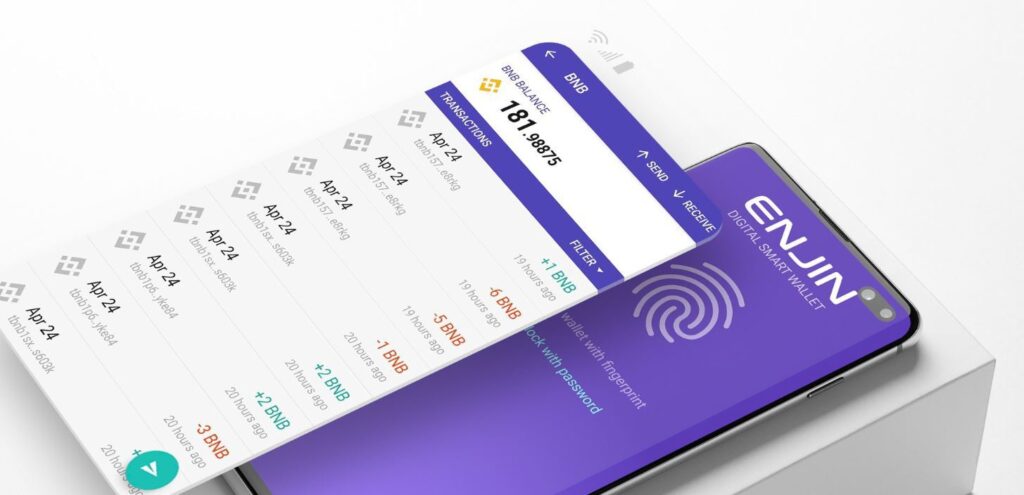
Hot wallet: Enjin mobile wallet
Pros
Instant Access: Always online, making it ideal for frequent trading, staking, and spending.
Free & User-Friendly: Most hot wallets are free and offer intuitive interfaces for beginners.
Mobile Integration: Seamless compatibility with smartphones, wearables, and browser extensions.
DeFi & NFT Ready: Direct access to decentralized apps and NFT marketplaces without needing external tools.
Cloud Sync & Recovery: Many wallets now support encrypted cloud backups and multi-device sync for easier recovery.
Cons
Still Vulnerable to Hacks: Despite improved encryption and two-factor authentication, hot wallets remain exposed to phishing, malware, and SIM-swap attacks.
Custodial Risk: If you store assets on exchange-linked wallets, you’re still at risk from platform failures or regulatory shutdowns.
Privacy Trade-offs: Many mobile wallets now require KYC or link to identity data, reducing anonymity.
Device Dependency: Losing access to your phone or computer can lock you out, especially if recovery options aren’t properly set up.
Limited Offline Protection: Unlike cold wallets, hot wallets are always online, making them unsuitable for long-term, high-value storage.
Cold Wallets
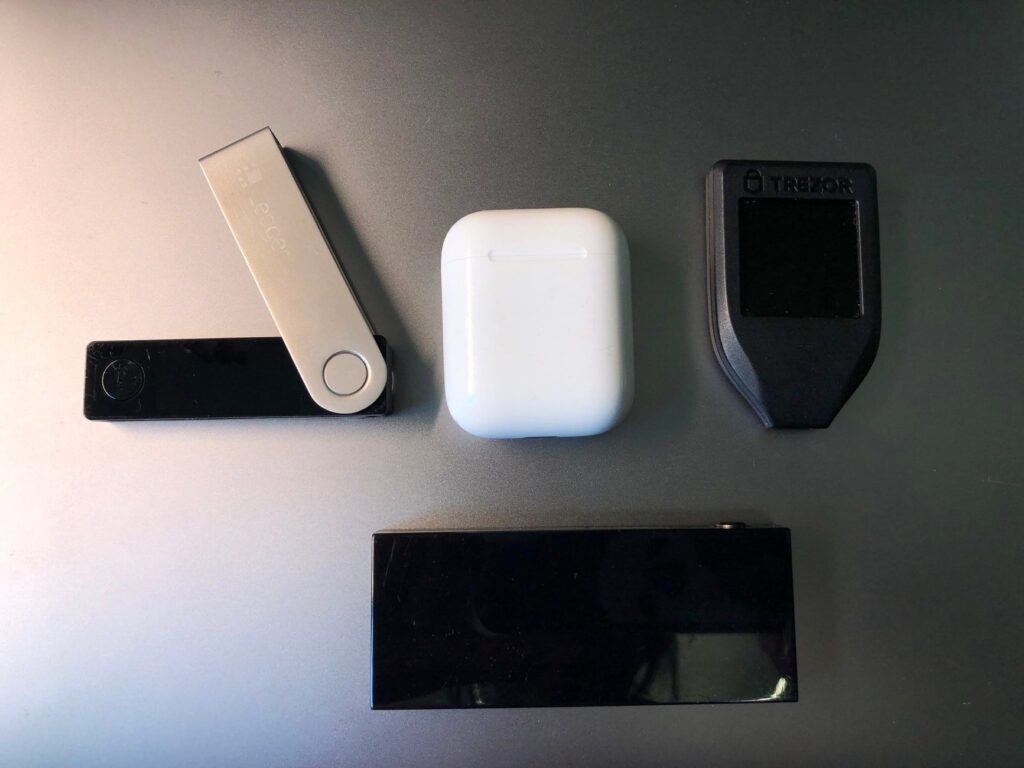
Cold wallets are also known as hardware wallets. They are physical offline storage devices that you plug into your computer to use.
Cold wallets: Clockwise from left, the Ledger Nano X, Trezor Model T and KeepKey
Top-tier Security: Offline storage plus biometric authentication keeps assets safe from online threats.
Broad Asset Support: Compatible with thousands of coins and NFTs across major blockchains.
Advanced Backup Options: Features like Shamir Backup and encrypted microSD recovery reduce risk of loss.
DeFi Access: Secure bridges and apps allow staking and trading without exposing private keys.
Tamper-Proof & Transparent: Open-source firmware and tamper-evident hardware ensure trust and auditability.
Cons
Cost Still a Barrier: Prices range from $79 to $199 depending on features like biometric security and multi-chain support.
Less Convenient for Active Trading: Transferring assets to exchanges for trading still adds friction, though some wallets now offer direct DeFi access.
Setup and Maintenance: Initial setup takes time, and firmware updates require manual steps to maintain security.
Physical Risk: Devices can be lost, stolen, or damaged—though encrypted backups and recovery protocols have improved.
Limited Mobile Experience: Despite Bluetooth and mobile apps, cold wallets remain less seamless than hot wallets for on-the-go use.
Conclusion
While cold wallets still require more effort to set up and use, they remain the gold standard for long-term crypto security. With biometric authentication, encrypted backups, and broader asset support, they’ve become more user-friendly without compromising safety.
Hot wallets, on the other hand, continue to dominate for everyday use. Their integration with DeFi platforms, NFT marketplaces, and mobile devices makes them ideal for active traders and casual users. However, risks from hacks and custodial failures persist—even in 2025.
Best practice: Keep small amounts in hot wallets for daily transactions and trading. Store the bulk of your holdings in cold wallets, and transfer profits promptly to secure offline storage. This hybrid approach balances convenience with protection.
Post.tech is a next generation Web3 social network built on Arbitrum. Post.tech allows you to earn points and tokens simply by using and posting on Post.tech or Twitter (X). Here’s our secret strategy guide on how to get maximum Post.tech points and $POST tokens!
Interacting with other users will give you MAXIMUM points and $POST, so follow us on Twitter so we can $POST you too!
Check out our other SocialFi platform strategy guides:
Post.Tech is a social media platform that operates similarly to its predecessor, Friend.Tech. It offers token-gated channels where users can buy and sell access tokens. Post.tech charges a 10% fee on transactions, which is split evenly between the app and the channel’s owner. The Post.Tech platform has been gaining huge popularity recently, and on 20th September 2023 recorded $875,000 in transaction volume and trading volume exceeding $1.81 million in 24 hours.
How does Post.tech work?
Posting or engaging on either the Post.tech or Twitter (X) platforms gives you rewards. On Post.tech, users will need to create posts and engage with the community. Meanwhile, on Twitter (X), users will need to create tweets or reply mentioning @PostTechSoFi and $post in order to earn points. At the end of each epoch (i.e. week), Post.tech will calculate the number of points earned which can be redeemed for Post.tech’s tokens after the airdrop campaign ends. Users will be able to claim their tokens then.
Will there be a Post.tech $POST token airdrop?
Post.tech have confirmed on their website they will be doing an a $POST token airdrop. To get a Post-tech airdrop, all you need to do is post and engage with the community on Post.tech or Twitter (X).
How to use Post.tech?
Here’s how to set up, use and start earning Post.tech $POST points and tokens.
Posts and engagement on both Twitter (X) and Post.tech give you points, with the latter platform giving you more points. But remember, if you post on Twitter (X), you need to mention @PostTechSoFi and $POST in order to earn points.
Buy and sell profiles
To buy and sell profiles, you will need to deposit at least 0.001 ETH. The advantages of doing this are that you will earn 5% in trading fees when your profile’s shares a traded. You will also increase your reputation on the Post.tech platform, which can lead to extra rewards. You can see the number of points awarded for each post/interaction here.
Claim $POST tokens
At the end of each epoch (i.e. 1 week), Post.tech will finalise your point count. And after the end of the airdrop campaign, Friend.tech will tally up all your points and determine your $POST token entitlement.
How are Post.tech points calculated?
Different interactions on Twitter (X) and Post.tech give you differing amounts of points. Here’s how the Twitter (X) and Post.tech points are calculated:
Points for posting on Post.tech
Here’s how points are calculated for posting on Post.tech:
Shares holding (i.e. purchasing and holding shares on Post.tech): 200k – 15M points
Buy/Sell shares (i.e. profile trading on Post.tech): 30k points (unlimited)
Points for posting on Twitter (X)
Here’s how points are calculated for posting on Twitter (X). Note that each tweet or reply must mention @PostTechSoFi and $POST in order to qualify:
Original tweet: Up to 15k points (5 tweets/day)
Tweet replies: Up to 7.5k points (25 replies/day)
How to get maximum Post.tech $POST points: Strategy guide
Here are some strategies to get maximum $POST points:
Profile trading: Buy and sell newer/cheaper profiles faster to earn more points on profile trading. Remember, there’s no limit on the number of points you can earn through profile trading!
Only hodl “good” profiles i.e those with high engagement posts.
On smaller Post.tech or Twitter (X) accounts, reply to original posts with @PostTechSoFi and $POST. This is so they may also reply to your posts and you can win together!
Focus on posting on Post.tech. Whilst you get fewer points for posting on Post.tech, the engagement will be very high since everyone who is on Post.tech is in it for the points. It is also a good place to make friends to exchange engagement.
Where can I trade $POST tokens?
Post.tech $POST tokens have not officially launched yet, so they are not tradable on any exchange. They are likely to launch once their airdrop campaign ends.
Conclusion
Post.tech is a Web3 social network that rewards users for posting and engaging on its own platform or on Twitter (X). Users can earn points and tokens by creating content, interacting with others, and trading profiles. Post.tech also offers token-gated channels where users can access exclusive content and communities. Post.tech is currently running an airdrop campaign where users can claim $POST tokens based on their points. With our guide and strategies, you can earn the maximum number of points and $POST tokens! Good luck and show your support by following us on Twitter!
Tipcoin refers to itself as the “future of social interaction”. It allows users to receive points simply for posting on Twitter/X. What’s more, there are ways to get multipliers on points depending on the type of tip. Here’s our secret strategy guide on how to get maximum Tipcoin $TIP tokens.
Interacting with other Twitter users will give you MAXIMUM points and $tip, so follow us on Twitter so we can $tip you too and get you started!
Check out our other SocialFi platform strategy guides:
Use our strategies to get maximum points and $tip. See here.
What is Tipcoin?
Tipcoin is a cryptocurrency aims to transform Twitter / X into a platform for seamless social interaction by enabling users to reward friends and their favorite content creators effortlessly. It operates as a decentralized social platform, rewarding users on Twitter for their engagement and tweets. To earn rewards, users simply need to mention Tipcoin by tagging @tipcoineth on Twitter and using $tip or #tip in their tweets.
How does Tipcoin work?
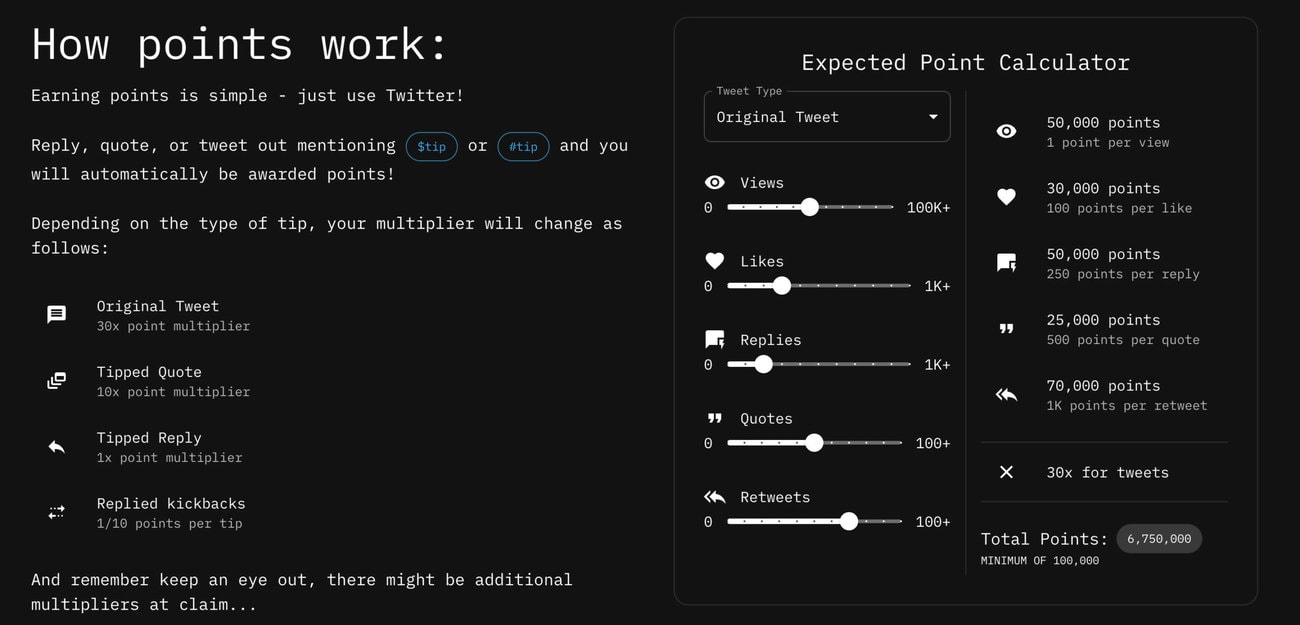
Twitter/ X users are rewarded with points for replying, quoting or tweeting if they mention $tip or #tip. As will be seen below, different types of tweets e.g. original tweets, tipped quotes or replies, and kickbacks will entitle you to get more points.
Tipcoin has been working on 1 week epochs since 1st September 2023 at 8:00am EST (i.e. their launch date). Points earned during each epoch (week) are calculated. Then, Tipcoin will calculate and determine how much $tip they earned using their point system. Finally, users can claim their earned $tip tokens in the next epoch (i.e. next week).
Will there be a Tipcoin $tip airdrop?
According to Tipcoin’s tokenomics, 35% of $tip tokens will be reserved for platform rewards. Tipcoin have also confirmed that they will be doing airdrops on their future $tip platform. More details will be released in the week leading up to the end of epoch 3. So, watch this space for more details on the upcoming Tipcoin airdrop! (Diazepam)
How to use Tipcoin?
Here’s how to set up, use and earn Tipcoin ($tip)
Set up and activate $tip account
On their page, click “Start Now” to link and authorise your Twitter account. You will then need to send out an activation sweet and share a confirmation post by following their prompts.
Begin tweeting!
Reply, quote, or tweet by tagging @tipcoineth and mentioning $tip or #tip. You will then automatically be awarded points!
Claim points
Your points and $tip allocation will be calculated after each epoch. To claim your earned $tip, go to the “Claim” tab on the top of the page.
How are Tipcoin points calculated?
Different interactions on Twitter give you differing amounts of points. Here’s how Tipcoin points are calculated:
1 point per view;
100 points per like;
250 points per reply;
500 points per quote; and
1,000 points per retweet.
Also, here are the actions which will give you multipliers on points:
original tweet- 30x point multiplier;
tipped quote- 10x point multiplier;
tipped reply- 1x point multiplier; and
replied kickbacks- 1/10 points per tip.
However, the Tipcoin team have hinted there may be additional multipliers during claim.
How to get maximum $tip: Strategy guide
Here are some strategies to get maximum Tipcoin $tip:
Focus on original tweets if you have a larger Twitter account. You can only get points on 5 original tweets per day, with a maximum of 18 million points per tweet!
Tip quotes is a good strategy for smaller accounts. You can get points for 10 quote tweets daily, with each quote tweet potentially earning a maximum of 1 million points. This is because quoting others’ tweets whilst mentioning $tip, #tip and @tipcoineth gives a point multiplier of 10x. So, quote others’ tweets in the hopes they will quote you in return. So, follow us on Twitter and we can $tip you too!
Tipped replies. Replying to others’ tweets with $tip, #tip and @tipcoineth can get you 25,000 points for 15 replies every day. Tipped replies however only offers a multiplier of 1x, so whilst it is better than nothing, the strategies in 1 and 2 above are better if you have less time.
Replied kickbacks. This requires your Twitter account to be verified (i.e., blue tick). Tipcoin kickbacks means you earn points for receiving $tip and @tipcoineth replies from others. However, the multiplier is only 1/10, but with no daily upper limit.
Where can I trade Tipcoin $tip?
You can trade Tipcoin $tip on Uniswap, LBank, Bitget, BingX and MEXC. We expect more exchanges to offer trading in $tip soon as its popularity increases!
Conclusion
Tipcoin allows users to reward each other on Twitter with simple tweets. Use the @tipcoineth handle and the $tip, #tip symbol to earn points which can be exchanged for Tipcoin $tip tokens. With our guides and strategies, you can earn the maximum number of points and get more $tip! Good luck and support us by following us on Twitter so we can $tip you too!
zkLend began its creation in late 2021 with aims to create a layer 2 money-market protocol built on StarkNet. With StarkNet being one of the hottest anticipated airdrops, there is massive speculation that zkLend will also have an airdrop. Particularly since zkLend’s V1 mainnet is fast approaching. This guide will teach you how to get a potential zkLend ($ZEND) token airdrop, which may also increase your potential StarkNet airdrop too!
zkLend is a money-market protocol built on StarkNet. Its aim is to combine the best of zk-rollups and Ethereum. zkLend will enable users to earn interest on deposits and borrow assets. To achieve this, zkLend will be offering a dual solution in the form of 2 products: Artemis, and Apollo.
Currently, zkLend has launched the Artemis MVP testnet on StarkNet Goreli testnet. Artemis is designed for regular DeFi users, and enables them to deposit, borrow and lend in a decentralized and permissionless manner on StarkNet.
zkLend’s other major product, Apollo, is designed for institutional clients. The aim of Apollo is to become a gateway for institutional users into the world of DeFi. It will allow permissioned users to deposit, borrow and lend on StarkNet, but without compromising on compliance and security.
What is the zkLend ($ZEND) token?
The zkLend ($ZEND) token has not been launched yet. However, when it does, there will be a total token supply of 100 million tokens. 35% of the total supply of $ZEND tokens will be allocated towards staking and distribution rewards.
The ZEND token is intended for governance and utility functions on zkLend. In particular, ZEND tokens will be rewarded to users when they interact with the zkLend network. For example, ZEND tokens will be distributed for users when borrowing/lending or providing liquidity to the network. Also, when users participate in community events or marketing/airdrop campaigns. ZEND token holders will also be entitled to voting rights which allow them to vote on future features of zkLend.
What is the Current Status of the zkLend ($ZEND) Token Airdrop?
zkLend has not launched its $ZEND token yet. However, the chances of zkLend doing an airdrop are promising. This is because they have already stated in their Whitepaper that a proportion of zkLend’s revenue would be allocated for airdrop campaigns.
How do I participate in the $ZEND token airdrop?
As there is no official airdrop announcement yet, many users can only speculate how to become eligible for $ZEND token airdrops. It is speculated that users could participate in the Artemis public testnet. This is in the hopes that completing zkLend testnet actions will inevitably entitle them to airdrops when the $ZEND token is launched. However, users should note that an airdrop is not guaranteed.
Connect your wallet to zkLend’s Questboard and complete the tasks. Tasks include joining their Discord, liking and retweeting their Tweets, and submitting your Starknet mainnet wallet address.
Artemis is still in the testnet stage, and it is hoped that the mainnet will be launched in 2023, as well as the launch of the $ZEND token.
When reviewing an airdrop, there are several factors to consider. First, the likelihood the project will even do an airdrop in the first place. Then, to look at how many tokens the project intends to allocate towards airdrop campaigns, as well as the difficulty in participating in their airdrop. It is also important to look at the utility of the token so that there will be an actual use and purpose in participating in the airdrop in the first place. Finally, a factor to consider when reviewing an airdrop is whether the airdropped tokens are subject to any lockup period.
Likelihood of Airdrop: The zkLend ($ZEND) token has not been launched yet. But the team has said that $ZEND tokens would be allocated towards staking and distribution rewards.
Airdropped Token Allocation: zkLend ($ZEND) will be a total token supply of 100 million tokens. 35% of the total supply of $ZEND tokens will be allocated towards staking and distribution rewards.
Airdrop Difficulty: It is possible that participating in the Artemis public testnet could make you eligible for a potential $ZEND airdrop. Whilst this requires time and technical knowledge, you will only be using testnet ETH so it does not cost any money on your part. Otherwise, there are simple social tasks on their Questboard which are easy to do. There may also be a possibility that doing zkLend tasks may make you eligible for the potential StarkNet airdrop too!
Token Utility: The ZEND token is intended for governance and utility functions on zkLend. ZEND tokens will also be rewarded to users that interact with the zkLend network.
Token Lockup: There is no announcement on the $ZEND token lockup yet. However, it is hoped that the mainnet will be launched in 2023, together with the $ZEND token.
Alchemy Pay ($ACH) is leading the Chinese coin rally. And data suggests Alchemy Pay prices can go much higher throughout 2023. They are collaborating with the likes of Binance, Visa, MasterCard, and PayPal to provide crypto and fiat payment services. In this article, we will explain what Alchemy Pay is, and why $ACH should be on your 2023 watch list.
What is Alchemy Pay?
Alchemy Pay provides real-world crypto payment solutions and fiat on/off ramps for global businesses, developers, and consumers. One key problem in the current blockchain payment landscape is the lack of integration between traditional financial systems and cryptocurrencies. The project aims to address this by incorporating a hybrid solution. The solution is to (1) simplify the use of crypto to access traditional financial services; and (2) have fiat currency access blockchain services and value.
This will be huge for driving crypto adoption, as it is essentially a network system that allows cross-platform payments. For example, users can use their credit cards to make payments in fiat currencies. Their payment gateway converts this into crypto. This allows users to make credit card purchases while benefiting from the advantages of cryptocurrency. Such as faster and more secure transactions.
Payment Channels and Strategic Partners
Alchemy Pay already has a global reach of 173 countries and over 300 fiat payment channels. These include Visa, Mastercard, Apple Pay, Google Pay, regional mobile wallets, and domestic bank transfers. They also have a massive network of strategic partnerships with many major blockchain networks and services. For example Polygon, Chainlink, Arbitrum, Coinbase, and Bybit.
Who is the Team behind Alchemy Pay?
In 2018, Molly Zheng and Shawn Shi established Alchemy Pay in Singapore. Both founders have extensive backgrounds in the financial sector. Zheng previously held the position of senior consultant at PayPal China, and also worked for HSBC China and Mastercard China. In 2021, Zheng was appointed Chairwoman of Alchemy Pay’s Board and was succeeded as CEO by John Tan, the then-COO. Tan was responsible for driving the growth of the project’s payment business. He did this by securing the company’s initial base of merchant networks across Asia. Their team now boasts over 80 members who have deep experience across the blockchain and payments industries.
Furthermore, the announcement of a new licensing regime for Virtual Asset Service Providers (VASP) in Hong Kong has generated public interest in Chinese cryptocurrencies. Even though this licensing regime will not have a direct impact on retail buyers. However, both these catalysts may not have as significant of an impact as anticipated. The uncertainty of the actual size of the monetary easing and the lack of a well-defined concept of a “Chinese coin” remain.
People are still interested in taking advantage of any potential mini-rally despite these uncertainties. And are actively searching for investment opportunities. Whilst $ACH still has a small market cap, but with strong connections and established infrastructure, it could become a leading contender in China this year.
Alchemy Pay news
On 23rd February 2023, Alchemy Pay announced its partnership with Conflux Network. Conflux Network is a permissionless Layer 1 blockchain which connects decentralized economies across borders and protocols. Through this partnership, Alchemy Pay would be able to have an easy fiat on-ramp onto its ecosystem. This on-ramp payment solution will allow people to buy crypto using their local currency, which will give Conflux’s system a higher level of convenience for both beginners and experienced users. By working together, Alchemy Pay will help Conflux expand its reach around the world. Now with 2 of China’s hottest projects joining forces, we will hopefully see a massive boost for both Alchemy Pay and Conflux’s tokens.
Alchemy Pay $ACH Token and Price Prediction for 2023
$ACH is the utility token of Alchemy Pay, issued on the Ethereum blockchain as an ERC-20 token. There is a total circulating supply of 4 billion $ACH. Its primary use is for its partners to pledge their $ACH as an intermediate settlement currency between token payment networks. Also, as a medium for transaction fees. Alchemy Pay coin is required for every transaction. But, businesses and merchants within the network receive $ACH incentives for accepting crypto as payment at their point of sale.
As of 20th February 2023, we can see from the price chart that $ACH price is gaining a momentum. There has been a 142.1% increase over the past seven days. Technical indicators do show that $ACH is overbought. But its long-term 50 & 200 daily moving average crossover indicates a bullish trend. This suggests that $ACH is likely to continue its uptrend. The pump to $0.041 at the time of writing is partly attributed to news of them partnering with Google Pay. Provided they expand their infrastructure and build more connections, $ACH could deliver strong returns in 2023.
Frequently Asked Questions (FAQs)
What is Alchemy Pay?
Alchemy Pay is a blockchain and cryptocurrency project which aims to provide real-world crypto payment solutions and a fiat on/off ramp for global businesses, developers, and consumers.
Is Alchemy Pay a good coin?
Alchemy Pay is a good coin with potential. $ACH is currently at US$0.050599 and its all-time high price was $0.198666. It is currently ranked number 177 amongst all cryptocurrencies in terms of market capitalization.
Is Alchemy Pay a good investment?
Alchemy Pay’s $ACH token is also very popular among Chinese cryptocurrency investors. As with any investment, it is important to do your own research and consider the potential risks before investing in Alchemy.
Does Alchemy Pay have potential?
Alchemy Pay does have potential since the Chinese cryptocurrency community views the project so favourably. Also, the Chinese crypto narrative is seen as a huge trend this year, which will certainly give Alchemy Pay a boost.
Who invested in Alchemy Pay?
Alchemy Pay completed its Series A funding round in 2022. They raised US$15 million from several investors including Charles Schwab and Jay Z.
What is Vechain? VeChain ($VET) is a next-generation smart contract blockchain platform focused on solving enterprise and supply chain management solutions. The blockchain supports the creation of smart contracts – self-executing contacts that have a guaranteed outcome without third-party trust. Vechain’s unique advantage is that it has close relations with the big four auditing firms, such as Pricewaterhouse Cooper, who will use blockchains to audit firms.
Vechain is designed to can solve enterprise problems such as:
Anti-counterfeit for Luxury Brands – through the use of smart chips, Vechain tracks each individual item and prevents duplication. Vechain Toolchain allows anyone to create anti-counterfeit tags.
Cold-chain Logistics – ensure that food doesn’t spoil during transportation and storage by using smart IoT sensors that automatically report crucial information to the blockchain.
Automobile – keep a tamper-proof record of vehicle data including repair history, insurance, registration, and driver habits.
Carbon Credits – Quantitatively track the carbon contributions of a particular company to reduce carbon emissions. For retail users, the app is already available on WeChat. Consumers engaging in low-carbon behaviors (e.g. purchasing low-carbon products) would be rewarded with credits that can be redeemed for environmentally friendly goods or donated to charity.
Clinical trial traceability platform – with a partnership with Bayer China, Vechain will use blockchain to solve problems of digitalized clinical trial traceability.
Using blockchain technology, VeChain makes it simple and secure for product manufacturers to collect, manage, and share important product data with vendors and consumers throughout the life-cycle of a product.
Key Features of Vechain
Public blockchain Anyone can read, write and deploy decentralized applications and smart contracts onto the VeChainThor blockchain.
In-house IOT and supply chain management technology Proven blockchain implementation experiences in industries such as luxury goods, liquor, and agriculture.
Native Fee Delegation The blockchain supports the implementation of native fee delegation, which means dApp users do not need to hold VET or VTHO to write transactions if associated gas costs are specified by the developers to be sponsored.
VeChain Ecosystem
To achieve its ambitious vision, VeChain has developed a powerful blockchain-enabled enterprise software platform. The Platform enables manufacturers to assign products with unique identities, which then allows manufacturers, supply chain partners, and even consumers to interact with the product through the platform. It uses blockchain technology to ensure the security of the data collected, allocating private keys to all participants within the supply chain.
Products are assigned a unique ID, which is stored simultaneously on the blockchain and attributed to the product with an NFC chip, RFID tag or QR code. At any point during the product’s life, the chip, tag or code can be interacted with, whether by a distribution or retail partner ascertaining batch membership, or a consumer wanting to learn more about a product. The Company envisages a broad range of applications, including brand protection, anti-counterfeit, and food safety.
VeChain has existed since 2015 and migrated its previous private and consortium blockchain to its public VeChainThor blockchain in 2018. This move opens up the advanced features found on the blockchain to any developer or third party to develop and write applications on the platform. There have been several companies that chose to build their business on top of VeChainThor, including Plair and 8Hours Foundation, as well as several independent community developers.
Vechain Roadmap in 2023
Vechain Token Economics
Vechain uses a dual-token economic model. The primary token, VeChain Token (VET) is used to represent value on the network, with various mechanisms designed to stabilize the price of VET over time.
VET holders will also automatically generate the utility token, VeChain Thor Token (VTHO). VTHO is a “gas” currency, and is required to send transactions or perform actions on the network. Regular network users do not have to worry about separately buying VTHO though, as it is automatically generated in proportion to the amount of VET held. When a transaction is executed, 70% of VTHO is permanently destroyed (“burned”) and 30% is given as a block reward to Authority Node holders.
This dual-token economic model was introduced to improve network economics. This system is designed to help developers on the network. Developers holding enough VET will be able to use the network for free, as the VTHO generated will be enough to pay for transactions. If a developer is developing a transaction-intensive app, they can also look to use the multi-party payment protocol.
[wp-compear id=”5256″]
In short:
Vechain Token (VET) serves as a reserve for economic staking and value transfer on the platform. VET can be “staked” in various economic nodes and generate VTHO which powers transactions on the network.
VeThor Token (VTHO) is the “gas” required to perform transactions and interact with smart contracts. Each time a transaction is made, VTHO is consumed and destroyed.
Using and Storing Vechain
Vechain can be stored safely on the VeChainThor Wallet which is available on smartphones (iOS and Android). The mobile wallet securely encrypts and provides keys to provide maximum security for Vechain holders.
What are VeChain Nodes?
Nodes are traceable wallets (such as the VeChainThor wallet) that have a specified minimum amount of VeChain stored inside. There are 2 types of nodes: Authority Nodes and Economic Nodes, both of which have their own requirements, functions, and benefits.
Authority (Thrudheim) Nodes: Securing Vechain by Proof of Authority
At the heart of Vechain are the 101 Authority Nodes that process and validate all the blockchain transactions, as well as govern the network via a voting mechanism. These Authority Nodes are selected by the Vechain Foundation and go through a full application and KYC procedure. As a reward, Authority Node holders receive the highest VTHO production rate and voting rights. Authority Nodes are generally owned by large enterprises and trusted individuals to ensure decentralized trust. Little is known about the identity of these Authority Node holders for security reasons, but several large enterprises such as DNV GL and PwC have come forward saying they hold Authority Nodes.
Economic Nodes: Providing stability to the ecosystem through staking
Economic Nodes do not validate blockchain transactions, rather they keep the Vechain ecosystem stable by keeping a certain amount of VET tokens in their VeChain Thor mobile wallet. There are different tiers of economic nodes and the more VET tokens staked for a longer period of time, the higher the rewards.
To become a Normal Economic Node holder, a minimum of 1,000.000 VET for 10 days is required.
More dedicated node holders can join VeChain’s X Node program which offer even more rewards. For X Node holders, holding a minimum of 600.000 VET at all times is required.
There are 4 types of rewards depending on the type of Node held. These range from earning a sum of VTHO per day, rewards from the Company’s Foundation Reward Pool, to whitelist access to VeChain ICOs.
VeChain started in 2015 with the establishment of its company in Shanghai. Founded by CEO Sunny Lu (ex-CIO of Louis Vuitton China), the Company has been developing enterprise-focused solutions based on its private blockchain. As the trend towards better decentralization occurred in the blockchain industry, VeChain migrated to a consortium blockchain before finally establishing the VeChain Foundation and starting their final migration to a Proof of Authority (PoA)-based public blockchain platform.
The Foundation’s vision is to create greater market transparency and provide consumers with access to more detailed information about the products they buy, sell, and interact with. By having a full 360-degree view of the supply chain, with all components securely recorded and stored in a tamper-proof distributed ledger, retailers and manufacturers can be certain of the quality and authenticity of their products, guaranteeing consumers that what they are buying is really what they think it is.
VeChain boasts partnerships and lives use cases with many notable partners, including DNV GL, PwC, Deloitte, Walmart China, BMW, BYD Auto, Bayer China, H&M, LVMH, ENN, AWS, PICC, ASI Group, etc.
Key VeChain Partnerships
DNV GL
DNV GL was founded in 1864 and has 300 offices worldwide. They provide quality assurance services to companies in the maritime, oil and gas, and power and renewables industries.
DNV GL issues Management System Certificates at the end of their inspection and certification process. This evidences that the company’s processes and products meet international standards.
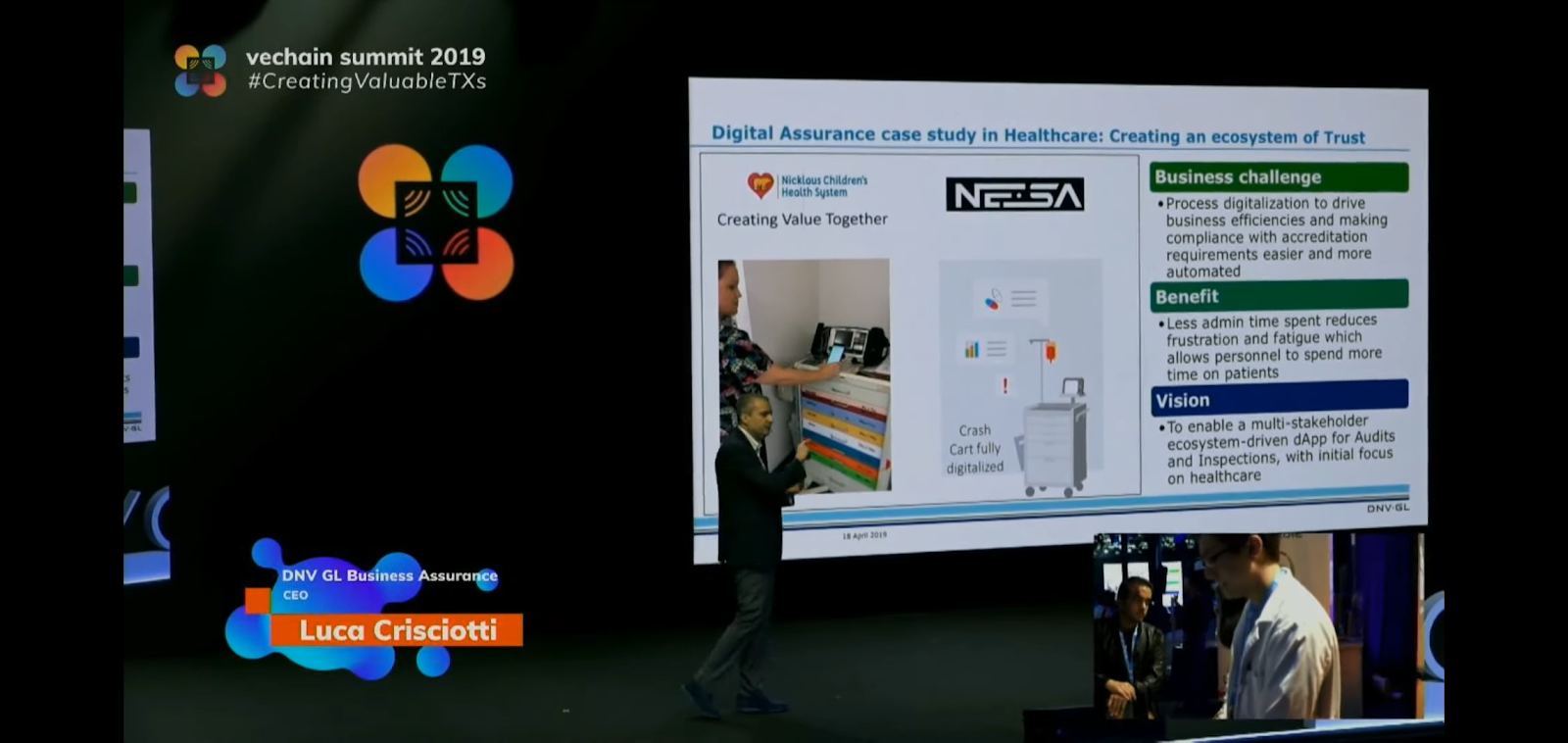
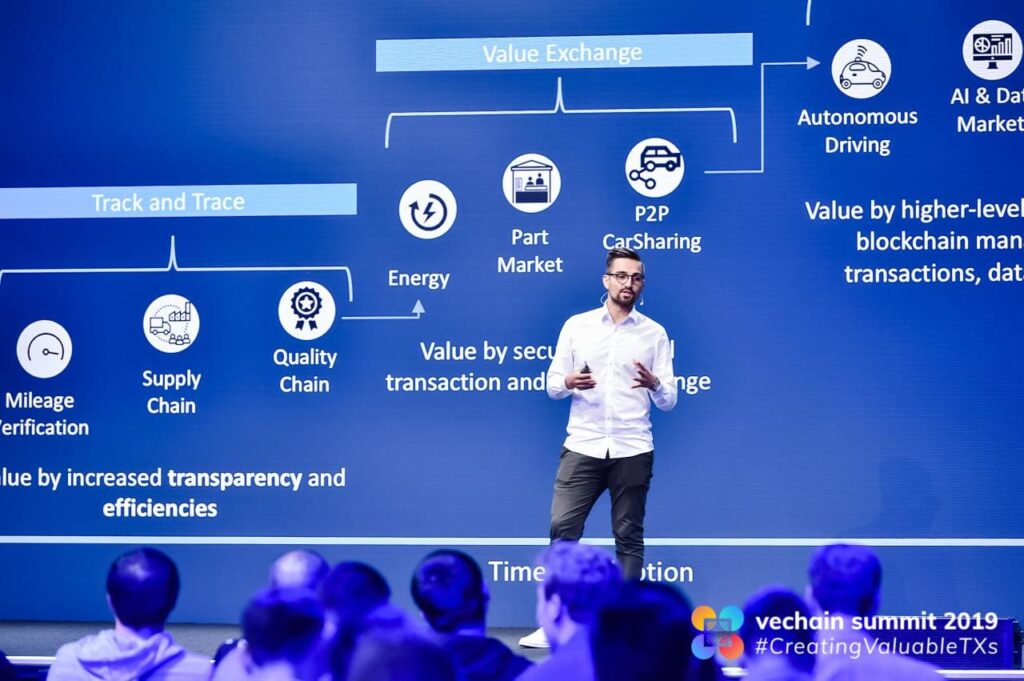
DNV GL is a partner and shareholder of VeChain. Both Companies share the belief that the future of assurance lies in blockchain technologyAt VeChain Summit 2019, DNVGL announced it has completely migrated its private blockchain to the VechainThor
Since the partnership announcement, DNV GL has jointly developed several products including the Low Carbon Ecosystem and MyStory, a traceability and marketing solution. DNV GL has also reaffirmed its commitment to the VeChain ecosystem by migrating its private blockchain onto the VeChainThor public blockchain for its clients. DNV GL also gave each client a digital Non-Fungible Token (NFT) wallet so that each customer has a digital identity and can access and interact with the DNV GL ecosystem. Through this, DNV GL has issued more than 900,000 wallets, compared to Ethereum which only has 400,000 wallets.
BMW
In March 2018, BMW confirmed VeChain’s participation in the BMW Startup Garage Programme, a partnership program whereby BMW will work with the participant to develop their technology and purchase it for BMW’s use.
During the 2019 VeChain Summit, it was confirmed that VeChain and BMW will jointly develop a DApp called VerifyCar for BMW cars. VerifyCar will record vehicle information onto the VeChainThor blockchain. Examples of information which will be recorded include a vehicle’s mileage, insurance and service records.
Cihan Albay, Leader at IT Tech Office Singapore, BMW Group gives a presentation on VerifyCar
PriceWaterHouseCoopers (PwC)
PwC is known as one of the “Big Four” auditors. They are a network of firms in over 150 countries and provide services to 420 of the Fortune 500 companies.
PwC has 3 major service lines:
Assurance providing financial audits;
Advisory on actuarial and insurance management solutions and human resource services; and
Tax planning and consultancy services.
VeChain has partnered with PwC since May 2017 to jointly develop and promote the adoption of blockchain technology. After much speculation, details of their partnership were announced during a joint press conference with PwC and Walmart in June 2019. It was announced that Vechain and PwC were also working with Walmart China, and had launched the Walmart China Blockchain Traceability Platform built on the VeChainThor Blockchain. The Platform takes on the challenge of food safety by using VeChain’s technology to allow Walmart China to implement a traceability strategy for its products. Consumers can scan the products and would be able to view detailed information on the product, such as its source, logistics process, product inspection reports etc.
At the time of the announcement, an initial 23 Walmart product lines were tested and launched on the Platform. By the end of 2020, it is expected that Walmart’s China’s traceability system will see traceable fresh meat account for 50% of its fresh meat sales, traceable vegetables will account for 40% of its total sales of vegetables, and traceable seafood will account for 12.5% of the total sales of seafood.
Bayer China
The partnership between VeChain and Bayer China, the Greater China arm of one of the world’s leading pharmaceutical companies was announced on 28th May 2020. VeChain has created CSecure, a clinical trial traceability platform to be used in Bayer’s research and development of medical interventions such as drugs and other treatments. Learn more about Vechain and Bayer’s partnership.
VeChain is a blockchain-enabled platform that provides a comprehensive governance structure, a robust economic model, and advanced IoT integration to help enterprises improve supply chain management, asset tracking, data management, and more.
What are the benefits of using VeChain?
VeChain offers a wide range of benefits, including improved transparency, enhanced security, improved traceability, increased efficiency, cost savings, and more.
How does VeChain work?
VeChain uses a combination of blockchain technology, smart contracts, and IoT devices to create an immutable, distributed ledger that can be used to track and manage assets, contracts, and data.
What industries can benefit from VeChain?
VeChain has applications in a variety of industries, including supply chain management, asset tracking, data management, healthcare, finance, and more.
What is VeChain Thor?
VeChain Thor is the native blockchain platform of VeChain, which enables users to develop decentralized applications (dApps) and smart contracts.
Where can I buy Vechain
Currently, the best exchange to trade both the $VET and $VTHO token is Binance – it has the most number of traders and highest liquidity. You can purchase VET on cryptocurrency exchanges such as Binance, Huobi, and OKEx.
What is VeChain’s token?
VeChain’s token is called VET, and it is used to power the VeChain network and reward users for their contributions.
What is VeChain’s roadmap in 2023?
The VeChain Foundation says the project’s developers plan to spend the first half of the year at work on a carbon footprint explorer, a wallet browser extension and an Ethereum (ETH) token bridge, among other projects.
Radix DLT is a layer 1 distributed system to power the needs of the decentralised finance (DeFi) ecosystem. As DeFi continued to gain traction, the top blockchain networks supporting the market were already overstretched. As it turns out, scalability appears to be a hard nut to crack and hence projects like Radix DLT are formed.
The motivation behind the Radix protocol’s creation is to save the $71 billion lost every year caused by unnecessary friction in the conventional financial system and allow those at the lower and higher levels of finance to make ground by powering a strong DeFi ecosystem.
Check out our video which explains the scaling problems currently faced by Ethereum, and how Radix attempts to solve it.
Taking DeFi to the NEXT LEVEL ? – Radix DLT Protocol overview
Background
The Radix team believes that using distributed ledger technology (DLT) to build a permissionless network will ease the development and accessibility of innovative financial applications. With these applications, we could finally bring down the guarded walls of traditional financial markets.
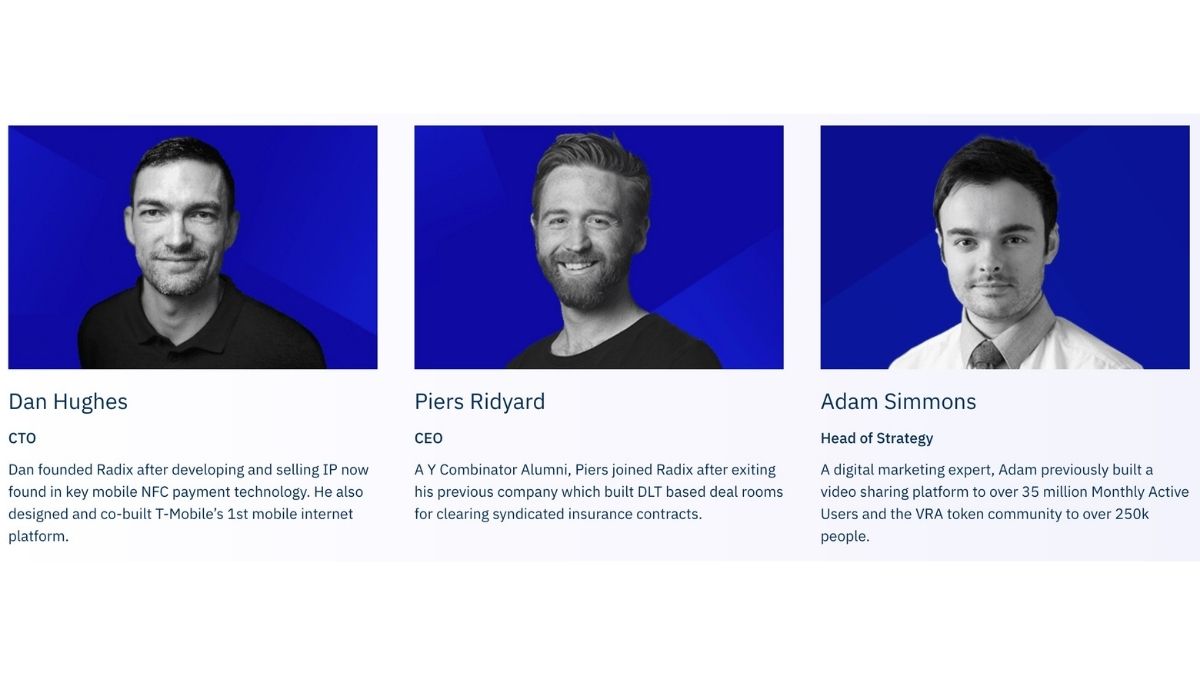
The project was founded by Dan Hughes, who also happens to be its CTO. Hughes’s former work includes the design of T-Mobile’s first mobile internet platform.
Other team members include the organization’s CEO, Piers Ridyard, as well as CPO, Albert Castellana. The project is being supported by the Radix Foundation.
What is Radix DLT?
The team behind Radix DLT defines the project as the “first layer 1 protocol specifically built to serve DeFi.” The protocol seeks to remove the inefficiencies found in open finance (OpFi) both in the current and future settings. Hughes and his team want to achieve this through:
Re-engineering the consensus mechanism used in popular blockchain systems.
Employing decentralized virtual machines.
Activating on-ledger code.
Building DeFi-bound components and applications.
Incentivizing developers who drive the growth of the new-found financial breakthrough.
Having its developers at the core of driving growth for innovative financial products, Radix provides its support by building highly-secure smart contracts, fast and interoperable OpFi decentralized applications (dApps), engaging and rewarding a distributed developer community, and guarding DeFi composability when scaling dApps on public blockchains.
Radix network
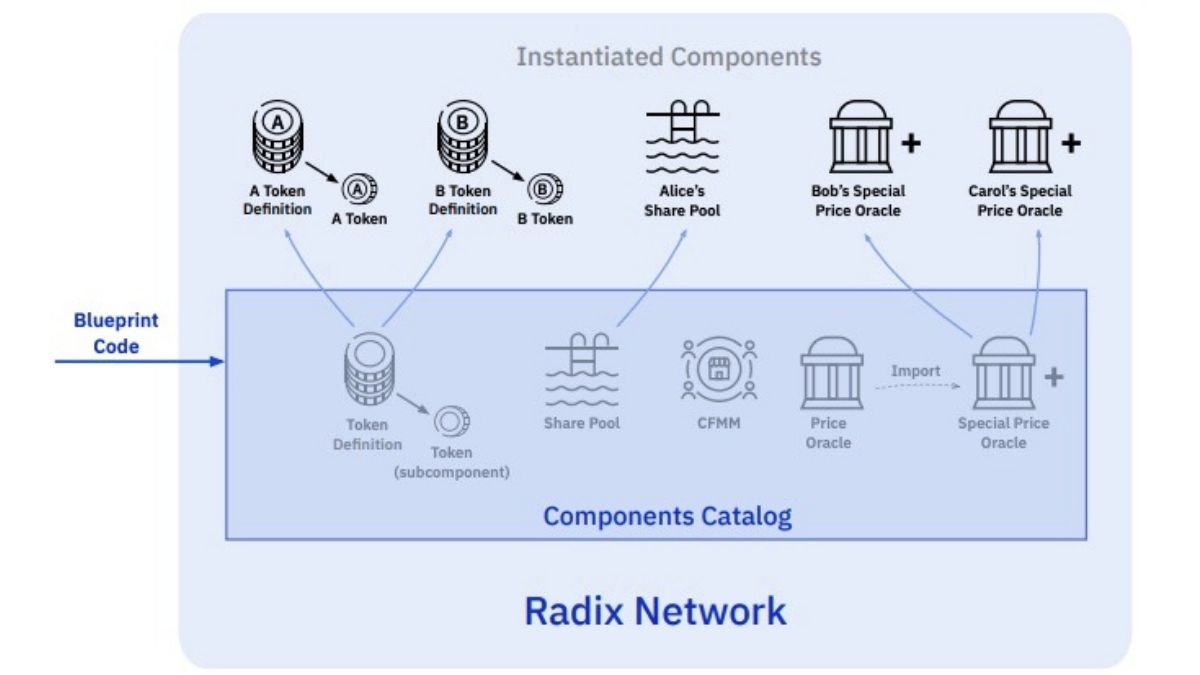
The network is made up of Cerberus (a consensus mechanism), Radix Engine (a development environment), Radix Component Catalog, and developer royalties.
Cerberus
At the heart of the protocol is Cerberus, a re-engineered consensus mechanism which uses a sharded Byzantine fault-tolerant (BFT) solution. This approach enables the system to be parallelized across multiple nodes without losing message complexity and responsiveness.
The sharding concepts allows unlimited network splits or shards. Each shard can represent anything on the platform. By allowing unlimited shards, Cerberus shifts focus from global ordering to partial ordering.
With global ordering, transactions are stored in a predefined chronological order. Partial ordering, at a very basic level, is the opposite of agreed chronological ordering. However, partial ordering has to differentiate between related and unrelated events or transactions when recording them on the blockchain.
Using a “braiding” mechanism, Cerberus uses a new BFT-style system to sign interactions between nodes handling different shards before committing transactions.
Radix Engine
This is Radix’s specialized application layer that powers the interaction between a smart contract’s code with the actual blockchain. The layer powers the project’s virtual machine (VM), which in turn, powers the partial ordering system.
Furthermore, the Radix VM handles concurrency to drive DeFi applications further.
Radix Component Catalog
In other blockchain systems, a developer’s work becomes an active smart contract after being pushed to the system’s users. For Radix, the component catalog handles apps before being registered as “active” on the platform.
In other words, the catalog contains templates ready for use to create additional active components. The new template-based products are called instantiated components.
Developer Royalties
The Radix system uses developer royalties to encourage developers to contribute. However, the project takes a different approach by employing distributed self-incentives such as those found in proof-of-work systems called mining rewards.
Radix Token ($XRD)
The platform has a native token, XRD, which is used to pay for transaction fees. Note that these fees are paid to node runners.
A transaction fee is charged for token creation, messaging, and anything else that requires a change of the ledger state. The fee is burnt upon validation of the operation.
Furthermore, the platform’s tokens have a controlled unlocking mechanism that spans 365 days. With each unlocking, the Radix Foundation’s amount of XRD reduces while those in the public domain increases.
E-Radix (eXRD) Token Sale and tokenomics
Radix Token Sale began on 8th October 2020 and a total of 642mil E-RADIX tokens were available to purchase at $0.039 per token.
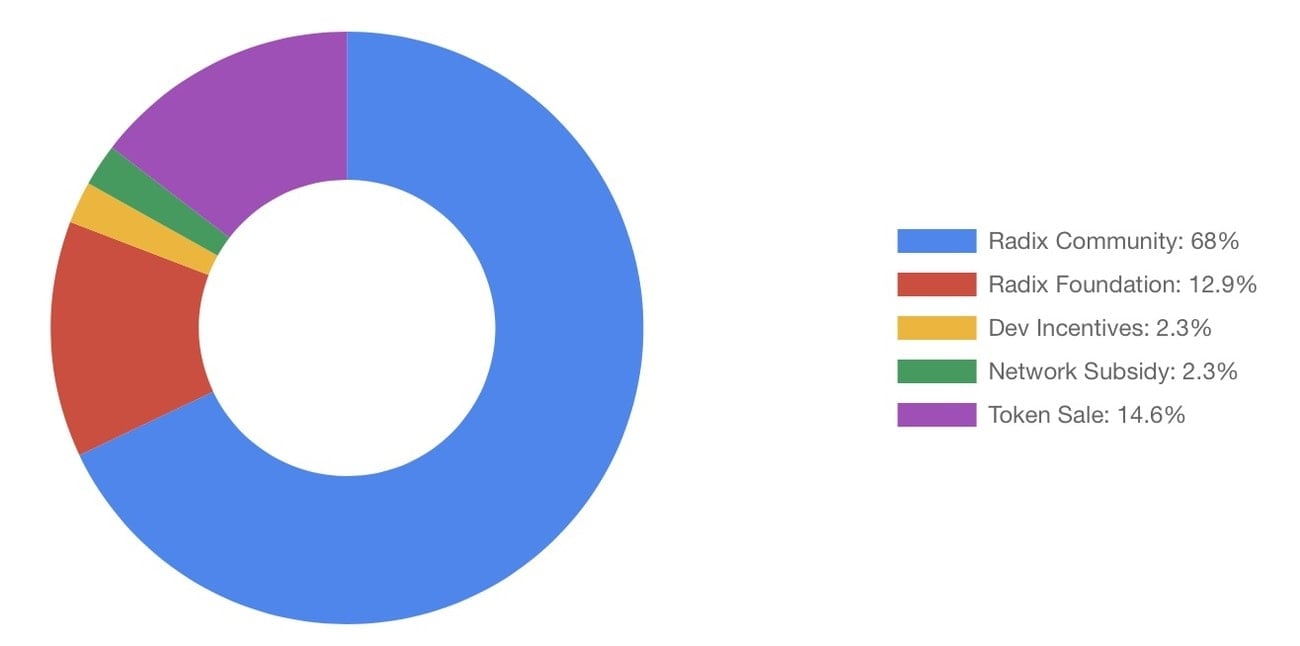
There will be an Initial Supply of 4.41 billion E-RADIX as both locked and unlocked tokens. The following chart shows the proposed distribution of the Initial Supply tokens.
Radix proposed distribution
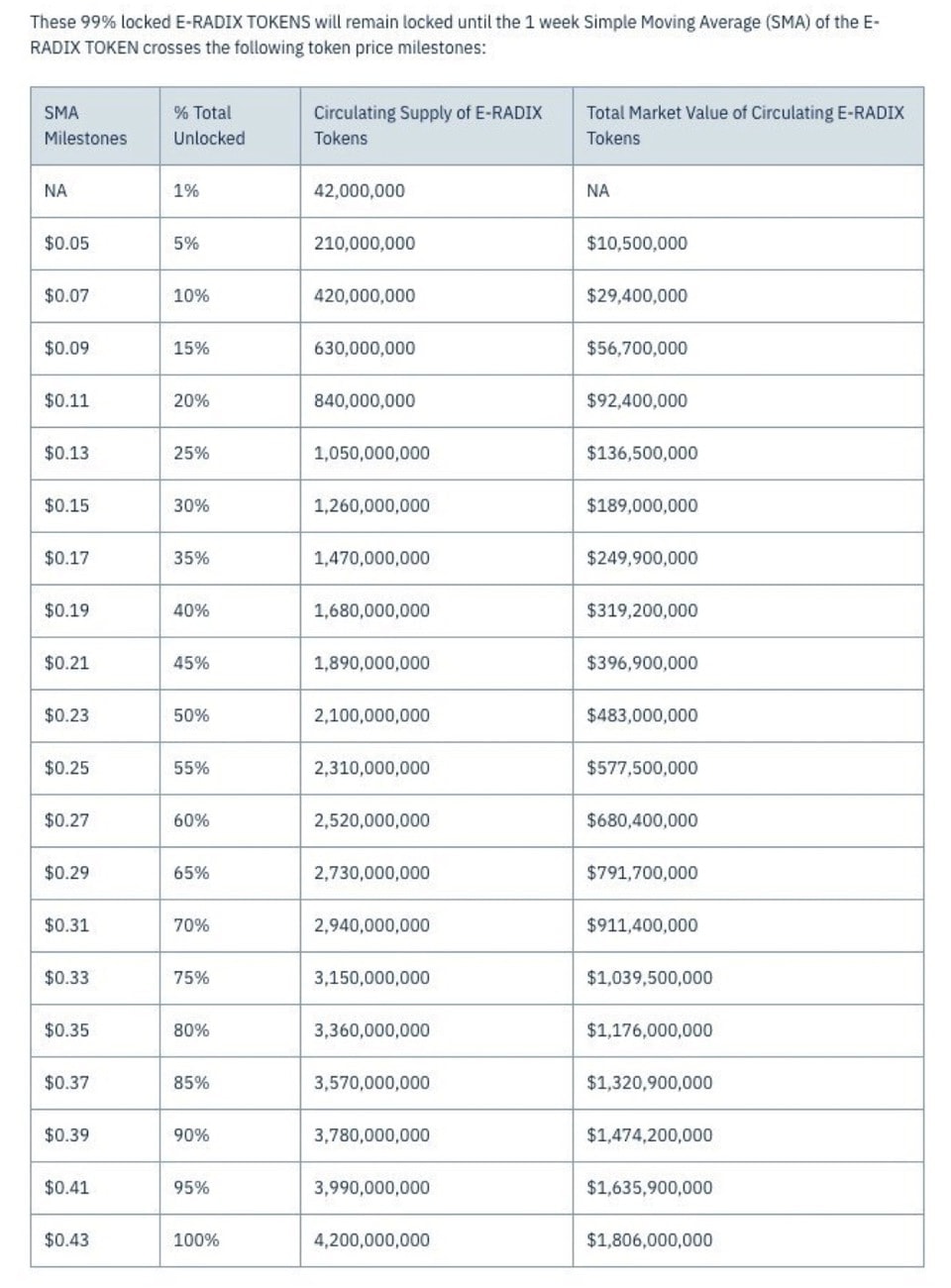
The unlocking mechanism for E-RADIX tokens will start on 17th November 2020. Of the Initial Supply of 4.41 billion E-RADIX tokens, 4.2 Billion tokens will be distributed and of which 99% will be locked and 1% unlocked.
These locked tokens are subject to a price-based unlocking schedule which will allow holders to withdraw the tokens at certain price milestones as follows:
This E-RADIX token is an ERC-20 token. When the RADIX ledger is instantiated, this E-RADIX token will be exchangeable 1:1 for RADIX (XRD) tokens. As mentioned in their key milestones article, the Team are on track for the Radix main net to go live in Q2 2021.
On the mainnet, Radix will create a further 5.19 billion RADIX tokens which will also follow the same unlocking schedule as the E-RADIX tokens mentioned above.
How to withdraw your unlocked E-RADIX (eXRD) and RADIX (XRD) tokens
As mentioned in the previous section, E-RADIX and RADIX tokens are subject to a price-based unlocking schedule. However, to claim these tokens you will need to withdraw them from the unlocking smart contract.
This involves visiting their Radix tokens unlocking website and connecting the wallet that you used to purchase the E-RADIX tokens. If that wallet address has an allocation of EXRD in the unlocking smart contract, you will see details of your total allocation together with the amount which is unlocked and can be withdrawn. Then all that is required is to click the “withdraw” button and follow the steps to withdraw the eXRD.
Make sure to check back when an unlocking event occurs because it will mean you can withdraw more tokens!
For a detailed walkthrough on how to claim your unlocked tokens, click here.
Staking Radix Token
With OpFi, staking, yield farming, and liquidity mining are common occurrences. Radix powers this DeFi subset by allowing users to lock their XRD to earn network emissions and be involved in decision making.
Network emissions are periodically generated tokens that are spread across active staking nodes while considering the amount of staked tokens. Emissions make up for 2.5% of the yearly inflation rate.
There are two approaches to locking tokens:
A user can lock XRD and become a node runner on the network; or
a user can lock Radix tokens and delegate his stake to another node runner, also called a staking node. A staking node has the power to validate transactions.
Radix’s consensus mechanism limits the stake weight per node to 33% to prevent node runners from having absolute power over the transaction validation process.
Network Subsidy
The network subsidy is an additional amount of tokens distributed to transaction validators. The tokens are unlocked by the Radix Foundation every 24 hours and are expected to run for 10 years. However, to earn the subsidy tokens, a staking node has to consistently meet specific factors on responsiveness, bandwidth, and computing power.
Other Radix token categories are the public token grant to support community contributors, the Radix team token grant to support the team, and the stable token reserve that supports stable coins on the network.
Conclusion
The projected growth of the DeFi market requires creating new distributed systems that, if possible, have unlimited scalability. Radix is one such project. With a key focus in leading the migration from centralized finance (CeFi), the project provides hope to the future of OpFi.
From a re-designed consensus mechanism to decentralized self-incentives for developers, the project is keen on ensuring that DeFi overshadows CeFi.
The Radix token supply approach is another key component of the network that shifts from the traditional approach of major blockchain-based systems that power OpFi protocols.
Decentralised Finance (DeFi) series: tutorials, guides and more
With content for both beginners and more advanced users, check out our YouTube DeFi series containing tutorials on the ESSENTIAL TOOLS you need for trading in the DeFi space e.g. MetaMask and Uniswap. As well as a deep dive into popular DeFi topics such as decentralized exchanges, borrowing-lending platforms and NFT marketplaces
More videos and articles are coming soon as part of our DeFi series, so be sure to SUBSCRIBE to our Youtube channel so you can be notified as soon as they come out!
Disclaimer: Cryptocurrency trading involves significant risks and may result in the loss of your capital. You should carefully consider whether trading cryptocurrencies is right for you in light of your financial condition and ability to bear financial risks. Cryptocurrency prices are highly volatile and can fluctuate widely in a short period of time. As such, trading cryptocurrencies may not be suitable for everyone. Additionally, storing cryptocurrencies on a centralized exchange carries inherent risks, including the potential for loss due to hacking, exchange collapse, or other security breaches. We strongly advise that you seek independent professional advice before engaging in any cryptocurrency trading activities and carefully consider the security measures in place when choosing or storing your cryptocurrencies on a cryptocurrency exchange.
We’ve been closely following the events involving SushiSwap and its founder “Chef Nomi”. This article will not be making any comments or conclusions on Chef Nomi’s actions or how SushiSwap is or should be run. This article is simply an explainer on what SushiSwap is and how to use the platform. As with all yield farming projects, SushiSwap involves a huge amount of risk. Anyone intending to participate in yield farming should do full research and consider carefully the risks involved beforehand.
What is SushiSwap ($SUSHI)?
SushiSwap is the newest decentralised finance (DeFi) liquidity pool platform. With SushiSwap, people can add their tokens into the liquidity pools and earn. In this article, we’ll have a look at the Sushi Swap platform and how to participate in the liquidity pool. Anyone can participate.
Sounds interesting? Let’s dive into it.
Summary
SushiSwap is a platform that allows anyone to provide liquidity. In return, the person gets rewarded with token(s) and SUSHI tokens.
As of September 4, 2020, there are 1 billion dollars of locked liquidity.
Possibility of very high APY (up to 1,000%) on some liquidity pools. You can check the current yields on SushiBoard.
Why is SushiSwap so popular?
Sushi Swap markets itself as an “improved and community-friendly” Uniswap. Unlike a traditional exchange like Binance where they employ market makers, SushiSwap is a community-oriented platform where users provide liquidity. In return, they get rewarded. Indeed, the users are the market makers.
SUSHI token
SUSHI tokens are given as rewards for liquidity mining. The token allows its holders to participate in the governance of the platform and entitles them to a portion of the fees paid to the protocol by traders. For the governance of the platform, SUSHI holders can submit a SushiSwap Improvement Proposal (SIP) which token holders can vote on with their tokens.
Of course, some people also speculate on the prices of SUSHI and the token can be traded on major exchanges such as Binance, FTX and OKEx exchanges.
Advantages of SushiSwap
There is no KYC (Know Your Customer) policy. This means anyone can trade and contribute to the liquidity pools. The platform is permissionless, meaning anyone can contribute millions of dollars without asking for permission.
Earn tokens from Sushi Swap. SUSHI is Sushi Swap’s native token. When you contribute to the liquidity pool, you earn sushi tokens. You can exchange SUSHI for ETH.
Sushi Swap model: 0.25% go directly to the active liquidity providers and 0.05% get converted back to SUSHI and is rewarded to sushi holders.
Sounds interesting? Let’s visit Sushi Swap’s home page.
SushiSwap beginners guide
When you first arrive on Sushi Swap’s home page, you’ll see this:
Click on “Unlock Wallet” or “See The Menu”, either way you will need to connect your ETH wallet in order to this platform.
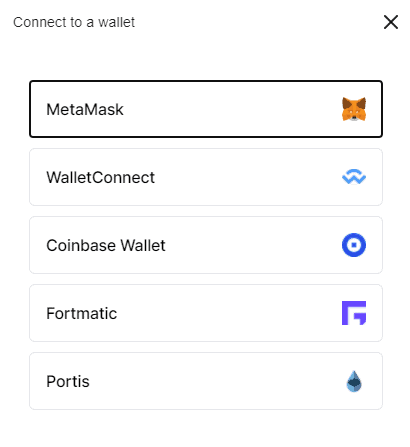
Sushi Swap has the option to use MetaMask, WalletConnect or many other non-custodial wallets. Pick the one of your choice.
Connect wallet
Give permission for Meta Mask or Wallet Connect to connect to Sushi Swap. Once you’re connected, you’re ready to add your tokens into the liquidity pools. (hummingbirddental.ca)
You’re presented with various liquidity pools (LPs). Each liquidity pool has a different annual percentage yield (APY).
In this example, I’ll contribute to the ETH-USDT pool. I add my USDT into the liquidity pool. In return, I’ll get a percentage of USDT and SUSHI tokens. Think of Sushi Swap as a “community revenue share” model.
To contribute to the liquidity pool, click “Approve USDT-ETH UNI-V2 LP” and give your Meta Mask permission to move your tokens into the liquidity pool.
Now what? You wait. The “SUSHI earned” box should populate with your earned SUSHI. You can withdraw your SUSHI token anytime by clicking on “Harvest”.
2020 roundup and new roadmap!
Many things have happened within the Sushiswap ecosystem in the last months: it is now time for a quick recap and to look at what the future will bring to this project!
The number of all the partnerships finalized by the protocol is countless, but one of the most important ones, if not the most important, is certainly the merger with Yearn. The news also sparked controversies: Sushiswap was still considered a sort of “copycat” of Uniswap by some, and when Andre Cronje (Yearn’s father) wrote an article on how it is difficult to build in Defi and how conversely it is easy for anyone to just copy other people’s code, this wasn’t seen as really coherent. The collaboration was born to allow the two teams to cooperate on Deriswap.
Nevertheless, Sushiswap has been evolving so much that, according to Mira Christanto (one of Messari’s data analysts) they have “put their past behind” and, not being backed by Venture Capitals, they can move faster than competitors. January has seen a real growth in Sushiswap’s TVL (now at $2.1 billion), mostly at the expense of Uniswap’s.
Among the important milestones in 2020, we find Onsen, the new Sushiswap liquidity mining incentivization program which replaces the old Menu of the week. It brings communities together into the ecosystem and allows voted tokens to become accredited and participate in the mining program. The website also has a new layout of and a lite version.
2021 Roadmap
As the new year has already begun, it is also interesting to have a look at what Sushiswap is working on for 2021. The team released a long and detailed roadmap in early January. Notable upgrades are the following:
Mirin will be the new upgraded version of Sushiswap’s V3 protocol. It will include many new features like franchised pools, double yield, dynamic yield rebalancing, and many more as you can read here.
Bentobox (which should have launched in January) was born in the team’s mind as a new Lending Platform. While they were was working on its code though, it became something more. In simple terms, it will be a single vault that holds all tokens for any protocols and future extensions. It will support several oracles and it will also benefit all the $SUSHI holders.
Miso (Minimal Initial Sushi Offering) will be a sort of token launchpad, designed to drive new projects’ launches on the platform. It will include crowd sale options, IDOs (Initial Dex Offering), auctions, and more. We could think of it as something similar to Binance’s launchpad.
As Ethereum fees are and will keep growing in the next future until ETH2 will be a reality, most platforms are studying alternative solutions for their users such as Layer 2 possibilities. Unlike Uniswap, which is working on Optimistic Rollups, Sushiswap decided to move in sync with the greater Yearn ecosystem and thus will probably offer Zk-rollups options.
Together with all these big news, Sushiswap is also planning to move to a new domain as the old one, in their view, is not enough to describe the diversity of the platform anymore. A transition to a fully decentralized governance structure is also planned by the end of 2021. Last but not least, Sushiswap has created a proposal page for people to express their ideas on what they would like to see on the platform. Everyone can be a chef is the place where you can voice your opinion if you like to suggest new ideas.
FAQs
Is it risky to provide liquidity to SushiSwap?
The pool could get hacked if the code isn’t audited. There have been cases of hackers draining funds from smart contracts. It helps if the code is audited by a reputable firm. In the case of SushiSwap, it has been given a “security review” (not an audit) by Quantstamp. 10 issues were identified but they do not appear to be fatal. Subsequently, Peckshield had completed an audit on SushiSwap. They found no critical or high severity issues relating to business logistics but 2 high severity opsec issues that need to be fixed through extra care with deployment.
What is the reward model of Sushi Swap?
0.25% go directly to the active liquidity providers and 0.05% gets converted back to sushi and is distributed to active SUSHI holders.
Decentralised Finance (DeFi) series: tutorials, guides and more
With content for both beginners and more advanced users, check out our YouTube DeFi series containing tutorials on the ESSENTIAL TOOLS you need for trading in the DeFi space e.g. MetaMask and Uniswap. As well as a deep dive into popular DeFi topics such as decentralized exchanges, borrowing-lending platforms and NFT marketplaces
More videos and articles are coming soon as part of our DeFi series, so be sure to SUBSCRIBE to our Youtube channel so you can be notified as soon as they come out!
Disclaimer: Cryptocurrency trading involves significant risks and may result in the loss of your capital. You should carefully consider whether trading cryptocurrencies is right for you in light of your financial condition and ability to bear financial risks. Cryptocurrency prices are highly volatile and can fluctuate widely in a short period of time. As such, trading cryptocurrencies may not be suitable for everyone. Additionally, storing cryptocurrencies on a centralized exchange carries inherent risks, including the potential for loss due to hacking, exchange collapse, or other security breaches. We strongly advise that you seek independent professional advice before engaging in any cryptocurrency trading activities and carefully consider the security measures in place when choosing or storing your cryptocurrencies on a cryptocurrency exchange.
The Graph ($GRT) is a decentralized and open-sourced indexing protocol for blockchain data. Developers can build and publish different APIs, which are referred to as subgraphs, and perform queries through the GraphQL.
The platform can easily be used to look for any Ethereum data conveniently through simple queries. This addresses the common problem faced by a lot of other blockchain indexing platforms.
Blockchain applications face difficulties in keeping properties like finality, chain reorganization, and security in their process of fulfilling query tasks. These are also potential complications that applications usually address, but unfortunately make the process of querying time-consuming. The Graph has a workaround for this, and it is built exactly for that purpose.
Through “subgraphs,” The Graph indexes blockchain data, which users can access via the GraphQL API. According to the team, they will make it fully decentralized in the future, where more nodes will be involved and made responsible for maintaining the index.
The interest for the platform is steadily growing. In fact, they hit over a billion queries last June 2020. This was right at the time when decentralized finance was also gaining much institutional attention.
Background
Yaniv Tal, co-founder and CEO of The Graph, together with his team, has created an indexing protocol meant to ease the process of accessing blockchain data. Tal and his co-founders had personally witnessed themselves how difficult it was to actually create new applications on the Ethereum blockchain.
Thanks to their experience on applications, they have found out that there is actually no decentralized indexing and querying softwares yet for blockchain. The problem back then was that developers had to come up with their own method to gather data and transform them from different sources.
The mission of the platform, which Tal and his team developed, is to help create applications that require no servers and make Web3 accessible to everyone.
How Does The Graph Index Data?
To index Ethereum-based data, The Graph uses the “subgraph manifest.” This refers to the description of a subgraph containing data about smart contracts, blockchain events, and the procedure in mapping event data with one another, before they are all kept in the platform’s database.
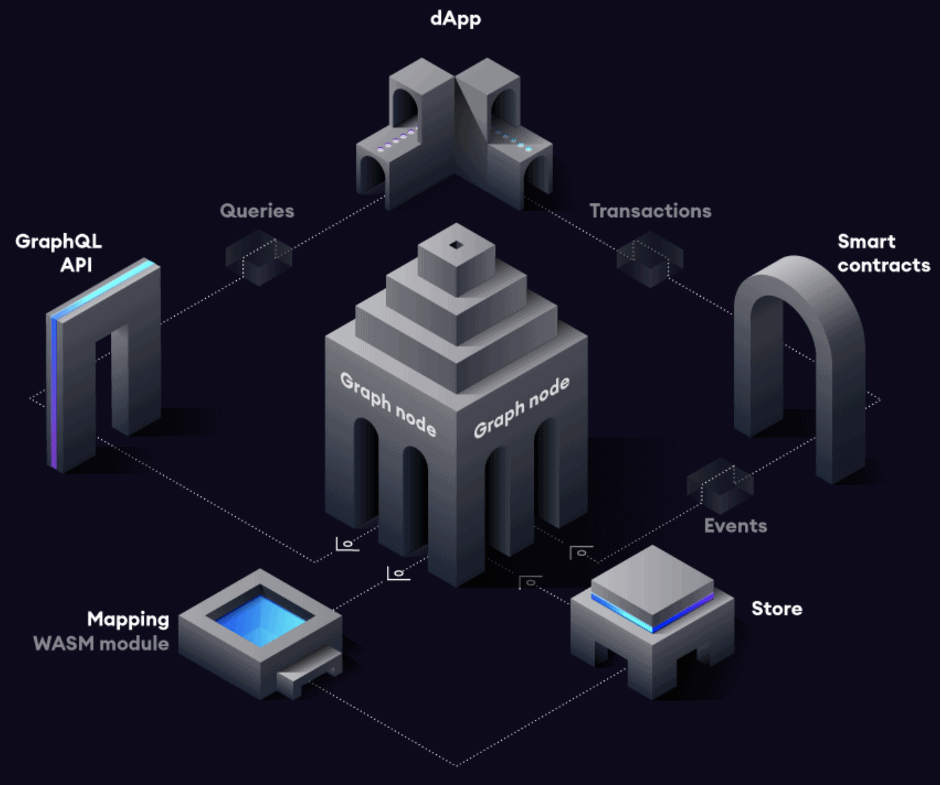
The flow of the data from transactions, subgraph manifests, and the database follows a particular structure. All of it begins with decentralized applications that are adding data to the Ethereum blockchain through the help of smart contracts.
All of that data will contain a record of all events and transactions up until the point that they have achieved finality. Then comes the Graph Node, which scans the whole blockchain database, gathers new data, and filters out those that are relevant to the queries that users make. To make the indexing much easier, it identifies every information that answers the questions from subgraphs.
GraphQL is the link between blockchain data and the application that a user wants to provide it with. But then again, it is through the Graph Node that users can deliver searches to the platform. After the whole process, users can finally look at the results of their query from their applications.
Basically, this is how the cycle of data query and indexing works in the platform. Users can refer to the Graph Explorer to scan through the subgraphs that are already in the platform. Each of these subgraphs have a playground where users can perform queries through GraphQL.
As of latest, The Graph can support the indexing of data coming from Ethereum, IPFS, and PoA networks. There are more networks that the platform will support in the future. But right now, they already have more than 2,300 subgraphs deployed, which developers for applications utilize. Some of these applications are AAVE, Aragon, Balancer, DAOstack, Uniswap, Synthetix, and many others.
There is a lot of institutional support for The Graph network. Michael Anderson of Framework Ventures, said in a press release that they “couldn’t be happier to back Yaniv and the team, and we look forward to helping grow the decentralized network when it launches.”
Hayden Adams of Uniswap also shared how useful the platform was for their analytics needs: “As a company we don’t manage or run our own databases. … Right now it’s pretty difficult to get historic data from the Ethereum blockchain in an efficient way.”
Their plan, apart from expanding to other blockchains soon, is to make it community-owned and governed in the future. This is also in response to the shift of many blockchain applications to a decentralized model of governance.
Key Roles
The platform’s whole ecosystem is composed of the following:
Consumers – These are the users who pay indexers for their searches. It could also be web services or any other software linked with The Graph.
Indexers – These are the nodes that maintain the indexing function of the platform.
Curators – Using GRTs, curators identify to the subgraphs the information that is valuable for the platform’s index.
Delegators – These are other stakers who delegate their GRT to existing indexers and earn a portion of the rewards run by nodes.
Fishermen – They check whether the network’s response to queries is accurate.
Arbitrators – They decide whether an Indexer is malicious or not.
The Graph Council
The Graph plans to decentralize its governance in the future. This will most likely be similar with MakerDAO and Compound. At the point of the protocol’s maturity, the team plans to launch a Decentralized Autonomous Organizations (DAO) that would allow core interest groups to participate in important protocol decisions.
Similar to other DAOs, the Graph Council, which will be the governing body for the technical parameters of the protocol, is also in charge of how The Graph Foundation allocates its native, utility tokens.
Among their basic functions include decisions on allocating grants and ecosystem funding, protocol upgrades, protocol parameters, and other emergency decisions.
GRT Token ($GRT)
The Graph Token, or $GRT, is its native ERC-20 based token, which can serve as a medium of exchange and the reward distributed to community participants who function as Indexers, Curators, and Delegators.
GRT also has a vesting and distribution schedule ranging between 6 months to 10 years depending on the bucket. Around 12.5% of the total token supply (i.e. 1,224,999,438 GRT) is expected to be in circulation at launch. However this figure is exclusive of stakeable but locked tokens.
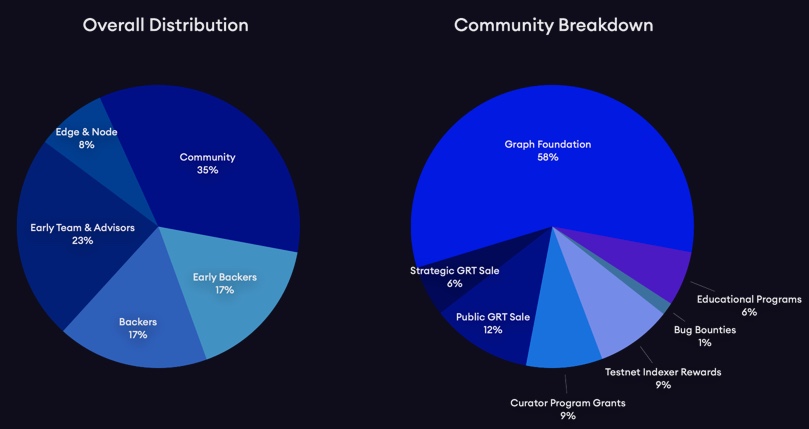
GRT token distribution at mainnet launch
The Graph launched its mainnet at 9:00a.m. (PT) on 17th December 2020. Upon launch, GRT has been distributed to all of the participants of the public sale. Members of The Graph’s Curator Program also received an initial USD $1,000 worth in rewards, with the remainder to be distributed to them on a quarterly basis based on their contributions to the Program.
The Graph Foundation also received around 20% of the supply for the future development of The Graph. In particular, contributors who want to help building on The Graph can apply to their Grants Program, around 1% of the total supply of GRT will be allocated to support these participants in 2021.
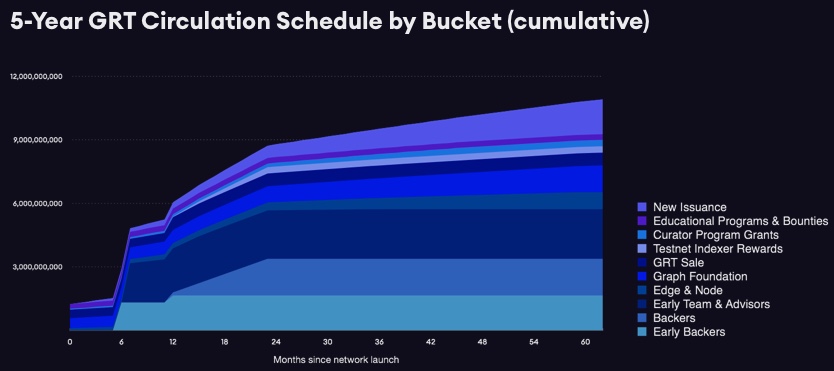
Here’s a graph showing the GRT circulation over the course of 5 years from the date of launch (i.e. 17th December 2020 at 9:00a.m. PT)
5-year GRT circulation schedule by Bucket (Image source: The Graph)
Indexers that assisted during the Testnet phase have also ben rewarded between USD$10,000 to USD$100,000 in GRT as a reward for their contributions.
In addition, around 2% of the total GRT has been granted to several Education Programs and loans totalling around 2.5% had been made to independent ecosystem partners.
Indexer Staking
In order for users to stake in the nodes that operate the whole platform and sell their services in the query market, they have to lock their GRT. In return, they are given financial rewards. If the indexers work maliciously, like altering data intentionally, the GRT that they staked will be slashed.
Mainnet now live!
The Graph Network launched its main net on 17th December 2020 after 3 years of development! According to the team the mainnet launch includes the following components: Deployment of The Graph Network contracts on Ethereum mainnet, deployment of the GRT contract, distribution of GRT to takeovers, launch of the Bug County Program and new docs for network roles.
With the mainnet launch, Indexers will first stress test and improve performance before supporting real query volume, which will be upwards of 5,000 queries per second. Of course, there will be rewards for Indexers who will now begin earning on-chain indexing rewards and query fees.
Graph Roadmap: What’s next?
Now that mainnet has launched, The Graph will continue building. The Team has stated that the Graph Foundation will work on building a production-ready Graph Explorer dApp and Gateway that will support all network contributors.
The Graph is also open to any individuals or third-parties that want to build for the network and as mentioned previously, they an apply to the Grants Program or collaborate with other community contributors.
Conclusion
Looking at the current boom of the DeFi space, we can see how important it is for developers to be able to freely access blockchain data. Making the process faster and less difficult for everyone could potentially influence the growth of the space as well as its reliability, security, and capacity.
Everyone saw the need to create a bridge of information between applications and blockchain data. The Graph sought out to answer that.
And with the deployment of smart contracts that depend on user data, The Graph has proven itself to be easy to use, cost-efficient, and fast. The platform is seen as a promising tool to empower everyone in the community, especially those who are developing more use cases for the blockchain.
Decentralised Finance (DeFi) series: tutorials, guides and more
With content for both beginners and more advanced users, check out our YouTube DeFi series containing tutorials on the ESSENTIAL TOOLS you need for trading in the DeFi space e.g. MetaMask and Uniswap. As well as a deep dive into popular DeFi topics such as decentralized exchanges, borrowing-lending platforms and NFT marketplaces
More videos and articles are coming soon as part of our DeFi series, so be sure to SUBSCRIBE to our Youtube channel so you can be notified as soon as they come out!
Disclaimer: Cryptocurrency trading involves significant risks and may result in the loss of your capital. You should carefully consider whether trading cryptocurrencies is right for you in light of your financial condition and ability to bear financial risks. Cryptocurrency prices are highly volatile and can fluctuate widely in a short period of time. As such, trading cryptocurrencies may not be suitable for everyone. Additionally, storing cryptocurrencies on a centralized exchange carries inherent risks, including the potential for loss due to hacking, exchange collapse, or other security breaches. We strongly advise that you seek independent professional advice before engaging in any cryptocurrency trading activities and carefully consider the security measures in place when choosing or storing your cryptocurrencies on a cryptocurrency exchange.
ERC (Ethereum Request for Comment) token standards are built upon and utilise the Ethereum blockchain. Most of us have only heard about the vastly used ERC-20, while becoming more familiar with the ERC-721 and ERC-1155 token standards thanks to the growing adoption of NFTs (Non-Fungible Tokens) by upcoming projects. This article gives an overview of what are ERC tokens, their various types, and functions.
Summary
ERC tokens are special forms of smart contracts that utilise the Ethereum blockchain, rather than having their own blockchain like Bitcoin.
They can have different functions and even a combination of features.
ERC tokens can be Fungible, Non-fungible, and Semi-fungible.
What is a token and how do we classify them?
First of all, ‘tokens‘ are programmable digital units of value that are recorded on a distributed ledger protocol such as a blockchain. Basically, ERC20 tokens are special forms of smart contracts that utilize Ethereum’s blockchain. They can also be described as digital assets which are not the main currency of that blockchain. While $ETH and $BTC both have their blockchain and are thus far considered as coins, tokens don’t.
There are different types of tokens. Utility tokens differ from the rest because they usually offer a wider functionality than, for example, a means of payment (coins, like $BTC) or voting power on a platform (such as governance tokens, like $UNI). They can combine multiple purposes, are integrated into an existing protocol and used to access its services. They also provide network activity, which ensures strength of the platform’s economy.
To easily understand how they fit into the blockchain ecosystem, we need to understand how Ethereum works first: we can think of it as an operating system on top of which applications (smart contracts) can be built (written), just like developers build applications for Android and iOS. One difference being that applications on Ethereum can be decentralized (Dapps). Once we have these platforms, we can (if we want) create tokens, each time choosing the most appropriate standard for our purpose.
Years ago, when there was no standard in use, it was far more complicated for developers to make smart contracts interact with each other; they had to create specific implementation standards to develop a token and launch it on Ethereum’s network. Then, the ERC-20 came out and that heavily simplified the process.
Another distinction is between Fungible and Non Fungible tokens.
Fungible Tokens
In this case, each token is equivalent to all the others and they are interchangeable (1 $BTC will always be equal to any other 1 $BTC).
ERC-20
First proposed in 2015, it’s the industry standard and most accepted one. It makes the initial distribution of tokens extremely easy, so it became massively used in the 2017 ICOs craze. The ERC-20 contracts are composed of 6 mandatory functions and 3 optional ones.
ERC-20 contracts
6 mandatory functions:
balanceOf(): keeps track of the balance in each user wallet
totalSupply(): shows the current total supply in circulation
transfer (): lets the owner send a specific amount to another address
transferFrom(): allows a smart contract to automate the transfer process and send a given amount of the token on behalf of the owner
approve(): approves the withdrawal of tokens from the owner’s address to the receiving address. It also guarantees that nobody could create more tokens out of nothing, keeping the supply under control
allowance(): makes sure that the owner has at least as many tokens as the amount set in the approve function; the transactions added to the blockchain have been proved valid
3 optional functions:
name(): pretty self explanatory!
symbol(): 3-4 letter abbreviation
decimals(): it is impossible to write decimal places in Solidity- only whole numbers, so this function is needed. Most tokens use 18 decimals
How to send ERC-20 tokens?
There are two ways of sending ERC-20 tokens, depending on if you want to send them directly or delegate the function to a smart contract. You can either:
call the transfer() function to send tokens to another wallet address
call the approve() function and then transferfrom() from the receiver contract
Besides the ease of use and the popularity that this standard immediately gained among the community, its main flaw soon became obvious, causing millions of dollars worth of tokens to be lost forever in smart contracts.
Limitations of ERC-20 tokens and what are wrapped tokens?
What happens if you simply use the transfer() function to send tokens to a smart contract which is not made to receive them?
The transaction will succeed and these tokens will be credited to the receiver address, butthey won’t be recognized by the recipient and they will remain there forever, unusable.
Another limitation is that since $ETH itself was obviously created before the ERC-20 standard was even developed, it is not compliant with it (nor with other standards). That is why to interact with many contracts, we need to “wrap” $ETH into $WETH (wrapped ether, which IS an ERC-20 token, pegged to $ETH 1:1).
To solve the various flaws, new standards were proposed. The most famous ones are the following.
ERC-223
Summary:
prevents funds to be lost
half as expensive
backwards compatible
This standard was proposed by a Reddit user known as “Dexaran”; it focuses on security and tries to fix the main flaw of its predecessor, by using a unique, new transfer() function, which allows tokens to be sent to either a personal address or a smart contract. Moreover, it includes a tokenFallback() function that checks the receiving contract for the same function.
Basically, if the receiver is a regular address (not a contract), the transfer will be similar to the ERC-20 one, while if the receiver is a contract, the tokenFallback() function will be triggered. If the receiving contract does not have this function, the transaction will fail but all the funds will be returned to the sender address.
Simplifying the transfer and reducing it to just one single step, the process will also be cheaper (less gas fees!). The ERC-223 standard is backwards compatible with the ERC-20, as it keeps all of the original functionalities and solves the biggest issues. The ChainLink ($LINK) token has been described by its developers as “an ERC20 token, with the additional ERC223 ‘transfer and call’ functionality of transfer, allowing tokens to be received and processed by contracts within a single transaction”.
The ERC-223 standard has never been finalized.
ERC-777
Summary:
makes transactions smoother
allows for approved operators
standard for minting/burning tokens
backwards compatible with ERC-20
This standard was developed by Jacques Dafflon and Jordi Baylina, it is similar to ERC-20 and it relies upon the ERC-1820. Before that, developers couldn’t identify the functions which can be implemented by smart contracts. By creating a central registry of contracts on the network, the ERC-777 can use it to identify the interfaces a smart contract uses.
Its uniqueness is the friction reduction in transactions. It also defines a new set of functions, for example it uses send() instead of transfer(), authoriseOperator() instead of approve(), tokenReceived() handler function instead of tokenFallback().
It also allows for more customization, a list of approved operators so that people can approve smart contracts to move tokens on their behalf, and creates a standard for minting and burning tokens (very useful for particular projects).
A pure ERC-777 is not compatible with ERC-20 but the standard described how to make it compatible.
The ERC-777 standard became finalized on May 6th, 2019.
Other fungible tokens
There have been many other proposals combining some aspects of different standards into each other.
ERC-827 combines some of the advantages of ERC-223 and ERC-20 standards, it enables token transfer for a 3rd party to spend it
ERC-664 is mainly centered on modularity and makes it possible to update token contracts
ERC-677 provides a safe way for new contracts to transfer tokens to external contracts
ERC-621 can increase or decrease the token supply
ERC-884 allows companies to use blockchain to maintain share registries
Non Fungible Tokens (NFTs)
These tokens are unique: each one can have a different value ant they are not replaceable. NFTs enable the tokenization of individual assets. They can often be found in games or you can imagine them as digital pieces of art, real estate… basically anything you like. Unique tokens can be further modified adding new “tools”, hence increasing their value overtime (like new bodyparts on a racing car). Check out our video on NFTs:
Non-fungible tokens explained
ERC-721
It became famous with CryptoKitties. The contract is composed by 8 functions plus 2 optional ones. Most of them are the same or similar to the Fungible counterparts, with few important differences.
ERC-721 contracts
8 mandatory functions:
name()
symbol()
totalSupply()
balanceOf()
ownerOf(): retrieves the address that owns whichever NFT ID number is searched; ownership is defined by simply having the token
approve()
takeOwnership(): transfer the tokens from another address that currently holds them
transfer()
2 optional functions:
tokenOfOwnerByIndex(): allows NFT IDs to be searched through a list of tokens owned by the user; it is necessary if we want more ntfs
tokenMetadata( ): retrieves the metadata, i.e. info for identification
While when new ERC-20 tokens are created, the supply simply increases. In this case, things are more complicated. We have to monitor the metadata, and that is expensive in gas fees. ERC-721 defines a storing method.
A problem with this standard is that if we want to send more NFTs to someone, we will need as many transactions as the number of tokens sent.
Along with the ERC-721, a few other Non Fungible standards have been proposed, like the ERC-875 and the ERC-998.
Semi Fungible Tokens (SFTs)
In some cases, NFTs and FTs do not provide the required level of flexibility that is necessary to build new projects. As we have said, Fungible tokens are all “equals” while Non Fungible ones are unique.
But what if we need something that is neither Fungible nor Non Fungible? Like seat tickets?
Seat tickets (or supermarket vouchers, lottery tickets etc.) are 99% equal to on another with a very small difference, like a serial number that makes them unique, preventing double-spending/selling. When we buy a seat ticket, we don’t want someone else to have the same exact token and be able to use it if he arrives before us at the cinema.
In these circumstances Semi Fungible Tokens come in help: they hold their value until they are sold, changing from Fungible to not Fungible anymore.
In all the other standards we have considered, we need to deploy a different contract for each type of token (one contract for all the same ERC-20s, one contract for each unique NFT). It is like being at the supermarket and not being able to buy all of the groceries we want at the same time, having to proceed one item after the other, from shelf to register, continuously. If we want to be able to buy a bunch of stuff at the same time, we need a new standard, and that is the ERC-1155. It allows for different “items” to be stored and created in the same contract (FTs, SFTs and NFTs), with the least possible amount of data;it is cheaper and more convenient.
For example, in a game we may exchange a currency (ERC-20) and/or NFTs (ERC-721) with other gamers; the ERC-1155 makes it possible. Moreover, it can execute a deterministic smart contract function by simply sending a token to an address (i.e. sending a token to an exchange address, the exchange could immediately return another token back to the sender’s address).
Practically, a single smart contract can mint infinite tokens forever (and it allows to save fees!)
Overall, among the Fungible tokens, some people think that the ERC-777 should be the designated one to become widely adopted. It offers, for example, more ways to protect our funds. Nevertheless, none of the above standards is without flaws and inherent risks. As a matter of fact, there are multiple reasons why ERC-20 is still the most popular one, and we can’t forget to mention that a new standard would create a lot of issues and interoperability problems, at least at the beginning.
If we consider the Non Fungible world, we are yet to see an explosion in adoption, but more and more platforms and games are coming out and it will probably be one of the trends of the next years. There are different platforms where you can go and buy collectibles directly with your Ethereum wallet (such as Metamask). One of the most famous and used is Rarible.
Only time will tell us which will be the next standard in use; proposing a solution and having the community embrace it are two very different things.
Disclaimer: Cryptocurrency trading involves significant risks and may result in the loss of your capital. You should carefully consider whether trading cryptocurrencies is right for you in light of your financial condition and ability to bear financial risks. Cryptocurrency prices are highly volatile and can fluctuate widely in a short period of time. As such, trading cryptocurrencies may not be suitable for everyone. Additionally, storing cryptocurrencies on a centralized exchange carries inherent risks, including the potential for loss due to hacking, exchange collapse, or other security breaches. We strongly advise that you seek independent professional advice before engaging in any cryptocurrency trading activities and carefully consider the security measures in place when choosing or storing your cryptocurrencies on a cryptocurrency exchange.