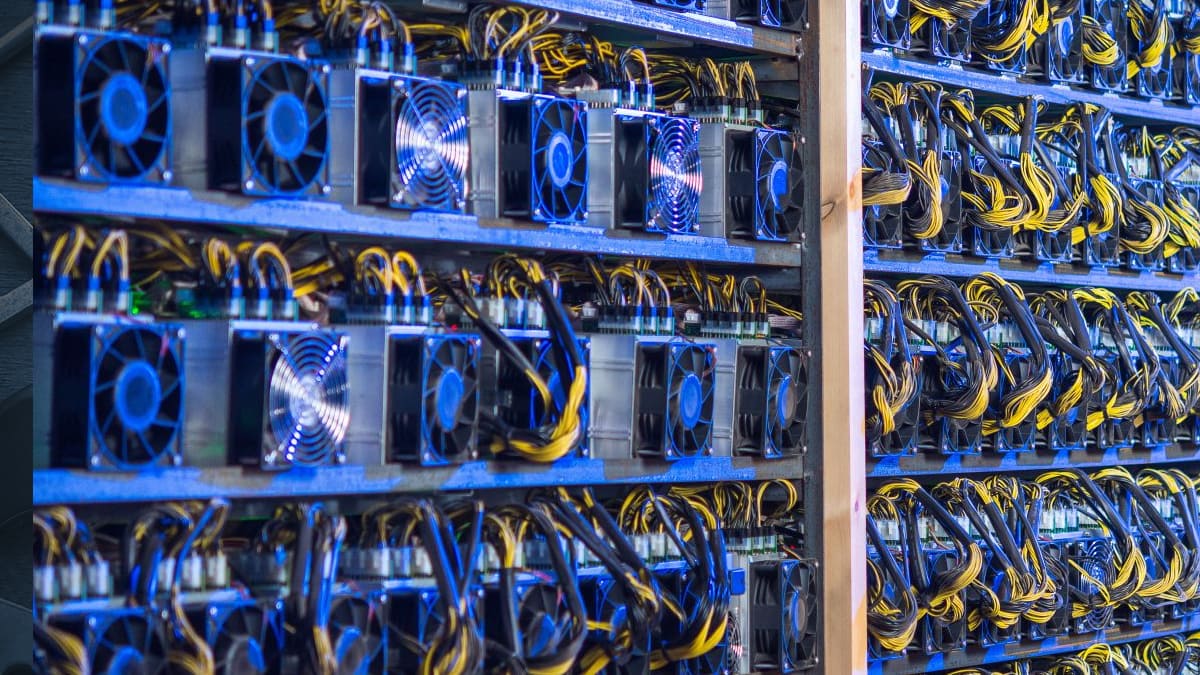
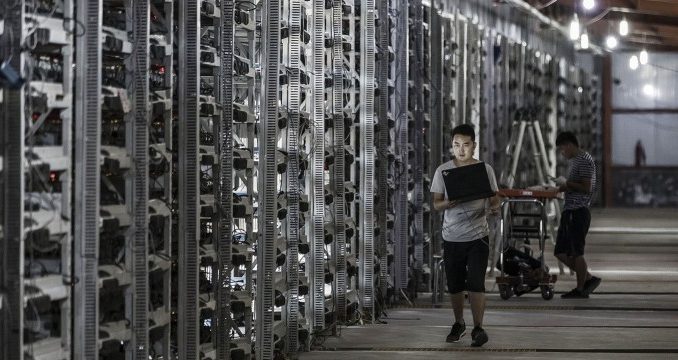
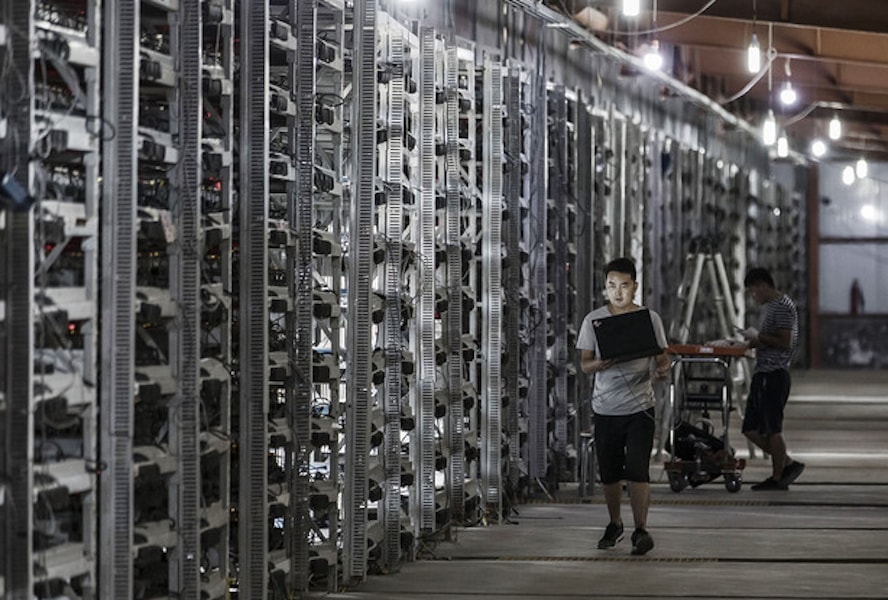
The cryptocurrency mining and hardware production company Ebang has just filed for a $100 million USD initial public offering with the US SEC. This filing not only shows the there is a market for Bitcoin mining, but that the industry in high demand. Ebang’s annual revenue is $109 million last year, despite falling cryptocurrency prices. The annual production of Bitcoin is worth $3.5 Billion USD at current Prices. Miners need new hardware as new chip technologies, such as those produced by Ebang, is both more powerful and energy efficient. In 2019, 82% of Ebang’s revenue came from application-specific integrated circuit (ASIC) chips.
Moving to 10nm production is expensive
One of the reasons for Ebang going public is to move to even more advanced technology and production techniques. In chip manufacturing, moving to smaller node sizes, such as 10nm makes the miner more powerful and power efficient. Ebang’s new mining chip, the DW1233 is independently developed and based on the new 10nm production process.
Although the Bitcoin price started to recover in the second quarter of 2019, our operations generally lag behind the increase of Bitcoin price.
Ebang Press Release
Failed IPOs and Second Chances
This is Ebang’s second attempt at an initial public offering, after they failed to file for an IPO with the Hong Kong Stock Exchange (HKEX) in 2018. The initial IPO was not granted by the HKSE after 6 months of application, indicating it was not accepted by the HKEX. This time around Ebang has a smaller raise of $100 Million USD as opposed to the first filing, which valued the company at $1 Billion dollars.
Cryptocurrency mining ecosystem
Large cryptocurrency mining hardware manufacturers have all been seeking Initial Public Offerings as a method to raise capital for expansion. Part of the reason is the growing market Bitcoin and cryptocurrency ecosystem.
2020 is a huge year for Bitcoin mining. Huge changes to the mining ecosystem – changes that will spark another “gold rush” for mining. This will be spearheaded by two factors – the release of new more efficient mining hardware known as ASICs and Bitcoin halvening. The release of new hardware will give new players a bigger advantage in mining due to the efficiency factor – new ASICs generate more hashpower with less power. (https://www.sliderrevolution.com) We’re already seeing large funds like Fidelity Investments building large mega-watt mining facilities in North America and other continents. You can hare about the North America mining explosion in this podcast. This marks the return of mining as a major investment opportunity this year.
Table of Contents
Cryptocurrency Mining is a $6 Billion+ USD per year industry
Sizes of Exchange, Mining, DeFi and ICO industries respectively
One well-kept secret of the mining industry is the huge profits being generated by cryptocurrency miners (Bitcoin, Ethereum, DASH and Monero mining). Let’s start off with an industry Fact – every day $19,000,000+ USD dollars worth of cryptocurrencies are being produced by miners across the world. This means a total of $6.8 Billion dollars will be mined in 2020 alone. The biggest currency being mined is Bitcoin – with a 1,800 bitcoin being produced per day totalling to a value of $15,833,340 USD. To put everything into perspective, the ICOs only raised a total of $371 Million in 2019 according to icodata.io. Mining is currently the second largest industry behind exchanges (source: Bloomberg).
Miners upgrading and replacing older hardware (often confused with “miner capitulation”)
Ironically the miners have perpetuated myths such
as “mining is not profitable” or “the bitcoin mining death spiral” to deter
new players coming into this profitable space. Many reports in 2019 have
featured erroneous calculations that Bitcoin mining is not profitable. This is
because researchers have incorrectly assumed that miners are getting
expensive commercial electricity costs of $0.07-12 cents per kilo-watt
hour. This is far from the truth – mining operations receive considerable
discounts as they purchase low priority power (meaning they will get cut off
grid in the event of a surge in power usage). The actual figure is in the range
of $0.01 – $0.03 per kw/h. This means miners are generating large amounts of
profit. It is the biggest industry in the blockchain space, and yet it is
surrounded by both mystery and false information.
New
Hardware (ASICs) is game changing
New high efficiency Bitcoin mining hardware is coming in 2020 will be a huge game changer. Bitmain will be releasing the new Antminer s19 based on the 7nm manufacturing process. Competing ASIC manufactures are also making new chips, with Innosilicon and Canaan hot on the heels. This die shrink increase the hashpower of chips whilst reducing power consumption at the same time. These two factors mean these new units will be more efficient – the biggest factor contributing to Bitcoin mining profitability.
Hashr8 – New MiningOS
New operating systems dedicated for mining cryptocurrencies such as Hashr8 are also being launched this year. These OSes will make it easier for commercial, enthusiast and retail miners to improve mining efficiency and management. This is a huge positive trend for the industry as a whole as it makes professional tools mainstream and accessible to the general public. This will level the playing field and reduce the gap between large-scale miners.
Why does Bitcoin always “pump” in short periods of time? Can we benefit on this type of price action. Are OTC Bitcoin trading volume flows responsible for this type of price action and how do we learn about Over-the-Counter trading.
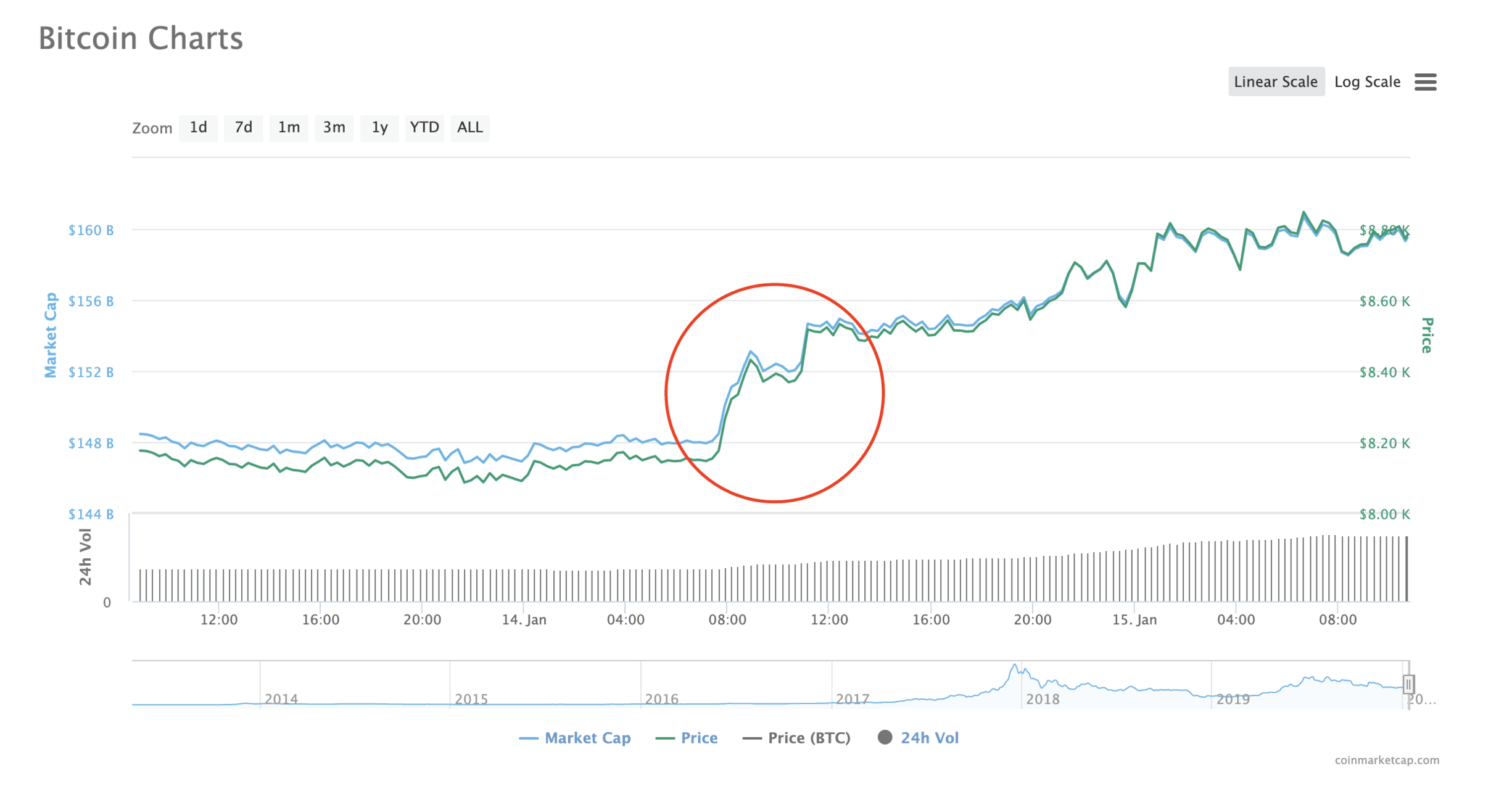
In this article, we’ll tackle one of the greatest mysteries in the Bitcoin and cryptocurrency investing space – namely why does Bitcoin prices have drastic price movements in short bursts of time. This type of movement is almost commonplace in Cryptocurrency investing, for example just today Bitcoin prices moved from $8150 to $8450, then to $8800 in the space of 4 hours, with two big green candles leading the charge. What’s also surprising is that there is no fundamental reason to cause these movements – they are not triggered by a single world or political event. In this article we’ll look at the must possible reason behind what’s happening.
Let’s get one thing out of the way – sudden Bitcoin pumps are not executed by a large group of people with small amounts of money. If this was the case, this group of people would have to be well organised, and information about such pumps are bound to leak out. We would know well in advance of the event happening. It would be common knowledge – especially considering how fast information spreads.
This leads to the next conclusion – Bitcoin pumps are executed by small groups of people with access to the OTC market. We already know the world has high wealth concentration – 1% of the world has 99% of the wealth. The 1% can easily transact enough fiat to cause these sudden shifts in the price intentionally or otherwise.
This theory is validated by reports of strong OTC volume flow in the past few weeks. This is across all trading desks around the world, especially with strong volume coming out of China and Southeast Asia. Recently reports have surfaced that OTC desks such as Genesis Block are expanding and opening new offices in Thailand to deal with the extra volume.
China has start a country wide initiative to rapidly adopt Blockchain Technology and ‘urgently’ develop use cases. China’s President Xi Jinping personally appealed for a greater urgency to develop blockchain in-front of the Communist Party of China Central Committee. This sentiment was echoed in by state media People’s Daily published a front page article on “Placing Blockchain as one of the countries core initiatives, with a target on key breakthroughs“. On top of this, national TV station CCTV-2 had various news segments dedicated to discussion blockchain technology – with a key emphasis that Blockchain, not Bitcoin is China’s key focus.
China’s leading newspaper, People’s Daily, calls for Blockchain Adoption
This huge initiative to push Blockchain is clearly related to the launch of China’s National Digital Currency – “DCEP” (Digitial Currency / Electronic Payment). This new currency is issued by the People’s Bank of China (PBoC), and will act as both a replacement for Researve Money (M0) and as a digital cash. DCEP will initially be rolled out to banks affiliated with PBoC and eventually to the general public via Tencent and Alibaba.
It is important to point out the DCEP will be a centralized & private blockchain. New currency on the network will be issued by the PBoC via authority from the Chinese Government. There will be no public participation in the network, unlike the decentralized Bitcoin network which uses Blockchain to form an open public consensus.
Blockchain, Not Bitcoin
One of the key areas of contention in the cryptocurrency space is whether a private or centralized Blockchains have value.
Opinion 1: Bitcoin, not Blockchain
Opinion 2: Blockchain, not Bitcoin
Proponents of Bitcoin argue that Blockchain’s key value is that it allows for a decentralized network, a leaderless network where anyone can join, participate and verify transactions. The argument is that if the purpose of a Blockchain is record transactions like a database, centralized databases like MySQL or MongolDB will have higher efficiency than Blockchain. Thus, it would only make sense to use Blockchain when there is a need for public open consensus. Following this argument, cryptocurrencies like Bitcoin and Ethereum are neccessary for a Blockchain to function, as they play an intrinsic role in rewarding good actors on the network.
Proponents of Blockchain argue that the Blockchain offers security and transparency, giving it a distinct advantage over traditional databases. China takes this argument one step further and actively discourages the use of cryptocurrencies and trading in cryptocurrencies (eg. Cryptocurrency exchanges are banned in China).
Government condones “Air Coins” and Cryptocurrency Speculation
State media People’s Daily have explicitly condoned cryptocurrency speculation and brought accusations against “air currency”. Air Currency, or air coins, is a chinese colloquial term used for cryptocurrencies that have no intrinsic value, very much like air. This move is designed to counter-act the surge in rushed venture capital investments into different cryptocurrencies in China, many of which don’t have a real use-case. In addition, the article explicitly called for illegal transactions and money laundering to be rectified, suggesting further enforcement actions against none state regulated cryptocurrencies. This heavy enforcement can be seen as a “stick” measure to push users away from decentralized cryptocurrencies into the centralized national currency, DCEP.
“Blockchain is a Scam” is Censored by Social Media
WeChat blocks articles calling Blockchain a Scam
Experiments done by @cn_Ledger and other Chinese media sources have found that articles calling Blockchain a “scam” are actively being censored in China. Anyone posting these articles will find that they are quickly deleted and may face potential account suspensions. This type of media content control is standard in China once the Central Party issues a particular doctrine. Media platforms are quick to comply, or they will risk the removal of their ICP license.
Cryptocurrency Mining is no longer “Banned” in China
The Chinese Government is no longer pushing for the elimination of cryptocurrency mining (such as Bitcoin and Ethereum mining). This is a complete 180° reversal of government policy will take effect on 1 Jan 2020, meaning mining will a legal and taxable industry in China. Previously “Cryptocurrency Mining” was part of a list of industries to be eliminated. This change comes directly from the new edition of China’s Industrial Structure Adjustment Guidance Catalog, where an updated revision no longer mentions cryptocurrency mining as an industry to be phased out.
Traditionally China has always played a major role in Bitcoin, Ethereum, Litecoin and DASH mining. This is mainly due to the abundant supply of cheap electricity in China (especially in the Sichuan and Mongolian regions), where electricity costs can go as low was $0.02 USD per kw/h. To find more about Bitcoin mining, check out our full Bitcoin mining guide.
Overall this policy reversal sends strong positive signals about cryptocurrencies in China. This is a clear indicator that the Chinese Government recognizes the importance of mining and it’s role in decentralized public Blockchains. Such policy changes suggest a positive future where other policies halting cryptocurrency development could be reversed.
Cryptocurrency trading is still banned
China has banned cryptocurrency trading since 2017. The government has taken down chinese operation of big fiat exchanges such as OKex, Huobi and BTChina. Chinese exchanges no longer have fiat bank accounts. As users move to peer to peer trading. Alipay has made it clear that it will not tolerate crypto trading on it’s platform.
If any transactions are identified as being related to bitcoin or other virtual currencies, @Alipay immediately stops the relevant payment services.
What about Chinese Blockchain projects like Vechain and NEO
Whilst China’s Blockchain Initiative explicitly discourages the speculation in cryptocurrencies – Blockchain projects are thriving in China. This is a Cryptocurrency is a core part of Blockchain – Satoshi Nakamoto created Bitcoin and Blockchain together in his 2009 white paper. So whilst the Publications by the central government tries the downplay cryptocurrency speculation, every public cryptocurrency network must have an associated platform token.
Having the Blockchain initiative being pushed forward will greatly help the adoption of projects like Vechain in China. At the end of the day, the government validated the value proposition of Blockchain, answering many skeptics who are critical of Blockchain’s real life use case.