
The next wave of crypto isn’t about humans trading tokens. It’s about AI agents transacting with each other — autonomously, at scale, without human oversight on every deal. The problem? There’s no infrastructure to make that trustworthy. KAMIYO is building it.
What Is KAMIYO?
KAMIYO is an on-chain trust and settlement protocol designed specifically for autonomous AI agents. The core trust, escrow, and dispute logic is built Solana-first, with Base support appearing in the x402 payment rails layer. It gives agents the primitives they need to transact at scale: verifiable identities, escrow-backed payments, oracle-verified quality checks, and private dispute resolution.
Think of it as the legal and financial rails for the agentic economy — the layer that answers the question: “How do two AI agents that have never met trust each other enough to exchange value?”
The Problem It Solves
As AI agents become capable of hiring other agents, paying for services, and executing multi-step workflows autonomously, the existing financial infrastructure breaks down. Traditional smart contracts are too rigid. Centralized payment processors require human accounts. There’s no reputation system for agents, no way to verify quality of work, and no dispute mechanism that doesn’t require human intervention.
KAMIYO addresses all of this at the protocol level.
KAMIYO Core Architecture
Stake-Backed Agent Identities
Every agent on KAMIYO registers with on-chain stake as collateral. This isn’t just identity — it’s skin in the game. Agents that behave badly lose their stake. The reputation system evolves on-chain over time, creating a verifiable track record any counterparty can query before transacting.
Escrow Agreements with Time-Locks
Payments are locked in PDA-based escrow contracts with configurable time-locks. The standard path is a direct agent/provider release — funds move when both parties confirm the work is done. If a dispute is raised, finalization is handled by an on-chain registered-oracle quorum:
import { KamiyoClient } from ‘@kamiyo/sdk’;
import BN from ‘bn.js’;const client = new KamiyoClient({ connection, wallet });
// Create agent identity with stake
await client.createAgent({
name: ‘TradingBot’,
stakeAmount: new BN(500_000_000) // 0.5 SOL
});// Lock payment in escrow
const agreement = await client.createAgreement({
provider: providerPubkey,
amount: new BN(100_000_000), // 0.1 SOL
timeLockSeconds: new BN(86400),
transactionId: ‘order-123’
});// Release on success
await client.releaseFunds(agreement.id, providerPubkey);// Or escalate to dispute — resolved by oracle quorum
await client.markDisputed(agreement.id);
Oracle-Assisted Dispute Resolution
When disputes are escalated, KAMIYO’s on-chain registered oracle quorum finalizes the outcome. OriginTrail’s Decentralized Knowledge Graph (DKG) is complementary tooling — it provides semantic, AI-readable provenance records that agents and oracles can query, but it is not a mandatory consensus gate on every escrow release.
The dispute vote flow uses commit-reveal combined with signature verification. The repository also includes ZK components (Noir/Groth16 circuits) for future cryptographic enforcement, but the current main escrow and dispute path runs on commit-reveal and on-chain signature verification.
Both oracles must agree before escrow releases. This dual-layer approach prevents a single point of failure or manipulation.
Meishi Compliance Passports
KAMIYO publishes on-chain compliance records — called Meishi — directly to OriginTrail’s Decentralized Knowledge Graph. These are tamper-proof, semantic, AI-native records covering:
• Agent identity and credentials
• Spending mandates and limits
• Full transaction history
• Quality assertions
• Dispute records
Any AI agent can query this audit trail in real time, making KAMIYO’s trust layer genuinely interoperable across the ecosystem.
Technical Stack of KAMIYO
The KAMIYO monorepo on GitHub is a serious engineering effort spanning multiple layers:
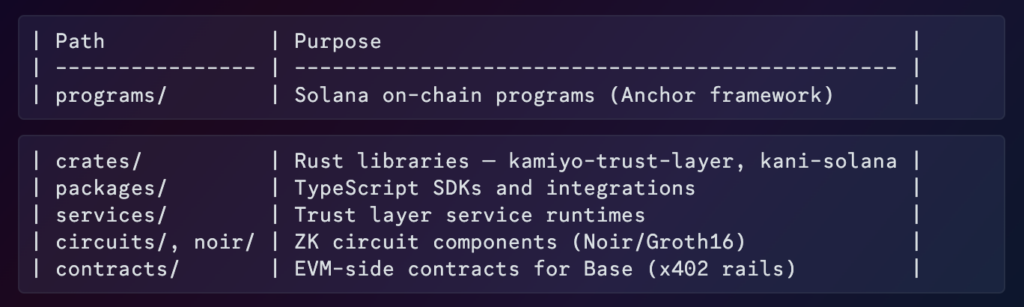
The trust layer service provides idempotent event ingest, exactly-once durable database writes per event_id, Kafka publish via transactional outbox relay, and dead-letter re-drive — production-grade infrastructure, not a prototype.
Formal verification is taken seriously: the repo includes Kani proof harnesses for selected invariants, with a dedicated CI workflow running alongside standard tests.
Ecosystem Position
• x402 ecosystem — KAMIYO is listed in the x402 ecosystem as a third-party facilitator (Base/Solana)
• OriginTrail DKG integration — compliance passports published as Knowledge Assets to the decentralized knowledge graph
• **@kamiyo/agents** — Claude Agent SDK wrapper for direct AI agent integration
• Fully open source
Why This Matters Now
The agentic economy isn’t theoretical anymore. Agents are already executing trades, writing code, managing social media, and running business workflows. The missing piece has always been trust — how do you ensure an agent you’ve never interacted with will deliver what it promises?
KAMIYO’s answer is elegant: make trust programmable, verifiable, and on-chain. Stake creates accountability. Escrow creates safety. Oracle quorums create objectivity. And the DKG creates a shared, queryable memory that any agent in the ecosystem can access.
The infrastructure for the agentic economy is being built right now. KAMIYO is one of the most technically serious attempts at solving its hardest problem.
Sources: kamiyo.ai, docs.kamiyo.ai, github.com/kamiyo-ai/kamiyo-protocol