Category: Decentralised Finance (DeFi)

Decentralized Finance (DeFi) is a sector within the cryptocurrency and blockchain space which aims to provide a decentralized version of the products available in traditional finance- without central control and at a lower cost with potentially higher returns. These products include loans, interest-bearing deposits and borrowing services.

The advantages of decentralized finance are that it addresses the problems we have with the traditional banking system. For example, decentralized finance protocols are controlled by multiple people, and all participants are required to abide by the rules written into the smart contracts underlying the protocols.

  • Polkadex: Polkadot’s DEX for the DeFi ecosystem

    Polkadex: Polkadot’s DEX for the DeFi ecosystem

    Polkadex is a new addition to the Polkadot ecosystem. Polkadex a decentralised cryptocurrency exchange (DEX) concentrating purely on tokens powering decentralised finance (DeFi) applications through a user-friendly interface and lightning-fast transactions.

    Background

    Polkadex is developed by a team of highly skilled professionals led by Matthias Hafner (cryptoeconomic advisor), Vivek Prasannan (executive director), Gautham J (CEO & tech lead), and Deepansh Singh (COO). In addition, the team comprises advisors on artificial intelligence, machine learning, and banking.

    The project has struck key partnerships with notable firms such as CMS, Cluster, Blocksync Ventures, Existential Capital, Web3 Foundation, among others.

    What is Polkadex?

    Polkadex is a non-custodial decentralized platform powering the P2P exchange of tokens used in the DeFi ecosystem. The platform looks forward to building a financial-inclusive future through bridges that connect traditional and decentralized finance spaces.

    The project leverages the power of the Polkadot platform.

    The decentralized exchange is designed to solve liquidity issues plaguing many platforms in the market today. The root of the problem is the use of an orderbook on a decentralized protocol.

    The introduction of automated market-maker (AMM) as the solution led to the birth of Uniswap and other DeFi protocols. Unfortunately, the approach had its own limitations.

    For example, it can only be beneficial when there’s a price difference on exchanges using an orderbook. However, even though AMMs rely on orderbook-based platforms, these platforms don’t need AMMs for them to run.

    To bridge the disconnect, Polkadex brought AMMs and the orderbook together. The project is unique because it uses on-chain bots for market making.

    Key Components of Polkadex

    To bring its vision into focus, the project is built on FIVE core components. They include:

    Fluid Switch Protocol

    The switch changes between the platform’s orderbook and automated market-making AMM. The shift ensures that the decentralized exchange (DEX) has seamlessly-flowing liquidity for traders and liquidity providers.

    By utilizing professionally-designed AMM algorithms, Polkadex provides a fully-supported orderbook, which in turn eradicates impermanent loss and price slippage, which are the biggest ills in the DeFi sector.

    Trading Bots

    Polkadex powers high-frequency trading using trading bots. Notably, these bots handle both institutional and retail customers. They use a carefully manicured architecture that optimizes cancellation fees by managing traders’ entry and exit points depending on the situations in the market. (radiomusical.com)

    The bots are also used to perform on-chain market making. This approach fuses AMMs with an orderbook. How does this work?

    When the bots don’t find a match during a trade, they automatically place the trade in an orderbook adding liquidity to the network.

    When a trade doesn’t find a match in the orderbook, the bots are tasked with finding a suitable pair. Note that trades on Polkadex are only completed using the best price.

    Ethereum Bridge

    With most DeFi networks running on the Ethereum blockchain, Polkadex employs a trustless Ethereum bridge to facilitate the movement of any token to the decentralized exchange. Consequently, it makes it possible to interact with other liquidity providers in a trustless way that allows users to maintain control of their virtual wealth.

    High Performance

    Currently, Polkadex is operating in a testnet capable of reaching a speed of 300 transactions per second (tps). Although this speed is enough in the current landscape, the project targets a throughput of 20,000 tps.

    Polkadot Parachain

    The exchange incorporates the Polkadot Parachain as an additional way to drive liquidity into the DEX. However, the parachain is only used to bring tokens from the Polkadot ecosystem to the Polkadex world.

    During the movement, the security of the tokens is provided through an interoperability layer provided by Polkadot. In addition, the layer assumes a non-custodial approach letting token holders have full control of their digital wealth, effectively eliminating centralized service providers.

    Types of Trades Supported by Polkadex

    The exchange supports market and limit orders. Limit orders enjoy zero trading fees while market orders incur a 0.2 percent trading fee.

    The main reason for the difference in trading fees is that limit orders add liquidity to the platform while market orders remove liquidity. Liquidity providers share the trading fee charged on market takers on a 50-50 ratio with the Polkadex team.

    Since bot-based transactions aren’t viable on a decentralized exchange using smart contracts, Polkadex moves above this hurdle by removing network fees.

    However, this presents another problem where malicious actors can attack the application through a DDoS (Distributed Denial of Service) attack. To guard against such incidents, Polkadex lets the blockchain anticipate such attacks and impose a network charge for specific trades.

    The exchange uses several methods to determine a potential DDoS threat. For instance, if a trade has an invalid price, trading pair, order type, or insufficient balance, then it’s categorized as a likely DDoS attack.

    Two Critical Polkadex Partnerships

    Polkadex X KILT Protocol X Fractal

    Polkadex joined hands with KILT Protocol and Fractal to bring decentralized know-your-customer (KYC) functionalities to the DEX. The partnership saw Fractal, an identification firm, and Polkadex leverage KILT’s infrastructure to manage KYC procedures needed by the exchange.

    The move eases the onboarding process for the DEX’s users. Note that KILT stores customer information. Thus, with the collaboration, new exchange users are directed to the KILT platform, where they set-up a wallet that stores their data in a decentralized way.

    Polkadex X Cryptecon.org

    This partnership involved including Cryptecon’s Matthias Hafner into the DEX’s advisory board. Hafner’s experience in developing economic models helps the exchange effectively merge its orderbook with multiple AMMs.

    Current status of Polkadex

    Polkadex is currently in the testnet phase and has recently released version 2.0. New features in this release include:

    1. ability for the public to use testnet tokens to submit trades; and
    2. ability to watch live trades being executed by the Polkadex engine.

    To participate in the testnet, you will need to download the Polka Chrome extension and create an account. Then you can ask for testnet tokens in their official telegram group.
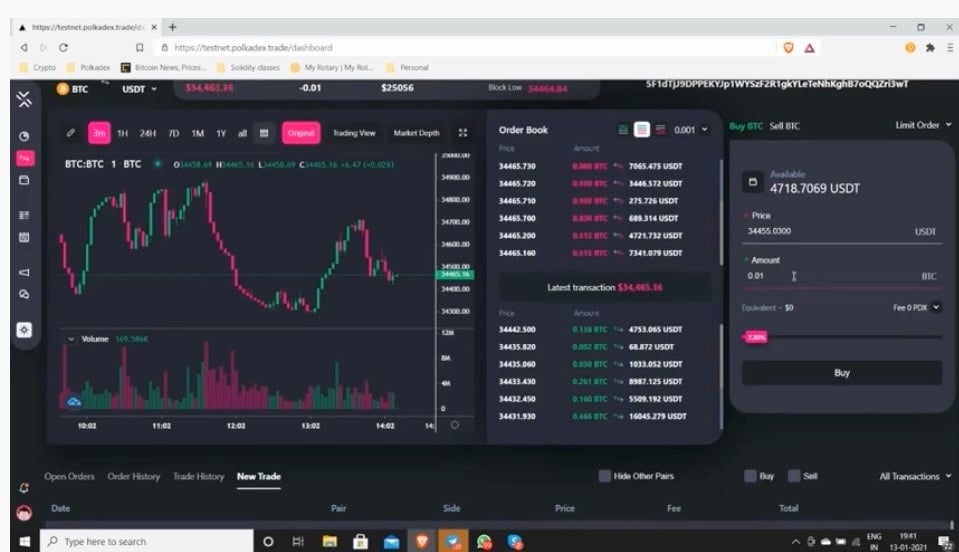
    Polkadex interface
    Polkadex interface (Image credit: YouTube)

    Roadmap: What’s next for Polkadex?

    The next exciting phase for Polkadex of course would be its mainnet launch. It appears that they intend to be on track for mainnet launch in Q1-Q2 2021.

    As for Polkadex’s token sale, they have indicated on their Telegram group that the community round will take place in March 2021.

    Conclusion

    Polkadex takes a superior approach in fusing AMMs with the orderbook through the inclusion of on-chain market-making bots. Notably, the provision of a user-friendly design, a high throughput, and a non-custodial approach add to the exchange’s uniqueness among other DEXs in the market.

    Additionally, its partnership with KILT and Fractal eases the onboarding process while the Cryptecon collaboration enhances its Fluid Switch component.

    Decentralised Finance (DeFi) series: tutorials, guides and more

    With content for both beginners and more advanced users, check out our YouTube DeFi series containing tutorials on the ESSENTIAL TOOLS you need for trading in the DeFi space e.g. MetaMask and Uniswap. As well as a deep dive into popular DeFi topics such as decentralized exchanges, borrowing-lending platforms and NFT marketplaces

    The DeFi series on this website also covers topics not explored on YouTube. For an introduction on what is DeFi, check out Decentralized Finance (DeFi) Overview: A guide to the HOTTEST trend in cryptocurrency

    Tutorials and guides for the ESSENTIAL DEFI TOOLS:

    More videos and articles are coming soon as part of our DeFi series, so be sure to SUBSCRIBE to our Youtube channel so you can be notified as soon as they come out!

    Disclaimer: Cryptocurrency trading involves significant risks and may result in the loss of your capital. You should carefully consider whether trading cryptocurrencies is right for you in light of your financial condition and ability to bear financial risks. Cryptocurrency prices are highly volatile and can fluctuate widely in a short period of time. As such, trading cryptocurrencies may not be suitable for everyone. Additionally, storing cryptocurrencies on a centralized exchange carries inherent risks, including the potential for loss due to hacking, exchange collapse, or other security breaches. We strongly advise that you seek independent professional advice before engaging in any cryptocurrency trading activities and carefully consider the security measures in place when choosing or storing your cryptocurrencies on a cryptocurrency exchange.
  • TotemFi ($TOTM): Combining prediction markets and DeFi

    TotemFi ($TOTM): Combining prediction markets and DeFi

    TotemFi is a blockchain-based prediction platform that operates on both the Ethereum and BSC networks, interfacing the prediction markets world with the decentralized finance (DeFi) ecosystem.

    In the predictions market, it’s either you agree with the system or leave the space. The ecosystem exists as a closed cave without a way to know whether you’ll get to enjoy the rewards even if you make a correct prediction. Blockchain technology came to the forefront to offer multiple solutions to the problems of traditional markets, and the predictions market should not be left out. Unfortunately, decentralized projects in the prediction world are yet to solve critical issues such as counterparty risks, accessibility, and bias.

    Fortunately, TotemFi is among the few reliable blockchain-based prediction platforms that aim to solve significant problems in traditional prediction markets through the use of, for instance, audited smart contracts. Additionally, it guards against cases where an individual’s prediction gets influenced by another. In this guide, we shall take a comprehensive tour of this project.

    Background

    Jolyon Layard leads the team as the CEO. He has a bachelor’s degree in mathematics and economics. Before joining TotemFi, he was a corporate tax associate at Grant Thornton LLP, CFO at Happy Space UK, and worked at One Young World in different capacities.

    Other key members include Harry Horsfall (CMO), Henry (CBO), and Dan (PR & Community). Note that the team members’ backgrounds cut across various industries such as cryptocurrency, brand management, and communications.

    DuckDao incubates the project in collaboration with Trustology, Ferrum Network, BlockPass, Certik, Lauchpool, among others. Its list of strategic partners includes Bluenode Capital, Alphabit, MoonWhale, and Nabais Capital.

    What Is TotemFi?

    TotemFi is a blockchain-based prediction platform operating on both the Ethereum network and Binance Smart Chain (BSC). Notably, the protocol interfaces the prediction markets world with the decentralized finance (DeFi) ecosystem. TotemFi offers solutions to five major ills in the prediction markets world.

    1. Financial risk – The platform guarantees that stakers will receive their incentives. As such, there is no way a staker will lose their input in the protocol.
    2. Incentivization – The conventional prediction market fails to form a clear incentivization route for individual and group participants. TotemFi breaks this hurdle by rewarding both parties for logical predictions.
    3. Accessibility – TotemFi uses decentralized applications (Dapps) to reduce and hopefully eradicate friction during the prediction process. It does this using a professional but easy-to-use user interface. The protocol take’s it a level higher by not penalizing inaccurate projections.
    4. Echoed influence – This happens when the market is influenced by factors such as partial media highlights and politics. The effect is largely felt on centralized prediction networks. To counter the impact, the project employs decentralization. Consequently, it distributes viewpoints and media sources.
    5. Counterparty risk – Verified and audited staking smart contracts help in building a trustless prediction platform. In return, it boosts user confidence and ensures that participants maintain ownership and control of their stake.

    How does TotemFi Work?

    The protocol works by interacting with various critical sections. Some of the areas include staking pools, prediction ranges, as well as results and tie breakers. (brownshvac.net)

    Staking Pools

    TotemFi staking pools provide a safe place for users to deposit their coins while waiting for the prediction of the price of cryptocurrencies like Bitcoin. These pools have varying maturity durations between 15 and 60 days. However, a pool only takes to the skies if it either reaches the maximum time limit or the pool’s allocation becomes full.

    Furthermore, the maturity date marks the end of the prediction date. For instance, a pool with a maturity length of sixty days means participants must predict the price of Bitcoin (BTC) in the next two months.

    Notably, TotemFi uses a single data source such as an oracle to check the prices of the assets, which enhances consistency and trust.

    TotemFi automatically births another pool with similar specifications to provide timeliness once a pool hits its allocation threshold.

    Prediction Range

    The range determines how far a participant can go with their price forecast. The number of the protocol’s native tokens, TOTM, held by a participant determines their projection range. More tokens mean a higher range and vice versa.

    However, TotemFi’s step function determines the range. The function gives the correlation between the TOTM stake size, the step size, and the range increase.

    Results and Tie Breaker

    In a prediction, the possibilities of a tie are very high. In case of a tie, the first person to provide the correct prediction becomes the winner. Also, this process applies in case a tie situation involves more than one participant. In such a scenario, users ranking is done in a chronological format.

    Staking Rewards and Price Pools

    Stakers receive guaranteed incentives. However, the rewards depend on the pool’s maturity time, staked amount, and staking time. Assuming that a staker lets their stake run peacefully for their entire pool maturity time, they’re likely to receive a tentative annual percentage rate (APR) of 60%, 65%, and 75% for pools with a maturity time of 15, 30, and 60 days, respectively.

    On the other hand, the prize pool contains both BTC and TOTM tokens. For example, in the case of a correct prediction, the winner takes home 0.03375 BTC and 1,687 TOTM coins, while the third in the winning queue gets 0.0110 BTC and 495 TOTM tokens.

    TotemFi Tokens (TOTM)

    TOTM has a fixed supply of 10 million tokens. This entire amount was excavated during the token generation event (TGE).

    The tokens go to advisors (8.5%), community development (10%), team (15%), seed (4.5%), and public sale (4.5%). Additionally, staking rewards get 16.5%, while strategic development, liquidity pool, and private sale get 15%, 6%, and 20%, respectively.

    Notably, the allocated coins are locked for varying months. For example, TOTM issued to staking have a lockup period of 48 months, while those meant for private sale have a five-month lockup period.

    Apart from rewarding predictions, TotemFi’s native asset acts as a governance token. Therefore, its holders are capable of taking part in critical decisions such as pool mechanics.

    Conclusion

    TotemFi is set to revolutionize an industry that is relatively underserved. Fortunately, a decentralized approach allows participants to blame themselves for not getting the forecasts right. Additionally, its use of blockchain increases participants’ confidence.

    Moreover, guaranteed incentives for stakers, as well as not penalizing incorrect predictions, allows everyone to participate, opening the door to broader adoption. Most importantly, the experience of the TotemFi core team, incubators, and advisors sets the project apart from other blockchain-based prediction networks targeting.

    Disclaimer: Cryptocurrency trading involves significant risks and may result in the loss of your capital. You should carefully consider whether trading cryptocurrencies is right for you in light of your financial condition and ability to bear financial risks. Cryptocurrency prices are highly volatile and can fluctuate widely in a short period of time. As such, trading cryptocurrencies may not be suitable for everyone. Additionally, storing cryptocurrencies on a centralized exchange carries inherent risks, including the potential for loss due to hacking, exchange collapse, or other security breaches. We strongly advise that you seek independent professional advice before engaging in any cryptocurrency trading activities and carefully consider the security measures in place when choosing or storing your cryptocurrencies on a cryptocurrency exchange.

  • Radix DLT ($XRD): Taking DeFi to the next level?

    Radix DLT ($XRD): Taking DeFi to the next level?

    Radix DLT is a layer 1 distributed system to power the needs of the decentralised finance (DeFi) ecosystem. As DeFi continued to gain traction, the top blockchain networks supporting the market were already overstretched. As it turns out, scalability appears to be a hard nut to crack and hence projects like Radix DLT are formed.

    The motivation behind the Radix protocol’s creation is to save the $71 billion lost every year caused by unnecessary friction in the conventional financial system and allow those at the lower and higher levels of finance to make ground by powering a strong DeFi ecosystem.

    Check out our video which explains the scaling problems currently faced by Ethereum, and how Radix attempts to solve it.

    Taking DeFi to the NEXT LEVEL ? – Radix DLT Protocol overview

    Background

    The Radix team believes that using distributed ledger technology (DLT) to build a permissionless network will ease the development and accessibility of innovative financial applications. With these applications, we could finally bring down the guarded walls of traditional financial markets.

    Radix team (Image credit: Radix DLT)

    The project was founded by Dan Hughes, who also happens to be its CTO. Hughes’s former work includes the design of T-Mobile’s first mobile internet platform.

    Other team members include the organization’s CEO, Piers Ridyard, as well as CPO, Albert Castellana. The project is being supported by the Radix Foundation.

    What is Radix DLT?

    The team behind Radix DLT defines the project as the “first layer 1 protocol specifically built to serve DeFi.” The protocol seeks to remove the inefficiencies found in open finance (OpFi) both in the current and future settings. Hughes and his team want to achieve this through:

    • Re-engineering the consensus mechanism used in popular blockchain systems.
    • Employing decentralized virtual machines.
    • Activating on-ledger code.
    • Building DeFi-bound components and applications.
    • Incentivizing developers who drive the growth of the new-found financial breakthrough.

    Having its developers at the core of driving growth for innovative financial products, Radix provides its support by building highly-secure smart contracts, fast and interoperable OpFi decentralized applications (dApps), engaging and rewarding a distributed developer community, and guarding DeFi composability when scaling dApps on public blockchains.

    Radix network

    The network is made up of Cerberus (a consensus mechanism), Radix Engine (a development environment), Radix Component Catalog, and developer royalties.

    Cerberus

    At the heart of the protocol is Cerberus, a re-engineered consensus mechanism which uses a sharded Byzantine fault-tolerant (BFT) solution. This approach enables the system to be parallelized across multiple nodes without losing message complexity and responsiveness.

    The sharding concepts allows unlimited network splits or shards. Each shard can represent anything on the platform. By allowing unlimited shards, Cerberus shifts focus from global ordering to partial ordering.

    With global ordering, transactions are stored in a predefined chronological order. Partial ordering, at a very basic level, is the opposite of agreed chronological ordering. However, partial ordering has to differentiate between related and unrelated events or transactions when recording them on the blockchain.

    Using a “braiding” mechanism, Cerberus uses a new BFT-style system to sign interactions between nodes handling different shards before committing transactions.

    Radix Engine

    This is Radix’s specialized application layer that powers the interaction between a smart contract’s code with the actual blockchain. The layer powers the project’s virtual machine (VM), which in turn, powers the partial ordering system.

    Furthermore, the Radix VM handles concurrency to drive DeFi applications further.

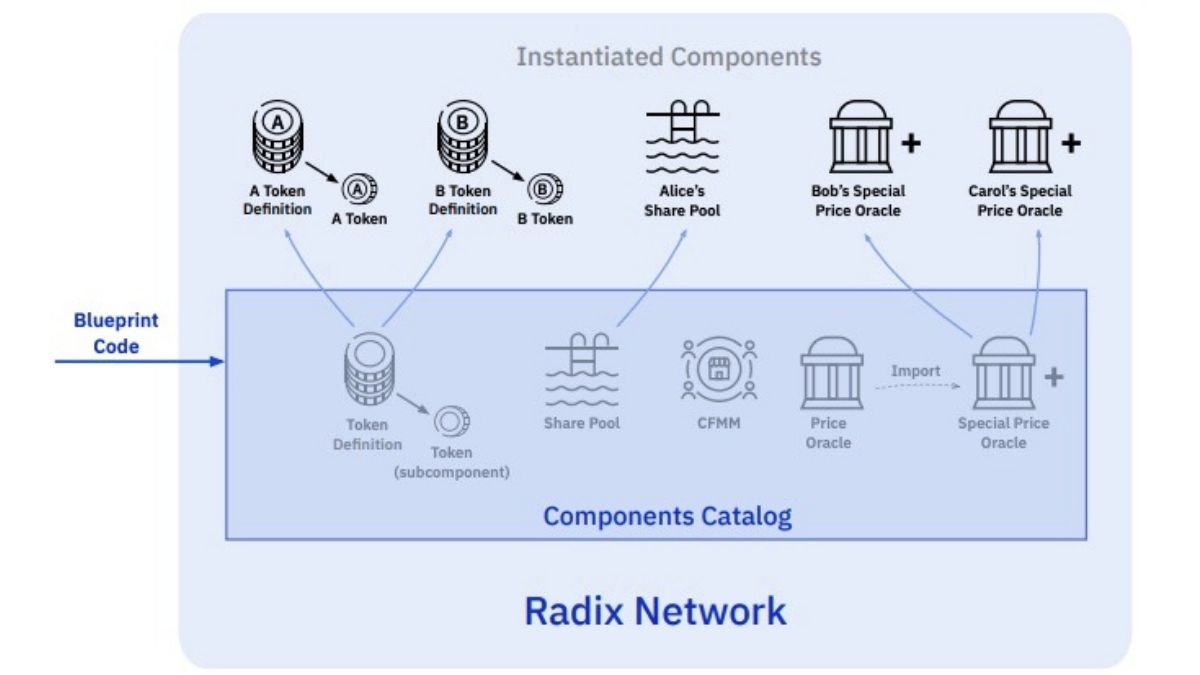
    Radix Component Catalog

    In other blockchain systems, a developer’s work becomes an active smart contract after being pushed to the system’s users. For Radix, the component catalog handles apps before being registered as “active” on the platform.

    Radix Network (Image credit: Radix Whitepaper)

    In other words, the catalog contains templates ready for use to create additional active components. The new template-based products are called instantiated components.

    Developer Royalties

    The Radix system uses developer royalties to encourage developers to contribute. However, the project takes a different approach by employing distributed self-incentives such as those found in proof-of-work systems called mining rewards.

    Radix Token ($XRD)

    The platform has a native token, XRD, which is used to pay for transaction fees. Note that these fees are paid to node runners.

    A transaction fee is charged for token creation, messaging, and anything else that requires a change of the ledger state. The fee is burnt upon validation of the operation.

    Furthermore, the platform’s tokens have a controlled unlocking mechanism that spans 365 days. With each unlocking, the Radix Foundation’s amount of XRD reduces while those in the public domain increases.

    E-Radix (eXRD) Token Sale and tokenomics

    Radix Token Sale began on 8th October 2020 and a total of 642mil E-RADIX tokens were available to purchase at $0.039 per token.

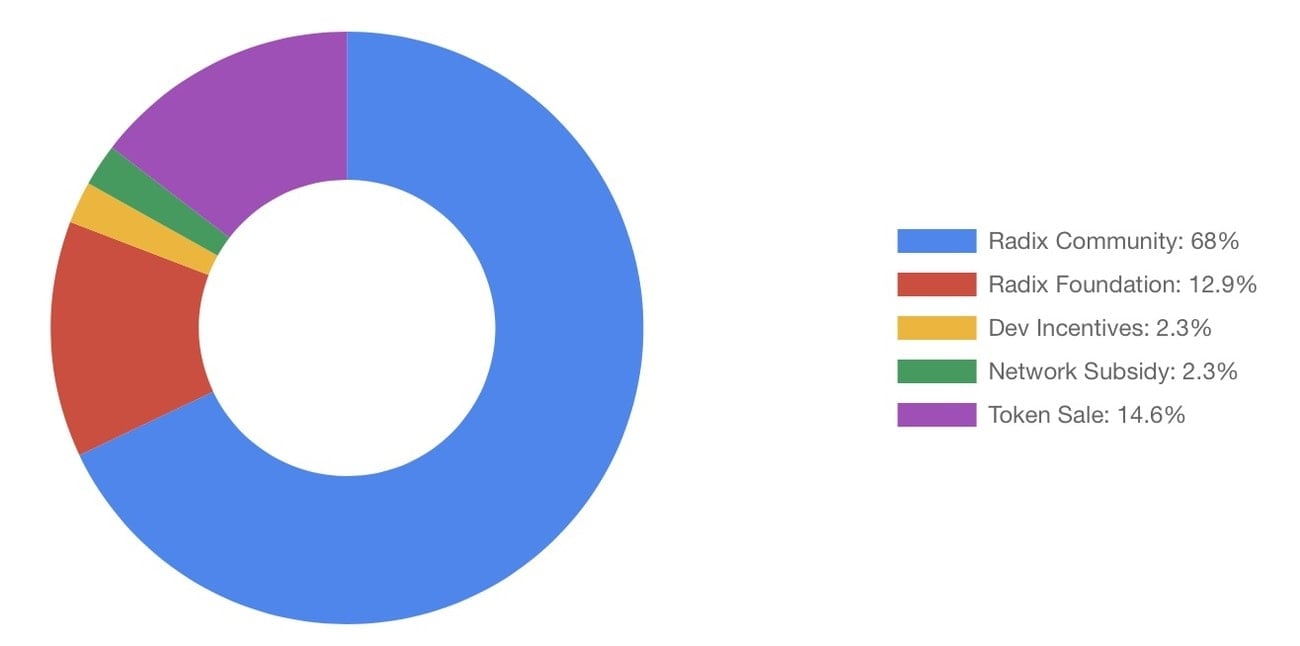
    There will be an Initial Supply of 4.41 billion E-RADIX as both locked and unlocked tokens. The following chart shows the proposed distribution of the Initial Supply tokens.

    Radix proposed distribution
    Radix proposed distribution

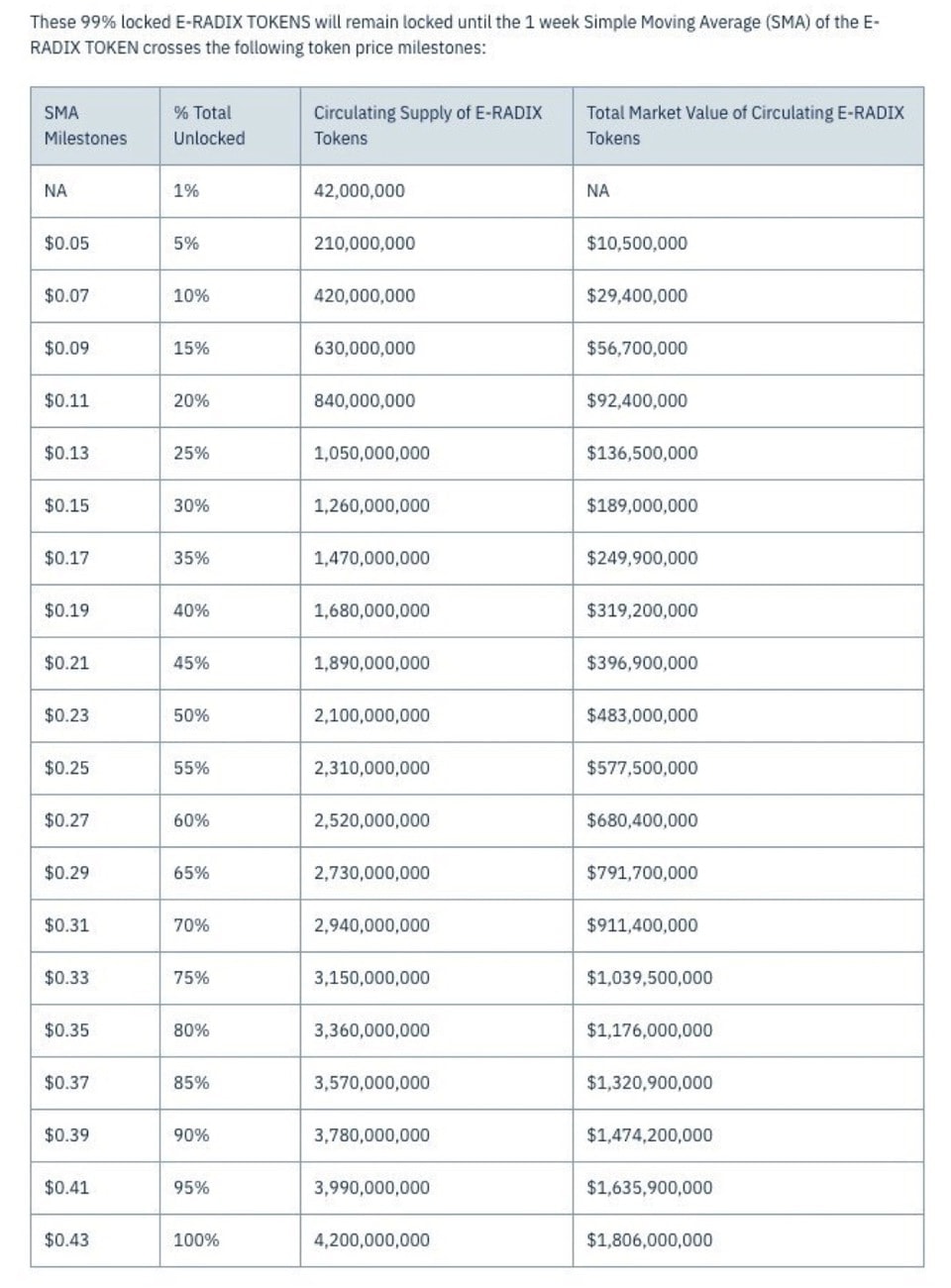
    The unlocking mechanism for E-RADIX tokens will start on 17th November 2020. Of the Initial Supply of 4.41 billion E-RADIX tokens, 4.2 Billion tokens will be distributed and of which 99% will be locked and 1% unlocked.

    These locked tokens are subject to a price-based unlocking schedule which will allow holders to withdraw the tokens at certain price milestones as follows:

    Radix token unlock schedule
    e-Radix token unlock schedule (Image credit: Radix token sale info page)

    E-RADIX will be available for trading on Uniswap.

    This E-RADIX token is an ERC-20 token. When the RADIX ledger is instantiated, this E-RADIX token will be exchangeable 1:1 for RADIX (XRD) tokens. As mentioned in their key milestones article, the Team are on track for the Radix main net to go live in Q2 2021.

    On the mainnet, Radix will create a further 5.19 billion RADIX tokens which will also follow the same unlocking schedule as the E-RADIX tokens mentioned above.

    How to withdraw your unlocked E-RADIX (eXRD) and RADIX (XRD) tokens

    As mentioned in the previous section, E-RADIX and RADIX tokens are subject to a price-based unlocking schedule. However, to claim these tokens you will need to withdraw them from the unlocking smart contract.

    This involves visiting their Radix tokens unlocking website and connecting the wallet that you used to purchase the E-RADIX tokens. If that wallet address has an allocation of EXRD in the unlocking smart contract, you will see details of your total allocation together with the amount which is unlocked and can be withdrawn. Then all that is required is to click the “withdraw” button and follow the steps to withdraw the eXRD.

    Make sure to check back when an unlocking event occurs because it will mean you can withdraw more tokens!

    For a detailed walkthrough on how to claim your unlocked tokens, click here.

    Staking Radix Token

    With OpFi, staking, yield farming, and liquidity mining are common occurrences. Radix powers this DeFi subset by allowing users to lock their XRD to earn network emissions and be involved in decision making.

    Network emissions are periodically generated tokens that are spread across active staking nodes while considering the amount of staked tokens. Emissions make up for 2.5% of the yearly inflation rate.

    There are two approaches to locking tokens:

    1. A user can lock XRD and become a node runner on the network; or
    2. a user can lock Radix tokens and delegate his stake to another node runner, also called a staking node. A staking node has the power to validate transactions.

    Radix’s consensus mechanism limits the stake weight per node to 33% to prevent node runners from having absolute power over the transaction validation process.

    Network Subsidy

    The network subsidy is an additional amount of tokens distributed to transaction validators. The tokens are unlocked by the Radix Foundation every 24 hours and are expected to run for 10 years. However, to earn the subsidy tokens, a staking node has to consistently meet specific factors on responsiveness, bandwidth, and computing power.

    Other Radix token categories are the public token grant to support community contributors, the Radix team token grant to support the team, and the stable token reserve that supports stable coins on the network.

    Conclusion

    The projected growth of the DeFi market requires creating new distributed systems that, if possible, have unlimited scalability. Radix is one such project. With a key focus in leading the migration from centralized finance (CeFi), the project provides hope to the future of OpFi.

    From a re-designed consensus mechanism to decentralized self-incentives for developers, the project is keen on ensuring that DeFi overshadows CeFi.

    The Radix token supply approach is another key component of the network that shifts from the traditional approach of major blockchain-based systems that power OpFi protocols.

    Decentralised Finance (DeFi) series: tutorials, guides and more

    With content for both beginners and more advanced users, check out our YouTube DeFi series containing tutorials on the ESSENTIAL TOOLS you need for trading in the DeFi space e.g. MetaMask and Uniswap. As well as a deep dive into popular DeFi topics such as decentralized exchanges, borrowing-lending platforms and NFT marketplaces

    The DeFi series on this website also covers topics not explored on YouTube. For an introduction on what is DeFi, check out Decentralized Finance (DeFi) Overview: A guide to the HOTTEST trend in cryptocurrency

    Tutorials and guides for the ESSENTIAL DEFI TOOLS:

    More videos and articles are coming soon as part of our DeFi series, so be sure to SUBSCRIBE to our Youtube channel so you can be notified as soon as they come out!

    Disclaimer: Cryptocurrency trading involves significant risks and may result in the loss of your capital. You should carefully consider whether trading cryptocurrencies is right for you in light of your financial condition and ability to bear financial risks. Cryptocurrency prices are highly volatile and can fluctuate widely in a short period of time. As such, trading cryptocurrencies may not be suitable for everyone. Additionally, storing cryptocurrencies on a centralized exchange carries inherent risks, including the potential for loss due to hacking, exchange collapse, or other security breaches. We strongly advise that you seek independent professional advice before engaging in any cryptocurrency trading activities and carefully consider the security measures in place when choosing or storing your cryptocurrencies on a cryptocurrency exchange.
  • Vortex DeFi ($VTX): One-stop Gateway to DeFi

    Vortex DeFi ($VTX): One-stop Gateway to DeFi

    Vortex DeFi ($VTX) aims to provide users a one-stop access to all leading decentralized finance (DeFi) platforms and protocols from a single web-based user interface.

    Decentralized Finance (DeFi) has evolved from a niche subcategory to the biggest catalyst driving the cryptocurrency and blockchain field today. It’s primarily focused on the Ethereum network, which has the majority of the DeFi share. There are, however, a large number of core DeFi protocols, combinators, and countless forks. All of this can become confusing fast.

    Fortunately, users don’t have to delve into the complex workings and nuances of these protocols, which can be overwhelming even for long-term users. Vortex DeFi is introduced to simplify the access and exposure to the sector. It has integrations with different protocols, which abstracts away the complexity in a simple and yet intuitive interface, to level the playing field and ensure greater participation.

    Background

    Vortex DeFi launched in Aug 2020 through a private investment round. It accrued interest and funding from X21 Digital, DuckDao, Moonrock Capital, Magnus Capital, Pluto Digital Assets PLC, Faculty Capital, A195 Capital, etc. A public sale will be held soon.

    It has a multicultural team, led by CEO Rahul Singh and strategic advisor Lester Lim. The other prominent team members are technical lead Arun Sunil and product lead Shaz. All team members have previous experiences in market-leading companies and blockchain projects.

    What is Vortex DeFi?

    Vortex DeFi is a web-based DeFi management system or a comprehensive DeFi aggregative solution platform, serving as a bridge between Ethereum and Polkadot. It combines the functionality and power of core protocols in a sleek dashboard to allow users of all categories to engage in yield farming. The core services provided are NFT asset management, lending and borrowing, insurance, and exchange.

    Vortex DeFi will also utilize the yEarn finance protocol to access and extract value from various lending protocols to enable automated profitable yield farming. The added advantage of cross-chain compatibility ensures that users don’t have to choose between two promising blockchains. Vortex DEFI also has several components, taking the guesswork and experimentation out of the process.

    Vortex DEFI – Components

    V-Swap

    Being the Uniswap or Bancor equivalent of Vortex, V-Swap will offer an automated digital assets exchange on the Ethereum and Polkadot blockchain. It’s likely to offer liquidity aggregation from multiple sources, so a peer to peer exchange of tokens can be performed without a direct counterparty or orderbook.

    V-Pay

    It will offer a fiat gateway for users, so they can acquire and sell crypto assets from FIAT, in their cards or bank accounts. This is required for onboarding new users, as well as ensuring that they have a way for realizing their returns.

    V-Yield

    A yield aggregator as the name goes, V-Yield will combine yield from different sources and optimize them according to the best return rate. It will spare users from the trouble of manually finding sources and having the need to rotate them.

    V-NFTs

    An asset management, V-NFTs will allow users to manage their asset collection and swap them for each other. Given that NFTs are an illiquid asset class and their infrastructure is scattered, it’s hugely important to develop a unified interface.

    V-Insure

    DeFi protocols are rife with exploits and smart contract risks. Therefore, to onboard new users and even to retain existing ones, it’s necessary to grant them peace of mind by ensuring the protection of their funds. V-Insure will seek to insure user funds by seeking out integrations with multiple DeFi insurance protocols.

    Vortex DEFI Native Token ($VTX)

    The native token of the platform is Vortex DeFi Token ($VTX), ERC-20 token, which will be used to incentivize users. It has four purposes:

    1. Liquidity pools (LP) rewards are distributed in VTX
    2. Usage for staking on the platform.
    3. Holding VTX tokens allows users to save on the platform fees
    4. The team has announced plans to regularly buy tokens and burn them every quarter to reduce supply and increase the value of existing tokens.

    All of these benefits and value accrual mechanisms will motivate users to hold tokens, in anticipation of rising demand and prices.

    $VTX Token Metrics

    The VTX token has a total supply of 100M $VTX and an initial circulating supply of $0.4M $VTX.

    Funding Rounds

    Private Sale (concluded): 32,500,000 VTX sold at 0.0276 USD per token.(25% TGE, 75% vesting over 120 days)

    Public Sale (on 28 February 2021): 2,500,000 VTX to be sold at 0.04 USD per token. No vesting period.*

    Advantages of Vortex DeFi

    The platform offers users the advantages of a unified DeFi management dashboard, the ability to fuse several protocols together offering a seamless experience with abstracted complexity, powerful lend and earn functionality, automated rotation of funds for optimized returns, non-custodial function, and insurance against loss of funds.

    Vortex DEFI Connected Protocols

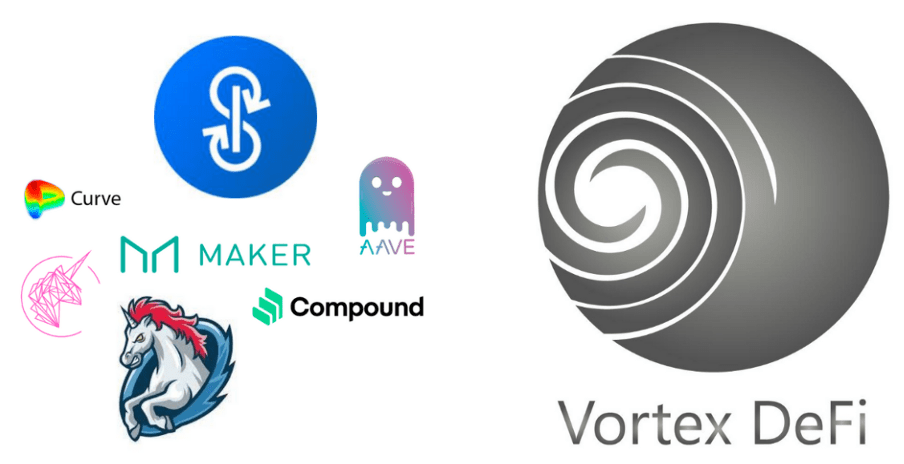
    Vortex DeFi connected protocols (source: Introducing Vortex DeFi Beta & Access to the Vortex of DeFi‘ medium article)

    Vortex DEFI will have integrations with several key DEFI protocols, including but not limited to Maker DAO, Compound, Kava, Idle, Aave, Yearn, Uniswap, Nexus Mutual, Curve. This will allow for a powerful user experience, which is likely to improve penetration of decentralized finance.

    Vortex Vision

    The team hopes that Vortex will become the top one-stop solution for a user’s DeFi needs and allow them to simplify their experience. Vortex hopes to make financial applications accessible and simple for all users, regardless of their technical expertise. It will also allow saving on transaction fees (gas) by batching and combining transactions.

    Vortex can also enhance the decentralization level of DeFi protocols by ensuring broad participation and an increase in user activity. Furthermore, it will feature the DAAS (DeFi-As-A-Service) business model. Currently, the product is in development and more changes are expected as the platform launch draws near.

    Conclusion

    DEFI was founded on the principle of openness, equal opportunity, transparency, trustlessness, lack of centralized control, fast processing, and lego-like composability. It is generally presented as a superior alternative to the traditional financial system, which differs heavily from the principles of the crypto community and disallows these services to a large number of people.

    On the other hand, DeFi is accessible to almost everyone with an internet connection and a personal computing device or smartphone. However, primitive user interfaces and experiences of the existing DeFi protocols were a problem. Thankfully, Vortex will overlap the strong functionality of these protocols with an amazing and simple interface.

    Currently, there is a lack of dashboard-style platforms connected to multiple DEFI protocols, aggregating their services and offering a one-stop solution. All of this is about to change with the Vortex launch, which is likely to onboard a large number of new users as well as provide a novel interesting solution to the existing ones.

    Decentralised Finance (DeFi) series: tutorials, guides and more

    With content for both beginners and more advanced users, check out our YouTube DeFi series containing tutorials on the ESSENTIAL TOOLS you need for trading in the DeFi space e.g. MetaMask and Uniswap. As well as a deep dive into popular DeFi topics such as decentralized exchanges, borrowing-lending platforms and NFT marketplaces

    The DeFi series on this website also covers topics not explored on YouTube. For an introduction on what is DeFi, check out Decentralized Finance (DeFi) Overview: A guide to the HOTTEST trend in cryptocurrency

    Tutorials and guides for the ESSENTIAL DEFI TOOLS:

    More videos and articles are coming soon as part of our DeFi series, so be sure to SUBSCRIBE to our Youtube channel so you can be notified as soon as they come out!

    Disclaimer: Cryptocurrency trading involves significant risks and may result in the loss of your capital. You should carefully consider whether trading cryptocurrencies is right for you in light of your financial condition and ability to bear financial risks. Cryptocurrency prices are highly volatile and can fluctuate widely in a short period of time. As such, trading cryptocurrencies may not be suitable for everyone. Additionally, storing cryptocurrencies on a centralized exchange carries inherent risks, including the potential for loss due to hacking, exchange collapse, or other security breaches. We strongly advise that you seek independent professional advice before engaging in any cryptocurrency trading activities and carefully consider the security measures in place when choosing or storing your cryptocurrencies on a cryptocurrency exchange.
  • Unido ($UDO): Crypto Banking and DeFi for Enterprise

    Unido ($UDO): Crypto Banking and DeFi for Enterprise

    Unido ($UDO), powered by Polkadot, provides enterprises crypto-asset management solutions, that specialize in governance, security, and interoperability within the crypto banking sphere guaranteeing the satisfaction of all users.


    Background

    Powered by Web3 blockchain Polkadot, Unido was founded by Chris Weddle who has over 20 years of experience within the blockchain sector. The project was initiated in 2017 and is anchored by an experienced team of finance experts, software developers, and blockchain developers. They all come from well-known financial and development firms such as Goldman Sachs, Wipro, and Macquarie.

    Unido’s Founder: Chris Weddle (Source: Unido website)

    Through the Unido project, the team has successfully managed to solve security and accessibility challenges with its distinct and dynamic implementation of a blockchain-based management tool that facilitates the handling of crypto assets.

    What is Unido?

    Unido is a technology ecosystem that addresses the governance, security, and accessibility challenges of decentralized applications, and enables companies to manage crypto assets and capitalize on DeFi.

    Unido’s distinct protocol facilitates investment in DeFi by leveraging its efficient proprietary and multi-sig key signing technology. Furthermore, users have the unique capability to manage crypto banking operations in complete security.

    Under the decentralized platform, assets management enterprises and crypto native companies are ensured agility and efficiency for the custody of their respective digital assets. This creates a strong bridge for firms and organizations to interface with DeFi networks as they remain compliant with licensing and regulatory requirements.

    The platform’s algorithm works best by leveraging, as well as supplying clients with a great deal of crypto trading, payments, and banking solutions.

    Through Unido’s user-friendly protocol, participants essentially have access to three main features all responsible for the system’s special implementation of the blockchain, namely, Enterprise Crypto Banking Suite, DeFi Vault Access, and Governance/Security features.

    Enterprise Crypto Banking Suite

    A business banking portal, through which firms can manage day-to-day operations and capital expenditure. This feature empowers users with a multi-user wallet management protocol that creates, assigns, and manages clients’ wallets.

    Additionally, it is equipped with user governance tools providing access to rights and access requirements unique to the blockchain solution. Overall, this business banking portal is a simple and intuitive instrument with an interoperable, modular architecture that provides analytics on DeFi transactions, activities, and trends.

    DeFi Vault Access

    The vault access is a multi-signature enterprise wallet or DeFi vault used to store, manage, and invest digital assets in an efficient and safe manner.

    The team behind the wallet describes it as a secured and most importantly, a well-integrated bridge into several prominent DeFi investment solutions such as UniSwap, Yearn Finance, and Balancer. Additionally, the vault provides users with a complete overview of investment opportunities within the DeFi space, as well as potential returns and benefits within specific DeFi networks.

    Supported by a portfolio performance dashboard, this feature facilitates the management and investment of digital funds.

    Governance and Security

    Through this blockchain-based feature, the Unido enterprise platform (EP) provides users with an array of security and management instruments ensuring the safety of all funds within the platform.

    The Unido platform guarantees blockchain-based security and agnostic architecture, rendering it versatile and applicable to any given on-chain use cases. Powered by a key signing technology, Unido EP ensures flexible and trustworthy governance, which provides assets access only to permitted entities and parties.

    Unido Token ($UDO)

    The platform’s utility token, $UDO, is the fuel behind Unido’s efficient implementation as it is used to drive network access, ensure transaction security, governance, and network management. Overall, the token is built on a trustworthy smart contract algorithm guaranteeing the development and expansion of the Unido network in the future.

    Furthermore, the token facilitates access to the platform’s variety of products to all users, including institutions and developers. UDO has three main use cases, being network access licenses, consumption fees, and DAO Governance.

    $UDO Tokenomics

    Total Supply: 115,000,000 UDO

    Initial Market Cap: $487,813

    Seed/Private/Pre-Public Sale Fundraising: $1,400,000

    Seed Sale: $0.04, 0% TGE, 20% monthly unlock

    Private Sale: $0.05, 25% TGE, 25% monthly unlock

    Public Sale:: $0.06, full unlock

    Deflationary Economics:

    • Phase 1: From consumption fees, 60% burn, 20% to EDF, and 20% into reserve. Phase 1 when token supply is reduced by 20%.
    • Phase 2: After enterprise products take off, 50% of fees to be invested into EDF & 50% into reserve.

    UDO Use Cases

    Network Access License

    All applications and Unido EP features will only be available via a license purchasable with the UDO token. Once the license is bought, the tokens are removed from circulation and placed into a secured smart contract until the license eventually expires.

    Companies are provided with annual licenses for the Unido platform, where fees are determined by the volume of usage for the target clients and the number of users.

    Consumption Fees

    All fees and consumption charges within the Unido ecosystem and auxiliary platform will be based on the volume of usage within the platforms. Additionally, UDO will be used to authenticate each transaction within its parent platform.

    All operations from developers will either be charged under a subscription model, Freemium model, paid model, or In-App model, all depending on the user specifications and needs.

    DAO Governance

    In general, the DAO will oversee Unido’s Ecosystem Development Fund (EDF) and allow for the subsidizing of new applications implementation and development, which will contribute to the diversification of the platform.

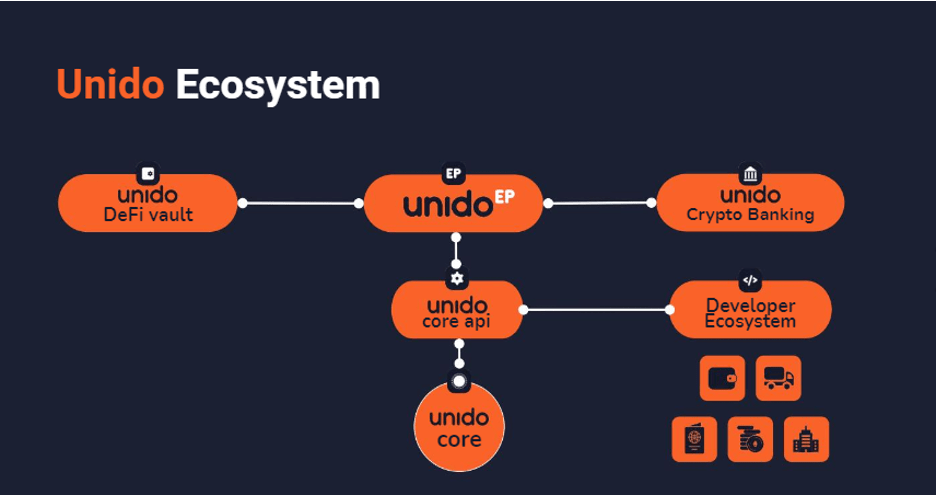
    Unido Ecosystem (source: Unido one-pager)

    Conclusion

    Unido EP aims to be a leader within the blockchain space by spearheading the race toward mass adoption; especially within the traditional financial sector. The platform’s drive to provide secured banking management tools is a great boost for wide DLT acceptance.

    Overall the Polkadot-based platform is a dynamic implementation of decentralized technology, which guarantees total accessibility and security through key features lacking in most solutions of its genre on the market.

    Unido Enterprise Platform is ahead of the curve as it provides a sure connection with blockchain giants, ensuring its growth and development in the future. Unido will likely become a leader within the blockchain given the protocol’s current algorithm and products.

    Decentralised Finance (DeFi) series: tutorials, guides and more

    With content for both beginners and more advanced users, check out our YouTube DeFi series containing tutorials on the ESSENTIAL TOOLS you need for trading in the DeFi space e.g. MetaMask and Uniswap. As well as a deep dive into popular DeFi topics such as decentralized exchanges, borrowing-lending platforms and NFT marketplaces

    The DeFi series on this website also covers topics not explored on YouTube. For an introduction on what is DeFi, check out Decentralized Finance (DeFi) Overview: A guide to the HOTTEST trend in cryptocurrency

    Tutorials and guides for the ESSENTIAL DEFI TOOLS:

    More videos and articles are coming soon as part of our DeFi series, so be sure to SUBSCRIBE to our Youtube channel so you can be notified as soon as they come out!

    Disclaimer: Cryptocurrency trading involves significant risks and may result in the loss of your capital. You should carefully consider whether trading cryptocurrencies is right for you in light of your financial condition and ability to bear financial risks. Cryptocurrency prices are highly volatile and can fluctuate widely in a short period of time. As such, trading cryptocurrencies may not be suitable for everyone. Additionally, storing cryptocurrencies on a centralized exchange carries inherent risks, including the potential for loss due to hacking, exchange collapse, or other security breaches. We strongly advise that you seek independent professional advice before engaging in any cryptocurrency trading activities and carefully consider the security measures in place when choosing or storing your cryptocurrencies on a cryptocurrency exchange.
  • SushiSwap ($SUSHI) Explained

    SushiSwap ($SUSHI) Explained

    Before we begin

    We’ve been closely following the events involving SushiSwap and its founder “Chef Nomi”. This article will not be making any comments or conclusions on Chef Nomi’s actions or how SushiSwap is or should be run. This article is simply an explainer on what SushiSwap is and how to use the platform. As with all yield farming projects, SushiSwap involves a huge amount of risk. Anyone intending to participate in yield farming should do full research and consider carefully the risks involved beforehand.

    What is SushiSwap ($SUSHI)?

    SushiSwap is the newest decentralised finance (DeFi) liquidity pool platform. With SushiSwap, people can add their tokens into the liquidity pools and earn. In this article, we’ll have a look at the Sushi Swap platform and how to participate in the liquidity pool. Anyone can participate.

    Sounds interesting? Let’s dive into it.

    Summary

    • SushiSwap is a platform that allows anyone to provide liquidity. In return, the person gets rewarded with token(s) and SUSHI tokens. 
    • As of September 4, 2020, there are 1 billion dollars of locked liquidity.
    • Possibility of very high APY (up to 1,000%) on some liquidity pools. You can check the current yields on SushiBoard.

    Why is SushiSwap so popular?

    Sushi Swap markets itself as an “improved and community-friendly” Uniswap. Unlike a traditional exchange like Binance where they employ market makers, SushiSwap is a community-oriented platform where users provide liquidity. In return, they get rewarded. Indeed, the users are the market makers.

    SUSHI token

    SUSHI tokens are given as rewards for liquidity mining. The token allows its holders to participate in the governance of the platform and entitles them to a portion of the fees paid to the protocol by traders. For the governance of the platform, SUSHI holders can submit a SushiSwap Improvement Proposal (SIP) which token holders can vote on with their tokens.

    Of course, some people also speculate on the prices of SUSHI and the token can be traded on major exchanges such as Binance, FTX and OKEx exchanges.

    Advantages of SushiSwap

    There is no KYC (Know Your Customer) policy. This means anyone can trade and contribute to the liquidity pools. The platform is permissionless, meaning anyone can contribute millions of dollars without asking for permission. 

    Earn tokens from Sushi Swap. SUSHI is Sushi Swap’s native token. When you contribute to the liquidity pool, you earn sushi tokens. You can exchange SUSHI for ETH. 

    Sushi Swap model: 0.25% go directly to the active liquidity providers and 0.05% get converted back to SUSHI and is rewarded to sushi holders. 

    Sounds interesting? Let’s visit Sushi Swap’s home page.

    SushiSwap beginners guide 

    When you first arrive on Sushi Swap’s home page, you’ll see this:

    Click on “Unlock Wallet” or “See The Menu”, either way you will need to connect your ETH wallet in order to this platform. 

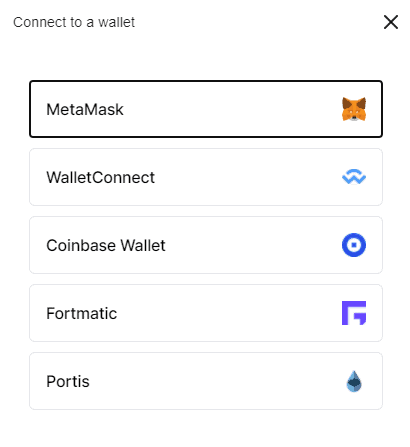
    Sushi Swap has the option to use MetaMask, WalletConnect or many other non-custodial wallets. Pick the one of your choice.

    Connect wallet
    Connect wallet

    Give permission for Meta Mask or Wallet Connect to connect to Sushi Swap. Once you’re connected, you’re ready to add your tokens into the liquidity pools. (hummingbirddental.ca)

    You’re presented with various liquidity pools (LPs). Each liquidity pool has a different annual percentage yield (APY).

    In this example, I’ll contribute to the ETH-USDT pool. I add my USDT into the liquidity pool. In return, I’ll get a percentage of USDT and SUSHI tokens. Think of Sushi Swap as a “community revenue share” model.

    To contribute to the liquidity pool, click “Approve USDT-ETH UNI-V2 LP” and give your Meta Mask permission to move your tokens into the liquidity pool. 

    Now what? You wait. The “SUSHI earned” box should populate with your earned SUSHI. You can withdraw your SUSHI token anytime by clicking on “Harvest”.

    2020 roundup and new roadmap!

    Many things have happened within the Sushiswap ecosystem in the last months: it is now time for a quick recap and to look at what the future will bring to this project!

    The number of all the partnerships finalized by the protocol is countless, but one of the most important ones, if not the most important, is certainly the merger with Yearn. The news also sparked controversies: Sushiswap was still considered a sort of “copycat” of Uniswap by some, and when Andre Cronje (Yearn’s father) wrote an article on how it is difficult to build in Defi and how conversely it is easy for anyone to just copy other people’s code, this wasn’t seen as really coherent. The collaboration was born to allow the two teams to cooperate on Deriswap.

    Nevertheless, Sushiswap has been evolving so much that, according to Mira Christanto (one of Messari’s data analysts) they have “put their past behind” and, not being backed by Venture Capitals, they can move faster than competitors. January has seen a real growth in Sushiswap’s TVL (now at $2.1 billion), mostly at the expense of Uniswap’s.

    Among the important milestones in 2020, we find Onsen, the new Sushiswap liquidity mining incentivization program which replaces the old Menu of the week. It brings communities together into the ecosystem and allows voted tokens to become accredited and participate in the mining program. The website also has a new layout of and a lite version.

    2021 Roadmap

    As the new year has already begun, it is also interesting to have a look at what Sushiswap is working on for 2021. The team released a long and detailed roadmap in early January. Notable upgrades are the following:

    • Mirin will be the new upgraded version of Sushiswap’s V3 protocol. It will include many new features like franchised pools, double yield, dynamic yield rebalancing, and many more as you can read here.
    • Bentobox (which should have launched in January) was born in the team’s mind as a new Lending Platform. While they were was working on its code though, it became something more. In simple terms, it will be a single vault that holds all tokens for any protocols and future extensions. It will support several oracles and it will also benefit all the $SUSHI holders.
    • Miso (Minimal Initial Sushi Offering) will be a sort of token launchpad, designed to drive new projects’ launches on the platform. It will include crowd sale options, IDOs (Initial Dex Offering), auctions, and more. We could think of it as something similar to Binance’s launchpad.
    • As Ethereum fees are and will keep growing in the next future until ETH2 will be a reality, most platforms are studying alternative solutions for their users such as Layer 2 possibilities. Unlike Uniswap, which is working on Optimistic Rollups, Sushiswap decided to move in sync with the greater Yearn ecosystem and thus will probably offer Zk-rollups options.

    Together with all these big news, Sushiswap is also planning to move to a new domain as the old one, in their view, is not enough to describe the diversity of the platform anymore. A transition to a fully decentralized governance structure is also planned by the end of 2021. Last but not least, Sushiswap has created a proposal page for people to express their ideas on what they would like to see on the platform. Everyone can be a chef is the place where you can voice your opinion if you like to suggest new ideas.

    FAQs

    Is it risky to provide liquidity to SushiSwap?

    The pool could get hacked if the code isn’t audited. There have been cases of hackers draining funds from smart contracts. It helps if the code is audited by a reputable firm. In the case of SushiSwap, it has been given a “security review” (not an audit) by Quantstamp. 10 issues were identified but they do not appear to be fatal. Subsequently, Peckshield had completed an audit on SushiSwap. They found no critical or high severity issues relating to business logistics but 2 high severity opsec issues that need to be fixed through extra care with deployment.

    What is the reward model of Sushi Swap?

    0.25% go directly to the active liquidity providers and 0.05% gets converted back to sushi and is distributed to active SUSHI holders.

    Decentralised Finance (DeFi) series: tutorials, guides and more

    With content for both beginners and more advanced users, check out our YouTube DeFi series containing tutorials on the ESSENTIAL TOOLS you need for trading in the DeFi space e.g. MetaMask and Uniswap. As well as a deep dive into popular DeFi topics such as decentralized exchanges, borrowing-lending platforms and NFT marketplaces

    The DeFi series on this website also covers topics not explored on YouTube. For an introduction on what is DeFi, check out Decentralized Finance (DeFi) Overview: A guide to the HOTTEST trend in cryptocurrency

    Tutorials and guides for the ESSENTIAL DEFI TOOLS:

    More videos and articles are coming soon as part of our DeFi series, so be sure to SUBSCRIBE to our Youtube channel so you can be notified as soon as they come out!

    Disclaimer: Cryptocurrency trading involves significant risks and may result in the loss of your capital. You should carefully consider whether trading cryptocurrencies is right for you in light of your financial condition and ability to bear financial risks. Cryptocurrency prices are highly volatile and can fluctuate widely in a short period of time. As such, trading cryptocurrencies may not be suitable for everyone. Additionally, storing cryptocurrencies on a centralized exchange carries inherent risks, including the potential for loss due to hacking, exchange collapse, or other security breaches. We strongly advise that you seek independent professional advice before engaging in any cryptocurrency trading activities and carefully consider the security measures in place when choosing or storing your cryptocurrencies on a cryptocurrency exchange.
  • Litentry ($LIT): Decentralized Cross-chain Identity Aggregator

    Litentry ($LIT): Decentralized Cross-chain Identity Aggregator

    Litentry ($LIT) is a decentralized cross-chain identity aggregator, built on Substrate, that features an identity matching and identity staking mechanism.

    In today’s world, personal data and identity are everything. Some companies in the conventional world make millions by selling user data. In the decentralized world, blockchain-based firms make losses.

    For example, one user can create multiple accounts to take advantage of free airdropped tokens. Also, platforms powering decentralized finance (DeFi) have no way of tracking users’ credit history, making them charge higher collateral when issuing loans.

    Fortunately, there’s a new way to keep track of identities in the distributed ecosystem securely. Powered by Litentry, we can see blockchain-focused platforms do more than just power token swaps. It’s now possible to scan through user’s deposit and withdrawal actions on Uniswap. Furthermore, a user’s activity can also be assessed on a community-governed blockchain.

    Since the platform is so diverse, below, we look at the major highlights.

    Background

    Litentry is developed by a team of blockchain professionals based in Germany. Its founder was among the early contributors of Parity, a decentralized network. Notably, the project engineering team’s background is rooted in Ethereum.

    The protocol is funded through a Web3 Foundation grant. On its Github page, the project lists eight team members with organization permission.

    What is Litentry?

    The project focuses on decentralized identity (DID), allowing user identities to be linked to multiple distributed protocols. Litentry acts as a DID aggregator where it collects, indexes, and distributes DIDs to blockchains.

    More importantly, it performs all these activities in a decentralized and verifiable way. Notably, built on the Substrate network, the platform works towards the greater goal of eradicating identity redundancy in the Web3-powered application ecosystem.

    The problem

    In the current internet world, third parties take control of storing user passwords and data pertaining to their online activity. Unfortunately, internet users are coerced into accepting unfavorable terms and conditions, consequently lessening the grip on their personal data.

    Litentry brings the change by returning the control of user data to the users by powering a user-focused internet using blockchain technology. As such, the revenue emanating from using users’ data gets the users to share in the profits. Before Litentry, these profits went to third parties managing the user data.

    Key Features of the Litentry platform

    Apart from using decentralized ledger technology (DLT), the platform has other critical features that help it bring the much-needed revolution to the blockchain sector. Key among them include:

    1. Identity management – The platform is all about identities, and their management sits at the protocol’s core. This feature powers anonymous and independent identities emanating from applications and or services used by the user.
    2. Distributed storage – After collecting the data, the protocol stores them in a decentralized manner to enhance access from all corners of the distributed world.
    3. Identity staking – This is a unique feature. Just like staking tokens and earning rewards, Litentry enables users to stake their identities and be rewarded.
    4. Decentralized contributors – Instead of creating multiple accounts to use different platforms or services, the project allows users to use one identity to interact with various services anonymously. Interestingly, the user doesn’t have to provide passwords or any other registration details.

    Litentry Architecture

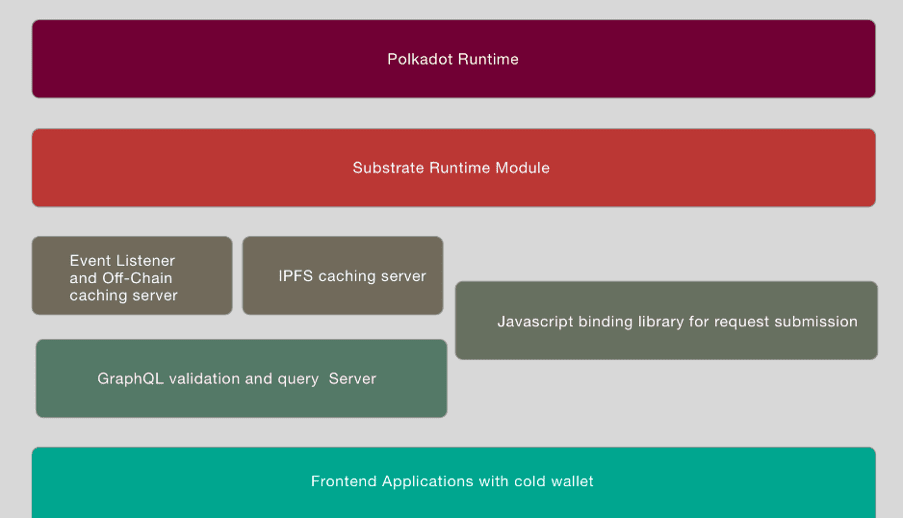
    Litentry Architecture (Source: Litentry Doc)

    To bring all the above features to life, the protocol uses a layered architecture. On the top layer is the Litentry Runtime, which sits on Substrate. The Runtime layer is a Parachain of Polkadot and employs offline workers when generating identities.

    The second layer is the User Side. Here, users flex their muscles when it comes to data under their control. Note that user data that comes from applications are anonymous, stored in a decentralized way, and cryptographically-separated.

    On the Litentry Authenticator layer, we have the mobile data hub. The hub can be used to manage a user’s different identities. Additionally, the hub can be connected to various IoT devices that the user wants.

    Next is the Litentry SDK enabling developers to fire up their creative juices to create completely decentralized applications and/or services. In addition, the Litentry IPFS data center offers users a chance to check the data attached to their identities.

    The middleware layer comprises services such as off-chain catching and query servers. It is also made up of a client-side SDK library that helps connect front-end apps with decentralized networks.

    Litentry Tokenomics

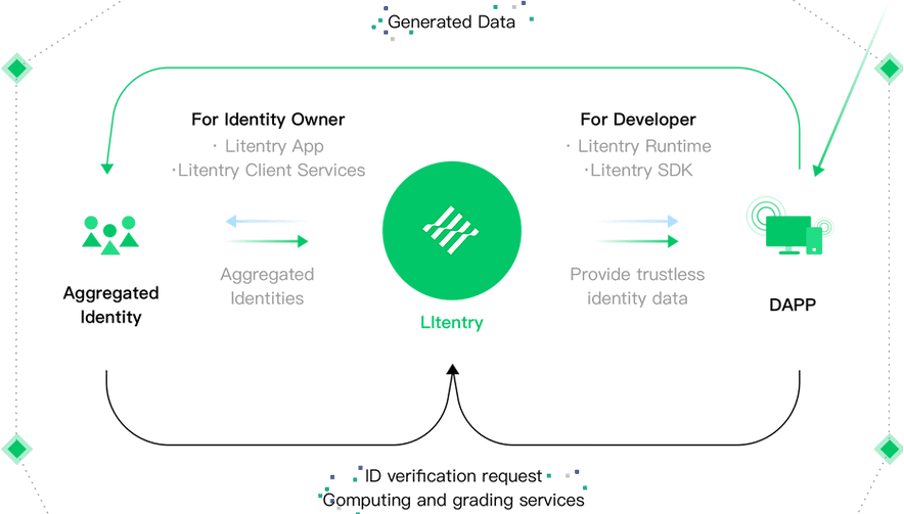
    The incentive mechanism on the Litentry platform takes into account different participants such as an identity staker, validator, external storage, node, and data buyer.

    1. Identity staker — This is the person who has an identity record and has a stake in the identities pool.
    2. Identity validator — An identity staker becomes a validator of new blocks when their identity has been confirmed.
    3. Storage — Stores all data about an identity in a decentralized manner.
    4. Node — The node is a critical component of the Litentry platform. Its work is to perform functions such as invoking off-chain workers to validate identity correctness and connecting with external decentralized storages.
    5. Data buyer — This is any entity on the blockchain that requests identity validation.
    6. Data generator — These are entities generating data and can include applications, users, or services offering migration services.
    Litentry Tokenomic (Source: Litentry Lightpaper)

    Litentry Native Token (LIT)

    Litentry’s base asset is called LIT. The network uses the asset to reward identity stakers in the identities pool. Two types of rewards the stakers get are the block reward and the matching fee.

    Apart from stakers, validators are motivated to truthfully verify the correctness of data. On the other hand, data generators enjoy benefits from the Litentry Foundation in the form of grants.

    External storage operators earn a section of the fee paid by users interfacing with the service. Others who are incentivized using LIT tokens are nodes.

    Those who pay using LIT tokens include identity buyers. Observe that these entities only have access to the winning identity or identities during an identity matching process.

    Conclusion

    The identity problem is two-pronged; users can create multiple entities to defraud a company. On the other hand, malicious actors aggregate user data and sell it to the highest bidder without profiting the real data owners.

    Fortunately, Litentry uses a layered approach to comprehensively tackle the problem to the benefit of both identity owners and decentralized platforms. Here’s to another promising project with a unique approach to solving some of the most crucial problems that often go overlooked.

    Decentralised Finance (DeFi) series: tutorials, guides and more

    With content for both beginners and more advanced users, check out our YouTube DeFi series containing tutorials on the ESSENTIAL TOOLS you need for trading in the DeFi space e.g. MetaMask and Uniswap. As well as a deep dive into popular DeFi topics such as decentralized exchanges, borrowing-lending platforms and NFT marketplaces

    The DeFi series on this website also covers topics not explored on YouTube. For an introduction on what is DeFi, check out Decentralized Finance (DeFi) Overview: A guide to the HOTTEST trend in cryptocurrency

    Tutorials and guides for the ESSENTIAL DEFI TOOLS:

    More videos and articles are coming soon as part of our DeFi series, so be sure to SUBSCRIBE to our Youtube channel so you can be notified as soon as they come out!

    Disclaimer: Cryptocurrency trading involves significant risks and may result in the loss of your capital. You should carefully consider whether trading cryptocurrencies is right for you in light of your financial condition and ability to bear financial risks. Cryptocurrency prices are highly volatile and can fluctuate widely in a short period of time. As such, trading cryptocurrencies may not be suitable for everyone. Additionally, storing cryptocurrencies on a centralized exchange carries inherent risks, including the potential for loss due to hacking, exchange collapse, or other security breaches. We strongly advise that you seek independent professional advice before engaging in any cryptocurrency trading activities and carefully consider the security measures in place when choosing or storing your cryptocurrencies on a cryptocurrency exchange.
  • XFai ($XFIT): Can it resolve the liquidity and gas fee issues in DeFi?

    XFai ($XFIT): Can it resolve the liquidity and gas fee issues in DeFi?

    XFai is a decentralized oracle service provider that aims to address liquidity and gas issues in decentralised exchanges (DEXs) through a so-called DEX Liquidity Oracle which will revolutionise cryptocurrency trading whilst reducing gas fees.

    If you are a regular DEX trader, you might notice that there are times when you can’t complete trades. This happens often with small-cap tokens that do not have enough liquidity. In this case, traders have two options, either to wait it out until there’s enough liquidity or to increase price slippage tolerance. But either way, it can result in huge losses on the part of a small-cap token holder.

    XFai wants to address this problem by empowering DEXs with liquidity that can be supplied to small-cap tokens. This equalizes the playing field for every single trader, allowing them to execute their strategy without having to shoulder massive costs just because a DEX might not have enough liquidity on any particular trading pair.

    Check out our interview with XFai’s Chief Scientist, Taulant Ramabaja.

    Background

    The problem with many DEXs today is liquidity. While liquidity pools and profit-generating DeFi systems like yield farming have offered revolutionary solutions in the last year or so, DEXes still face this concern. This leaves many traders vulnerable to huge price slippages and losses. And if the issue persists, cryptocurrency traders might be discouraged and go back to trading mostly on centralized exchanges despite having less options.

    This is what XFai worked is trying to solve.

    XFai, which was co-founded by Geoffrey Khan, was developed in order to deal with the problems hounding DeFi markets today. It has gained a substantial amount of support, garnering investments from companies like AU21 Capital, LD Capital, and Roger Ver, one of the earliest adopters of blockchain technology and the CEO of Bitcoin.com. It is also worth mentioning that they were able to generate over $3.8 million within the first 12 hours of their private sale.

    What is XFai?

    XFai is a decentralized oracle service provider with the aim of addressing liquidity and gas issues in DEXs through a DEX Liquidity Oracle (DLO). This means that the protocol’s role is not only limited to supplying data to price feeds and engaging with smart contracts, but is also capable of actively providing and managing token liquidity in partner DEXs such as Uniswap.

    The primary goal of the project is to support small cap tokens and token holders by establishing a system that helps them earn better rewards. In other words, the project seeks to help them gain as much in incentives as they can, just like how a holder of a large cap token does.

    DEX Liquidity Oracle

    XFai’s DLO is powered by the XFai smart contract, which allows users to stake small cap tokens that can later be supplied to Uniswap pools according to corresponding price ranges and existing orders. The biggest trades facilitated on Uniswap exchanges will be provided with the liquidity collected from the DLO.

    This does not just benefit large volume trades for small cap tokens, but also those who supply liquidity on the same tokens. They receive rewards when they do so as well. The good thing about DLO is that it does not require liquidity providers to supply all the assets supported in a liquidity pool. They can choose to simply supply a single token in a pool, which also mitigates the risks of impermanent loss on their end.

    What supports this function further is its real-time price feed from centralized exchanges. Furthermore, the liquidity from the DLO is easily accessible to DEXs, addressing the issue on price slippage. This is exactly the goal of the XFai team, to support the current DEXs in the market and not to present itself as a competitor.

    How Does XFai Work?

    First, the user has to add tokens on the DLO liquidity vault/pool. The DLO is governed by a smart contract that also sends the tokens to partner DEXes when liquidity is needed. Note that users do not need to supply multiple assets at a time anymore, thereby reducing their exposure.

    Second, the DLO looks into the data from existing order books from other exchanges to determine existing prices and trading volume. Then, it comes up with a synthetic curve which they will use in order to pair DLO liquidity with partner DEXs.

    Then, there is a smart contract that governs how and when liquidity is supplied to a DEX using the synthetic curve. The goal of the contract is to ensure that enough liquidity is met by AMMs in order to avoid price slippage while allowing small cap token holders to supply liquidity without incurring impermanent loss.

    XFIT Token

    XFIT token is XFai’s native, utility token, which can be used as a medium of exchange, store of value, and means of payment for transaction fees. But more than that, it also has governance and reward functions. Liquidity farming is accessible in XFIT and all other DLO pairs.

    To start liquidity mining, holders can stake their tokens in select pools to earn proportional rewards. Each time the DLO profits from the trades conducted by its platform users, token holders earn additional XFIT. They can either redeem XFIT tokens to be later sold to the market, or they can decide to return their rewards back to liquidity pools in order to increase their stake position.

    In addition, XFIT token holders are also entitled to discounts on transaction fees if they use XFIT. They can also make direct swaps from XFIT to any other token in the protocol as long as they are supported by the DLO.

    XFai Liquidity Generation Event: How to stake XFIT

    The XFai liquidity generation event is a way to allow users to become involved with XFai’s XFIT token early, and stake them in the liquidity pool in order to earn increased, sustained yield throughout the launch period.

    To participate, users can go on the XFai website and click on “Farm”, then choose your preferred pool. Note that the APY is synced for all pools so they earn the same amount of APY as each other. Then click “Connect Wallet” to connect using MetaMask, once connected the dashboard will automatically calculate how much XFIT you can purchase with the amount in your wallet. Select the amount you want to stake and hit “Farm”.

    Whilst farming, you have the option to either Add to Farm, which allows you to increase your stake or Harvest, which allows you to claim your XIFT rewards.

    To claim your rewards, click “Harvest” and you would be presented with the option to Harvest XFIT or Harvest XFIT and unstake. Harvest XFIT allows you to claim the XFIT tokens gained into your wallet whilst keeping the staked amount in the liquidity pool to keep farming more XIFT rewards. On the other hand, Harvest XFIT and unstake means you can claim your XFIT rewards and unstake the staked amount (or any part of it) from the pool.

    The XFai LGE will be from 16th April to 7 May 2021.

    For a full guide on how to farm XFIT, click here.

    Conclusion

    Perhaps one of the largest factors that stop people from completely shifting their cryptocurrency trading activities to DEXs is the liquidity problem, apart from the fees. It is difficult to execute trades with low liquidity and even if they often do, sometimes, it takes multiple slippage tolerance adjustments before a trade gets to be completed.

    While this can look trivial for some people, this is something that can’t be neglected. If XFai takes off, the DeFi space might experience a better market situation. If traders do not have to be burdened by price slippages and if liquidity further improves through the same solutions the XFai team did, DEXs can be even more alluring to everyone, which would help speed up adoption.

    Disclaimer: Cryptocurrency trading involves significant risks and may result in the loss of your capital. You should carefully consider whether trading cryptocurrencies is right for you in light of your financial condition and ability to bear financial risks. Cryptocurrency prices are highly volatile and can fluctuate widely in a short period of time. As such, trading cryptocurrencies may not be suitable for everyone. Additionally, storing cryptocurrencies on a centralized exchange carries inherent risks, including the potential for loss due to hacking, exchange collapse, or other security breaches. We strongly advise that you seek independent professional advice before engaging in any cryptocurrency trading activities and carefully consider the security measures in place when choosing or storing your cryptocurrencies on a cryptocurrency exchange.
  • Best Crypto Savings Accounts 2022

    Best Crypto Savings Accounts 2022

    Let’s be honest, traditional banking methods are starting to lose their value. Brick-and-mortar banks are paying disappointingly low rates on savings accounts these days. So if you want a higher return for lending out your money, it might just be the right time to explore alternative routes to engage your idle cash.

    More and more investors are exploring the advantages of cryptocurrency savings accounts. A crypto savings account allows you to enjoy the benefits of an old-school savings account but with the growth potential of cryptocurrencies.

    In this guide, we will explore some of the best crypto savings accounts for you to earn interest with your crypto assets.

    What is a Crypto Savings Account?

    The concept of crypto savings accounts are similar to traditional savings accounts. You put crypto assets into your crypto savings account, which are then lent on your behalf by a third party. The difference with a traditional account is that instead of dealing with fiat currency you will keep your funds in the cryptocurrency of your preference. 

    If you are looking for high returns but don’t want the risk of volatility in cryptos like Bitcoin or Ethereum, you can also choose to earn interest on stablecoins that offer high rates with more stability. Stablecoins are fixed to the value of the US dollar so you will not be exposed to cryptocurrency price fluctuations. 

    The best crypto savings accounts offer up to 12% interest on stablecoins and lets you earn 6% interest on popular assets like Bitcoin and Ethereum.

    What are the Best Crypto Savings Accounts for 2022?

    With so many players in the market, it may help to compare crypto interest rates side-by-side before deciding on where to put your money. That being said, high interests should not be the only consideration for choosing a crypto savings account. Some other factors to consider are supported coins, compound interest, loan-to-value rates, withdrawal restrictions, transaction fees and security. You should always choose a platform that best fits your needs.

    Let’s have a look at some of the best and most trusted crypto savings account providers for 2022.

    Nexo

    nexo crypto savings

    Nexo boasts a high yield of interest, as high as 20% APY, on a wide range of cryptocurrencies. It also has a minimum lock-up time below 24 hours, which means that the interest is paid on a daily basis. The platform also has security measures like two-factor authentication (2FA), login alerts, and withdrawal confirmation.

    With no account minimums and a tiered withdrawal system, Nexo allows you to make instant transfers with no fees or restrictions. You may withdraw any amount for free up to the percentage of NEXO tokens you possess. A Mastercard debit card is also available and accepted by millions of merchants worldwide.

    NEXO token owners earn bigger interest rates on savings accounts. Daily compounded interest is credited to your account, so there’s no need to wait a month to begin earning passive income.

    Despite the fact that the platform is jam-packed with features, it is geared toward novices. It is simple to learn and even easier to get started.

    Highlights:

    • Daily payouts
    • No minimum deposit
    • Tiered withdrawal limits
    • Clean layout and shallow learning curve

    Consensus:

    Best for daily interest and beginners

    Gemini Earn

    gemini earn crypto savings

    Since its inception, Gemini has best been known for its unbeatable high-level security. When a certain amount is deposited, a vast majority of it is stored offline, in an air-gapped cold storage system, and only a small amount is stored in hot wallets. This minimizes the chances of theft and malware attacks. Gemini also provides two-factor authentication (2FA) and bug bounty to prevent hacking. According to reports, Gemini has secured the highest amount of insurance, around $200 million.

    With Gemini Earn, you can receive up to 8.05% APY on your cryptocurrency, including stablecoins. Gemini is highly rated, secure, and simple to use for basic functions like making a trade or linking to external bank accounts. There are some good educational tools available on the website and app and it also offers competitive rates, a broad variety of cryptos, and a solid yield on stablecoins.

    Gemini is a sophisticated trading platform that is ideal for amateur and experienced traders and investors of all skill levels. However, the fee structure for small transactions is expensive, as is the case with most exchanges. There is no linked debit card but you can shop at a variety of internet retailers through their mobile app.

    Highlights:

    • Most safe and secure provider
    • No minimum deposit
    • No withdrawal fee, but costly transactions fee and convenience fee
    • No collateral required for loans

    Consensus:

    Best for security

    Binance Earn

    Binance earn crypto savings

    Binance Earn is the one-stop crypto interest solution from Binance. With Binance Earn, you get a complete suite of staking and savings products for earning passive income on your crypto holdings without any trading involved. There are more than 60+ cryptocurrencies and stablecoins to choose from and you can earn interest under fixed or flexible terms.

    Users can select between regular savings products, staking, and DeFi solutions, each with its own risks, terms, and returns. These include Savings with flexible or fixed terms, Locked Staking, DeFi-Staking, ETH 2.0 Staking, Liquid Swap, Launchpool, and the BNB yield aggregator Vault.

    If you’re not interested in trading but want to increase your holdings, the interest-bearing products from Binance are worthy of choice. While the many features can be overwhelming at first, the savings and staking solutions from Binance could potentially create a passive income if you’re willing to learn how to use them.

    Highlights:

    • Flexible and locked terms
    • Minimum deposits varies
    • Largest cryptocurrency exchange in the world
    • Overwhelming for beginners

    Consensus:

    Best for experienced traders looking for flexibility

    YouHodler

    youhodler crypto savings

    YouHodler is a European bank-like crypto asset management platform with offices in Cyprus and Switzerland. The platform focuses on long-term cryptocurrency holdings, offering attractive crypto savings accounts with high compound interest of up to 12.3% APR and crypto-fiat loans with high loan to value ratios of up to 90%.

    YouHodler has no lock-up periods, and investors are allowed to withdraw or sell their assets at any given time. Accumulated interest is paid out once every week, and the weekly interest period starts compounding as soon as you deposit funds into your savings account.

    YouHodler keeps your digital assets secure with insurance, two-factor authentication, withdrawal stopping feature, and by using a combination of hot and cold storage. It also has bonus features like crypto-backed loans, margin trading, and it also supports NFTs.

    Highlights:

    • Weekly payouts
    • No lock-up period or special tokens required to get the best rates
    • 5 USD minimum deposit
    • Zero weekly or monthly fees

    Consensus:

    Best all-in-one

    Coinloan

    coinloan crypto savings

    CoinLoan ranks next to Gemini when it comes to the safety and security of your digital assets. Apart from their security features, CoinLoan also offers about 26 types of cryptocurrencies offering APYs between 3% to 12.3%, which vary depending on the type of cryptocurrency. 

    Interest for crypto is accrued daily on your deposit and credited directly to your wallet on the first day of each month. There is no minimum deposit requirement.

    Coinloan is a European-based cryptocurrency lending and borrowing platform licensed and authorized in the EU. For security, CoinLoan stores crypto-assets in offline, cold, multi-signature wallets with the digital asset trust custodian BitGo with $100 million worth of insurance from Lloyd’s. Furthermore, all transactions are done in accordance with Cryptocurrency Security Standard (CCSS).

    Highlights:

    • Licensed and certified platform with fund insurance
    • No minimum deposit
    • Intuitive and easy-to-use platform
    • Excellent customer support

    Consensus:

    High yields and second best for security

    Coinbase

    coinbase crypto savings

    Coinbase is one of the most well-known names in crypto wallets as well as holding and trading cryptocurrency. They also cater as one of the best crypto savings accounts for newbies. Coinbase does not loan out the currency that you invest in, and this is what makes it a great alternative to traditional banks because there are fewer restrictions when it comes to funding withdrawal.

    The crypto savings account provides a wide range of currencies with small minimum deposits needed. Coinbase has a simple, top-rated mobile app with additional features. There is a wide range of beginner tutorials, crypto hints, and lessons in the app. You may also get free cryptocurrency by enrolling in certain courses.

    The current APY for stablecoins is around 4% compounded monthly. Because Coinbase is said to be more rigorous in its lending procedures, the yield is relatively modest.

    Coinbase charges a high 0.50% fee on every transaction, which few people are willing to pay for tiny purchases. On most currencies, interest rates are little. More experienced traders may want more sophisticated trading tools and low trade costs.

    Highlights:

    • Well-known and trusted platform
    • Easy-to-use for beginners with plenty resources and tutorials
    • Low yields
    • High transaction fees

    Consensus:

    Best for beginners

    Conclusion

    Cryptocurrencies are quickly becoming mainstream, and an increasing number of providers now offer crypto savings accounts that pay monthly or daily dividends. These platforms provide a great investment opportunity for crypto owners looking for ways to generate passive income.

    With such a high yield, it’s no surprise that crypto owners are increasingly demanding reliable crypto savings accounts to put their money to work for them. However, before you invest your hard-earned savings in any crypto savings account, there are many factors to consider.

    If chosen wisely, crypto-based savings accounts can provide pretty good long term returns. 

    It all depends on the choices you as an investor make in terms of the currencies you choose, the duration and size of your investment, and your risk-taking ability.

  • Aries Market Guide

    Aries Market Guide

    Aries Market is a decentralized cryptocurrency exchange built on Move, the same programming language used by Aptos to build its blockchain. Aries Market provides a wide range of decentralized finance (DeFi) products such as borrowing, lending, and margin trading on 1 single platform. Products include lending, borrowing, margin trading, swapping, and account risk management.

    What is Aries Market?

    Aries Market is a decentralized crypto exchange offering a wide range of DeFi products on a unified platform. On Aries Market, users can have a unified margin account on which they can borrow from various liquidity pools, earn interest on deposits, and do swaps and trades.

    What products are available on Aries Market?

    Aries Market is currently in a “soft launch” phase where all its features are not available yet. At present, the following products are available on Aries Market: lending, borrowing, swaps, and global account management. Notably, trading features are not yet available on Aries Market.

    There are, however, deposit limits for the available asset pools on Aries Market. The limits are as follows: 4 million zUSDC (LayerZero), 4 million USDC (Wormhole Bridge), 500,000 APT, 10,000 SOL.

    Aries Market
    Aries Market

    Supported assets

    Aries Market currently supports the following assets: zUSDC (LayerZero), USDC (Wormhole Bridge), APT and SOL. The team expects more assets to be listed soon.

    Coming soon on Aries Market

    The Aries Market team expects the following features to be available in the coming months:

    • Full set of features will be available on Aries Market;
    • integration of Aries Market with Aptos; and
    • Gamified events and campaigns on the Aries Market and Aptos community.

    Learn more about Aries Market

    Twitter

    Medium

    Website