Category: Decentralised Finance (DeFi)

Decentralized Finance (DeFi) is a sector within the cryptocurrency and blockchain space which aims to provide a decentralized version of the products available in traditional finance- without central control and at a lower cost with potentially higher returns. These products include loans, interest-bearing deposits and borrowing services.

The advantages of decentralized finance are that it addresses the problems we have with the traditional banking system. For example, decentralized finance protocols are controlled by multiple people, and all participants are required to abide by the rules written into the smart contracts underlying the protocols.

  • Cream Finance ($CREAM): What is it?

    Cream Finance ($CREAM): What is it?

    CREAM Finance ($CREAM) stands for Crypto Rules Everything Around Me. The project began with a vision to establish a financial system more accessible than its traditional counterparts. So CREAM has created an ecosystem that can be linked with other Ethereum platforms to efficiently provide a spectrum of services for its users. The liquidity mining trend, which is currently the most talked-about aspect of the decentralised finance (DeFi) space due to its potential high returns has also helped CREAM establish its popularity and footing in this field.

    Background

    Jeffrey Huang, the Founder of CREAM Finance, believes in the capacity of cryptocurrencies to create an open and inclusive financial system. And through the help of smart contracts, Huang’s team went on to create a DeFi ecosystem that would link together multiple products and services that many users need today.

    In recent weeks, the team has been continuously working on expanding its listing and preparing for the launch of its CREAM token. The launch of their beta liquidity mining on 12th August 2020 has been the subject of discussions in some social media platforms.

    What is CREAM Finance?

    CREAM Finance is a DeFi ecosystem focused on providing lending, exchange, payment, and asset tokenization services. It also claims to operate a permissionless and open-source protocol so any other internet participant can be a part of the development of the network, instead of just using it or locking up funds in smart contracts for staking rewards.

    Financial inclusion is among the team’s primary goals. And the objective is to be able to achieve it without compromising the safety and security of each user and their assets.

    Since CREAM is established on the Ethereum blockchain, it can take advantage of smart contracts that can be used to run Ethereum Virtual Machines (EVM). Such a set-up also allows the CREAM project to have better composability than other DeFi projects.

    EVMs can also help community users develop their own decentralized applications (Dapps) on top of the network. However, there is very little detail on the community’s plans for such at the moment.

    CREAM plans to launch its own algorithmic money market protocol on top of Binance Smart Chain (BSC) in the weeks to come. When it is finally deployed, it might ensure that the platform can take advantage of the transaction throughput and cost-efficient servicing available only on the BSC and other similar chains. In addition, linkage with the Binance Chain can provide them with better liquidity through its access to the biggest cryptocurrencies.

    There has not been any report yet on the audits being done for CREAM’s smart contracts. But according to a recent release they made, they recently hired a security adviser to work on the necessary platform developments.

    The first monthly payment the team has made to the new adviser totaled to 37,500 CREAM. Some of the more prominent crypto advisers on-board is Robert Leshner, CEO of Compound Finance. Leshner acts as one of the team’s technical advisers.

    CREAM’s Lending Services

    The emerging trend of DeFi projects facilitating peer-to-peer lending services enticed the team behind CREAM to work on a protocol that can do something similar. Available assets that users can borrow from the CREAM ecosystem include BAL, COMP, ETH, CRV, LEND, REN, BUSD, USDC, USDT, and YFI.

    CREAM is looking forward to the launch of BSC. When it is already available, users can take advantage of CREAM’s link with Binance through the BEP2 standard, or pegged tokens, to make the transfers of XRP, BCH, LTC, and TRX much easier.

    Without having to wrap tokens, CREAM transactions on BSC can be performed faster and more affordably.

    CREAM Token and Liquidity Pools

    The CREAM token, i.e. the CREAM platform’s native asset is available on Uniswap and Balancer. As at 25th August 2020, the CREAM token market cap is over $11.8 million, with a circulating supply of 149,927 CREAM. The total supply, however, is at 9 million CREAM.

    CREAM was recently launched in August 2020 yet the platform already has a total of roughly $48 million in total value locked (TVL). Although it certainly wasn’t able to emulate Yearn Finance’s ($YFI) meteoric rise, it is still a notable DeFi protocol since it has gained a lot of traction after only being in the market for a few weeks.

    Since there is a growing number of crypto users participating in liquidity mining or yield farming, the team behind CREAM also launched their own liquidity mining program. On 24th August 2020, CREAM also announced their v3 Beta Liquidity Mining program, some of their updates include increasing the rewards for 3 of their pools.
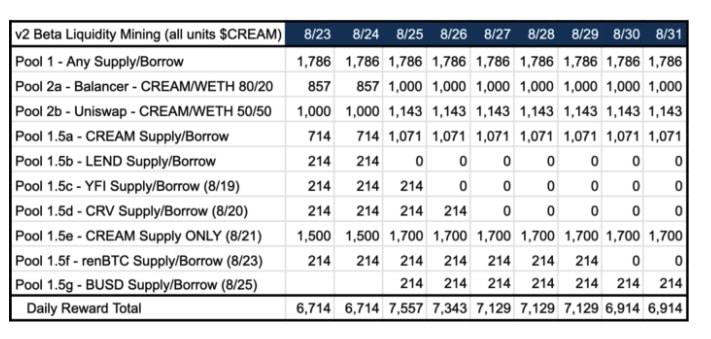
    CREAM pools (Image credit: Cream Finance)

    Conclusion

    CREAM is a relative newcomer to this space and we can see that they are continuously building and listing more assets onto their platform. They have recently updated the rewards available on their liquidity mining pools and are transparent on their liquidity mining distribution. So be sure to check their Medium where they provide announcements and updates at least once a day. The team behind CREAM are also very responsive on social media in terms of answering people’s queries about them.

    Finally, considering the inclusion of some very prominent crypto personalities and their linkage with the biggest exchanges and protocols in the space, the future of CREAM looks promising so far. Looking at the service they are offering, it sure seems that it fits into what many cryptocurrency users need from the market.

    Decentralised Finance (DeFi) series: tutorials, guides and more

    With content for both beginners and more advanced users, check out our YouTube DeFi series containing tutorials on the ESSENTIAL TOOLS you need for trading in the DeFi space e.g. MetaMask and Uniswap. As well as a deep dive into popular DeFi topics such as decentralized exchanges, borrowing-lending platforms and NFT marketplaces

    The DeFi series on this website also covers topics not explored on YouTube. For an introduction on what is DeFi, check out Decentralized Finance (DeFi) Overview: A guide to the HOTTEST trend in cryptocurrency

    Tutorials and guides for the ESSENTIAL DEFI TOOLS:

    More videos and articles are coming soon as part of our DeFi series, so be sure to SUBSCRIBE to our Youtube channel so you can be notified as soon as they come out!

    Disclaimer: Cryptocurrency trading involves significant risks and may result in the loss of your capital. You should carefully consider whether trading cryptocurrencies is right for you in light of your financial condition and ability to bear financial risks. Cryptocurrency prices are highly volatile and can fluctuate widely in a short period of time. As such, trading cryptocurrencies may not be suitable for everyone. Additionally, storing cryptocurrencies on a centralized exchange carries inherent risks, including the potential for loss due to hacking, exchange collapse, or other security breaches. We strongly advise that you seek independent professional advice before engaging in any cryptocurrency trading activities and carefully consider the security measures in place when choosing or storing your cryptocurrencies on a cryptocurrency exchange.
  • Mantra DAO ($OM): The DeFi project that’s all about community

    Mantra DAO ($OM): The DeFi project that’s all about community

    Mantra DAO ($OM) takes decentralized finance’s (DeFi) innovation of financial networks were users’ voices are heard one step further- by incentivizing token holders to participate in the maintenance and activity of the platform. Mantra also solves the problem that most DeFi projects face — user inactivity. Apart from providing financial services, Mantra gives its users rewards for assisting in system development. But how is Mantra doing this?

    Background

    Mantra DAO’s council is composed of various crypto experts including John Patrick Mullin, Will Corkin, James Anderson, Rodrigo Quan Miranda, and Stephane Laurent Villedieu. They are experienced crypto developers with backgrounds in finance and entrepreneurship.

    The project was developed to leverage the “knowledge and wisdom of the crowd” to create a fully-decentralized ecosystem. With an aim to give financial control back to the people, Mantra’s team decided to build a new financial protocol with community-governance functions.

    What is Mantra DAO?

    Mantra DAO is a Decentralized Autonomous Organization (DAO) built on the Parity Substrate for the Polkadot ecosystem, focused on staking and lending. It also features more community governance functions through its native $OM token.

    The ecosystem supports the following features:

    • Multi-asset staking and lending platform — Users can perform multiple types of transactions like savings, lending, and governance as Mantra DAO provides cross-chain access to other existing DeFi projects.
    • Merit-based reward system – Through Mantra’s incentive system, users can gain rewards for actively using the platform.
    • DAO – Through its native token, users can gain exclusive voting rights on important protocol decisions.
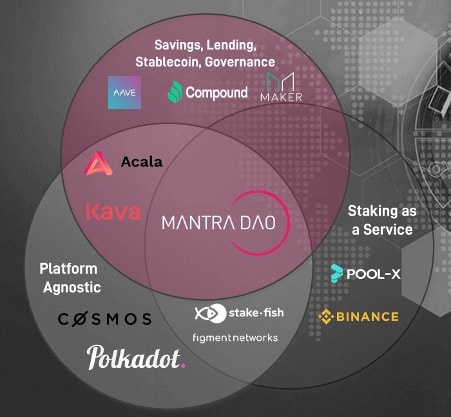
    What is Mantra DAO
    What is Mantra DAO (Image credit: Mantra DAO)

    Rio Blockchain

    The network is built on top of the Rio blockchain. And compared with other systems, Rio can process up to 3,000 transactions per second (tps) — a hundred times higher transaction throughput than Ethereum and Bitcoin combined.

    RioChain is also an interoperable system, allowing various entities and dApps across various blockchains to interact with each other smoothly.

    How does the DAO work?

    Users are given the option to stake or lend their digital assets by depositing them on Mantra’s smart contracts. These assets are pooled and can be loaned to other users to power the platform’s lending service.

    When users stake their assets, they gain interest fees and OM tokens in return. The following are Mantra’s primary services:

    Staking and Lending – Users can stake tokens like Polkadot (DOT), supported DPoS assets, and OM. In return, they receive staking rewards in the form of OM tokens. Users have the option to collateralize their loans with OM as well.

    Ownership and Governance – Holders of OM gain voting rights on Mantra’s DAO. This means that any important changes and parameters implemented in the platform are voted on by OM holders. These decisions can be anything from adjusting interest rates, level of inflation and grant allocations, among others.

    Reputation – Mantra implements a reward system named the KARMA protocol. This is designed to recognize the contribution of OM token holders in the platform by way of providing reputation points.

    The KARMA protocol

    Karma is Mantra’s reputation mechanism that plays a vital role in the ecosystem by enabling the reward and incentivization of its users to execute certain activities. Users who perform various actions with the system are rewarded with KARMA.

    The Karma Protocol has 10 tiers, each of them unlocks various perks that would allow users to enjoy extra incentives to increase their OM token, reduce fees, gain more rewards, etc.

    Here are some of the network activities that can help OM holders gain Karma points:

    • Staking their OM tokens, loaning from the platform, or loan repayments;
    • Governance participation, such as voting on protocol proposals;
    • Joining the Mantra pool; and
    • Referrals

    OM Token

    The whole Mantra ecosystem is powered by the OM token. OM allows community members to influence the direction of the whole project, access collateralized loans and compounded interest, and join the Mantra pool.

    When OM is used to enter the Mantra pool or pay for interest fees on their loans, that token is transferred to Mantra DAO’s burn wallet. This process is somehow different from the popular MakerDAO because the tokens are burned on a quarterly basis. The token burn will continue until eventually, a total of 50% of all the OM in supply is gone.

    Staking OM

    Mantra DAO has enabled a non-custodial staking service on the tokens DOT, KSM, and OM. In the future, other Polkadot supported tokens (RING, PCX, and ACA) and DPoS assets (XTZ, TRX, ADA, EOS, ELA) will also be made available.

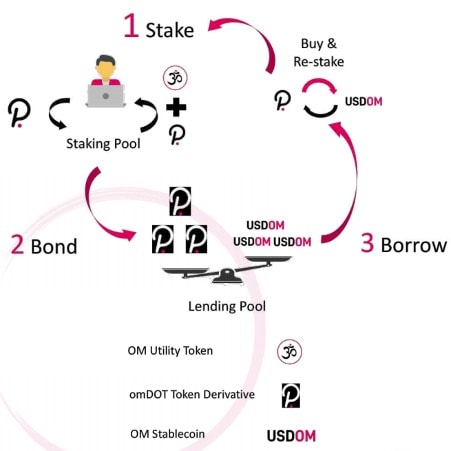
    Mantra DAO's staking mechanism
    Mantra DAO’s staking mechanism (Image credit: Mantra Dao whitepaper)

    Mantra distinguishes the staking of assets based on their chain and token type. DPoS assets are charged with a staking fee while Polkadot assets are not. These parameters, however, can be affected by the decision of the community in the near future.

    What is being developed in the pipeline is Mantra’s plan to add custodial staking-as-a-service (SaaS) products on other PoS assets.

    Borrowing in Mantra

    Mantra is working on different lending services that follow three phases.

    Phase 1 – Open Source Lending Protocol

    Through Mantra’s composability, it will provide cross-chain access to other DeFi lending protocols. The purpose of this is to offer Mantra users the opportunity to earn from lending interest fees gained from ERC-20 assets.

    Phase 2 – Third-Party Lending Service Providers

    This will aim to provide access to high-interest savings options and stablecoin loans through partnerships with third-party lending service providers. All of these services will be made accessible on Mantra’s platform.

    Phase 3 – Own Proprietary Lending Algorithm

    In the future, Mantra will launch its own proprietary lending algorithm and stablecoin system which can be collateralized by multiple assets, even those that are on top of other chains. Through tokenized derivatives, users can generate staking rewards while applying for stablecoin loans.

    Mantra Pool – Rewarding Savings

    Mantra has developed a savings game, not only to incentivize staking but to give users the chance to share Mantra DAO’s staking rewards. Winners will be chosen weekly and they will be selected randomly from the participants.

    To join the Mantra pool, users have to burn OM tokens. If they have enough Karma points, they can also be given automatic entries to the pool.

    The funds assigned for the rewards in the Mantra pool comes from 25% of the staking rewards generated by Mantra DAO assets. The prize will be given as a basket of its native assets like Polkadot (DOT), Kusama (KSM), Tezos (XTZ), and OM. If they choose to convert these rewards to OM, they gain interest income on top.

    Conclusion

    Mantra DAO belongs to one of the many DeFi projects seeking to provide crypto users with better control over how their protocol runs. The problem with many other DAO projects is that while they have locked-up value in their smart contracts, voting participation is actually low.

    Through Mantra’s incentive model for governance participation, there is a strong likelihood that the development of the protocol will be a result of its community’s decisions.

    Decentralised Finance (DeFi) series: tutorials, guides and more

    With content for both beginners and more advanced users, check out our YouTube DeFi series containing tutorials on the ESSENTIAL TOOLS you need for trading in the DeFi space e.g. MetaMask and Uniswap. As well as a deep dive into popular DeFi topics such as decentralized exchanges, borrowing-lending platforms and NFT marketplaces

    The DeFi series on this website also covers topics not explored on YouTube. For an introduction on what is DeFi, check out Decentralized Finance (DeFi) Overview: A guide to the HOTTEST trend in cryptocurrency

    Tutorials and guides for the ESSENTIAL DEFI TOOLS:

    More videos and articles are coming soon as part of our DeFi series, so be sure to SUBSCRIBE to our Youtube channel so you can be notified as soon as they come out!

    Disclaimer: Cryptocurrency trading involves significant risks and may result in the loss of your capital. You should carefully consider whether trading cryptocurrencies is right for you in light of your financial condition and ability to bear financial risks. Cryptocurrency prices are highly volatile and can fluctuate widely in a short period of time. As such, trading cryptocurrencies may not be suitable for everyone. Additionally, storing cryptocurrencies on a centralized exchange carries inherent risks, including the potential for loss due to hacking, exchange collapse, or other security breaches. We strongly advise that you seek independent professional advice before engaging in any cryptocurrency trading activities and carefully consider the security measures in place when choosing or storing your cryptocurrencies on a cryptocurrency exchange.
  • Yam Finance – Elastic Supply Token gone wrong

    Yam Finance – Elastic Supply Token gone wrong

    YAM Finance is a new elastic supply token where the supply of the token expands and contracts in response to the token price – with the ultimate aim of stabilizing to a $1 USD PEG. A 12 hour “Rebase” will increase/decrease the total supply of the token depends on its price. This means that after a rebase, wallets holding YAM will experience changes to the balance even if no YAM is sent out of the wallet. This concept is similar to Ampleforth (AMPL). YAM has gained enormous attention after it’s launch on the 12 of August due to its extremely high Yield Farming (More than 1000% APY) rewards and Meme suitability. On top of this, the elastic supply of YAM means that it catches the attention of those who missed out on the AMPL hype train.

    VOLATILITY WARNING: YAM supply is currently VERY as it was only recently launched. Expect circulating supply to increase over the next few days.

    What happened to $YAM?

    Due to a smart contract bug, the $YAM smart contract is no longer governable and no future modifications can be made. Initially, as part of the experiment, $YAM had a governance feature that allowed the community to vote on new features and add functionality to the contract. However, the bugged smart contract meant it was impossible for the community to reach the quorum necessary to vote new features or fix the bug. This means that $YAM cannot be modified, nor can it be safely placed in Uniswap liquidity pools.

    $YAM migration plan in a nutshell

    YAM is not giving up! The old $YAM will be migrated to a new version of $YAM, which will be a fully audited version of the YAM protocol. Currently, Peckshield Inc has audited the migration contract and reported it to be a success. Any “low” or “informational” issues which were found during the audit have also been resolved. Yam Finance has deployed the migration contract which enables $YAM holders to migrate to the new version. (https://chacc.co.uk/)  But $YAM holders will only have 72 hours to complete the migration process i.e. until 22nd August 2020 at 4:20pm (UTC). After such time, YAM v1 tokens will no longer be eligible for migration. So pack up your $YAM bags and GET MOVING!

    Details on the migration plan can be found here.

    Yam Yield Farming

    Yam Farms for different tokens

    $YAM’s distribution will only be made to Yield farmers – platform participants who stake YFI, LINK, AMPL, COMP, MKR, LEND or $WETH on the platform. This is a more fair method of distribution as there is no pre-sale of the token to early investors. The developers have stated that they were inspired by $YFI to adopt the staking model to distribute YAM.

    YAM distribution and Supply

    YAM will have a total supply of 5,000,000 Tokens (not counting rebases)

    Yam will be distributed to these following staking pools on http://yam.finance: WETH, YFI, MKR, LEND, LINK, SNX, COMP, and ETH/APML Uniswap v2 LP tokens. During the initial launch, 2,000,000 YAMwill be distributed to the staking pools (250,000 per pool). There will be a second distribution “Wave-2” that will be distributed to the Uniswap pool with 1.5 Million per week and decreasing by 50% each week after.

    Smart Contract Audits

    YAM has not undergone any smart contract audits. You can view the Yam’s source code on Github or on the submitted contracts to Etherscan. YAM is compiled using truffle, and the engineers at truffle are also conducting their own tests on the code. The staking contracts have been adapted from Synthetix – similar to those deployed by YFI with some changes to Starttime() and other variables. The token contract is based on COMP and Ampleforth – meaning it’s a non-standard contract which could present problems if placed in liquidity pools.

    Is YAM a Scam?

    Notable members of the Crypto community have come out to call Yam a scam or ‘transparent pump and dump’. The of the reasons why it’s accused of this is because questions into the long term use case of $YAM. YAM is launched as a zero value token, meaning that there is no inherent value other than speculation. Long term use case of $YAM as a synthetic asset is also untested, as it’s not truly a stable coin. Both YAM and AMPL attempts to stabilize price by changing its supply – a feature that inconveniences users as their wallet balance would change over time. Whether or not YAM is a scam or not can only be proven over time.

    Farming Tools and Profitability

    Currently, the best tool for YAM farming is Yieldfarming.info developed by @weeb_mcgee. Currently the panels are hidden so you can only access it via this hidden URL https://yieldfarming.info/yam/yfi/.

    YAM Resources:

    DefiRate: https://defirate.com/yam-finance-farming
    Yam Github: https://github.com/yam-finance/yam-protocol
    Yam Yield farming info: https://yieldfarming.info/yam/yfi/
    Yam Twitter: https://twitter.com/YamFinance

  • Curve Finance ($CRV) guide

    Curve Finance ($CRV) guide

    Curve Finance is a decentralized exchange (DEX) for trading stablecoins. As with every other Decentralised Finance (DeFi) project, Curve Finance has its own token known as Curve DAO token ($CRV). The Curve Finance DEX has already been up and running since January 2020, and yield farmers have already been making gains off of it. However, it was the abrupt listing of the $CRV token on 14th August 2020 that really turned heads in the cryptocurrency space, and not necessarily in a good way. In this article, we take a look at the background and features of Curve Finance and the controversial launch of its $CRV token.

    To learn more about Curve Finance and specifically $CRV yield farming and how to see if YOU may have any $CRV, check out our latest video:

    Curve Finance ($CRV) Yield Farming

    Background

    Michael Egorov CEO of Curve Finance, also worked with the NuCypher team as Co-founder and CTO for five years. Egorov has served Curve through his expertise in software development, thanks to his managerial stints at different tech companies in the past.

    The team behind Curve Finance officially began working on the exchange back in December 2019, and they launched it in January 2020. Even then, Curve was already being used by several arbitrage traders, but its popularity shot up after it recently (and surprisingly) launched its governance token this August 2020.

    Interestingly, it appears that even after the launch of the CRV token, some members of the Curve team did not know that it was already out. It was so abrupt that the team had to adopt it after having no option but to just review its codes following the deployment.

    What is Curve Finance?

    Curve is a decentralized exchange liquidity pool built to support the efficient trading of stablecoins. At present, Curve supports BTC pairs, as well as DAI, BUSD, sUSD, TUSD, USDC, and USDT.

    And through the help of AMMs (automated market makers), Curve makes low slippage trades possible while keeping transaction fees low. Most arbitrage traders prefer Curve compared with other liquidity pools like Uniswap simply because of the savings in trades.

    With only a few months in existence, the platform has already beaten other exchanges in terms of trading volume. With Uniswap at the top of the ranks, Curve performed stronger than projects such as Aave, Compound Finance and Balancer.

    What sets Curve apart from other DEXs?

    The problem with DEXs like Uniswap is the cost that users incur for token trades. If you look at other DEXs, they can’t facilitate direct token trades. In Uniswap’s case, for example, stablecoins still have to be traded for ETH, before they are traded with the stablecoin that the user wishes to get (Uniswap V2 might have already eliminated this drawback). Given that the transaction involves two trades, the transaction fees are also doubled for every user.

    Curve functions differently. The platform’s liquidity pool allows direct token trades among listed pairs. With a direct swap function, users save more by paying lower trading fees. And as of now, the fees are still set at 0.04% per transaction. This means that users have the opportunity to execute more efficient trades without having to pay much in fees for every transaction.

    The algorithms for both DEXs are also different. Uniswap focuses on maximizing available liquidity, but Curve’s algorithm puts more importance in minimizing slippage. Because of this, high frequency and large volume traders save more by using Curve.

    Compared with the order book systems, Curve uses an AMM model that maximizes on-chain liquidity pools to provide the necessary funding even before trades are executed.

    Making Money Providing Liquidity in Curve

    On-chain liquidity pools refer to funds held in exchanges to facilitate trades. With Curve, users can freely deposit any supported token in the pool and become a liquidity provider. This is what we mean when we talk about funding specific pools for Curve’s trading pairs.

    And in turn, liquidity providers earn fees from the swaps that are performed in the exchange.

    Thanks to Curve’s composability, its liquidity pool is also accessible to many other protocols. In fact, the platform experienced increased trading volume after the introduction of liquidity mining from yEarn.

    yCRV

    In liquidity mining, miners help run an exchange’s market-making bot to help it run its trades. This trend enticed miners to provide additional liquidity in yEarn’s yCRV token because it appeared to be quite profitable.

    The yCRV token is a wrapped token composed of Curve’s supported trading pairs and represents its liquidity pool. Additionally, since Curve’s liquidity pool is available to other protocols such as Compound, liquidity providers also earn additional income from their interest fees.

    While supplying liquidity in Curve’s pool appears profitable, it also entails some risks. These are some of the uncertainties that Curve’s liquidity providers are likely to face.

    DeFi Ecosystem Vulnerability

    Since Curve is already integrated with some other DeFi platforms, users have to be able to monitor ongoing issues on these other protocols. Looking after security issues in other projects will ensure that liquidity providers are well-knowledgeable about the risks of depositing their assets in Curve’s pools.


    Yield Volatility

    Curve’s yields fluctuate a lot. Although high yield pools entice users to provide liquidity over time, it also ultimately becomes low or medium yield pools over time.

    To combat this, users can opt to supply liquidity to all Curve pool, a diversification strategy. And this would give out the average yield of all pools. Unfortunately, it also raises slippage and gas fees, as well as exposure to smart contract vulnerability.

    Calculating Profits after Gas and Fees

    One hurdle with supplying liquidity on the Curve protocol is calculating your profits after gas and slippage fees are deducted.

    The platform splits liquidity across various pools and is linked to external protocols. As a result, gas fees are relatively high. And depending on tokens you supply, you may encounter significant slippage as well.

    This makes it rather difficult to do yield-hunting — the chasing of high yields by changing of pools. It is recommended that liquidity providers deposit tokens to pools for long enough periods in order to make a profit after slippage and gas fees are paid.

    $CRV Token

    $CRV is Curve’s native token, it is generated when you deposit and stake cryptocurrencies on the platform. It is awarded to liquidity providers proportional to their share from the yield which their pools make. And since CRV has just been released, those who have contributed to Curve’s liquidity pool will receive a prorated amount of it.

    With Curve’s transition to become a DAO, CRV tokens also represent the holders’ rights to take part in its governance mechanism, so they can make proposals and vote on them. And with CRV, governance will follow a ‘time-weighted’ voting system. It simply means that the longer they hold CRVs, the greater their voting power in the DAO becomes.

    What yield-farmers also do is to take advantage of the popularity of DeFi to speculate on tokens such as $CRV. So what they would do is after depositing and earning the $CRV token, they would sell $CRV on the market for profit.

    What happened with the $CRV token launch?

    Prior to the launch, $CRV was one of the most anticipated and talked about tokens, and the team saying it would launch in “early August 2020”. On 14th August 2020, the $CRV token was suddenly launched by an anonymous developer without anyone, including the Curve Finance team knowing. The developer was able to do this because the code of the $CRV token and DAO was available on GitHub, so all the developer had to do was to put the two together and launch the smart contract.

    Of course after the initial launch of the token other cryptocurrency enthusiasts started posting on Twitter about the news. This meant the Curve team had to go around clarifying the situation and saying it was a scam. The Curve team also scrambled to confirm that the contract deployed by the developer had the same code and that there were no significant changes or backdoors added i.e. there was nothing malicious in the contracts.

    So Curve ended up declaring that this was their official token and DAO launch, and needless to say, the cryptocurrency community were not happy about it. This was made worse by the fact that in the hours between the time the developer launched $CRV and Curve declaring it was an official launch, 80,000 CRV tokens were already mined by some users. This led many others to say that it was unfair to others considering the Curve team had previously announced there would be 24 hours between the contract being deployed and the first token being issued.

    Curve team declares their DAO and $CRV was launched

    Following this announcement, other major exchanges such as Binance, OKEx etc. also began listing $CRV.

    $CRV is highly volatile, prices were at an all time high of $54.01 on 14th August 2020, and went to an all time low of $4.17 on 17th August 2020. Also being a mined currency, the initial supply will be extremely low and only increases over time after more has been mined. This results in prices being highly volatile as we can see because with more tokens will be mined, these miners will quickly sell their tokens on the market. This is especially the case during the initial launch phase where there is a lot of hype, but very little supply.

    So those speculating on $CRV really need to exercise caution because it is very risky.

    How to Use Curve to Trade

    In order to use Curve Finance, simply go to their web portal at https://www.curve.fi and connect a web3 wallet like MetaMask.

    Choose which cryptocurrencies you want to trade. Then, click “Sell” at the bottom. You will then be prompted by your web3 wallet to confirm the transaction.

    Once confirmed, it means that your trade is successful.

    Conclusion

    While Curve can also be a profitable alternative against Uniswap in terms of high frequency and large volume trades, everyone still has to consider how to effectively balance potential earnings from its corresponding risks.

    And if the Curve project continues its run successfully in the months and years to come, it might even become one of the best performing DEXs in the DeFi space for offering low slippage trades as compared with its competitors.

    Decentralised Finance (DeFi) series: tutorials, guides and more

    With content for both beginners and more advanced users, check out our YouTube DeFi series containing tutorials on the ESSENTIAL TOOLS you need for trading in the DeFi space e.g. MetaMask and Uniswap. As well as a deep dive into popular DeFi topics such as decentralized exchanges, borrowing-lending platforms and NFT marketplaces

    The DeFi series on this website also covers topics not explored on YouTube. For an introduction on what is DeFi, check out Decentralized Finance (DeFi) Overview: A guide to the HOTTEST trend in cryptocurrency

    Tutorials and guides for the ESSENTIAL DEFI TOOLS:

    More videos and articles are coming soon as part of our DeFi series, so be sure to SUBSCRIBE to our Youtube channel so you can be notified as soon as they come out!

    Disclaimer: Cryptocurrency trading involves significant risks and may result in the loss of your capital. You should carefully consider whether trading cryptocurrencies is right for you in light of your financial condition and ability to bear financial risks. Cryptocurrency prices are highly volatile and can fluctuate widely in a short period of time. As such, trading cryptocurrencies may not be suitable for everyone. Additionally, storing cryptocurrencies on a centralized exchange carries inherent risks, including the potential for loss due to hacking, exchange collapse, or other security breaches. We strongly advise that you seek independent professional advice before engaging in any cryptocurrency trading activities and carefully consider the security measures in place when choosing or storing your cryptocurrencies on a cryptocurrency exchange.
  • Fuse Network ($FUSE): What is it?

    Fuse Network ($FUSE): What is it?

    Fuse Network is a Decentralised Finance (DeFi) project launched in 2019. They are a finance company that tries to connect everyday payments to the blockchain through leveraging a DeFi infrastructure to create a platform for entrepreneurs and allow them to turn their communities into valuable economies. With the platform, anybody can easily build their own applications where they can digitize and automate traditional financial transactions and processes.

    The project’s primary focus right now is to establish an ecosystem that can merge financial transactions on top of the blockchain. They are developing this in a way that does not trigger too much cost for the users while enabling a system that secures data privacy.

    In this article, we will look at how the Fuse Network designed a way to link different blockchain models (smart contracts, consensus mechanisms) and traditional business transactions without compromising its platform’s user-friendliness and affordability.

    What is the Fuse Network?

    The Fuse Network is a permissionless and borderless public ledger designed for easy integration of day to day payments. The Fuse Network is anchored to Ethereum via a bridge, so any token can move freely between Ethereum and the Fuse-chain. (aaplumbingsa.com) The function of this is so that when tokens are minted on Ethereum, they can be moved to the Fuse-chain which it can access a huge range of features and plugins that brings out different functions and opportunities.

    Functions of Fuse Network

    Integrate digital payments with crypto – Fuse makes it convenient for companies and enterprises to integrate digital payments on their platforms through its simple user interface. With digital payments, businesses can easily offer their goods and services even to other customers worldwide.

    Ease business operations – Because of smart contracts, business operations can be automated. Just by linking your business data with the Fuse network’s smart contracts, you can easily lower the cost of having complicated IT infrastructures.

    Fuse Studio

    The Fuse Studio is a decentralized application (dApp) that handles the whole interface which the user works with. It runs on top of the Ethereum and Fuse Network.

    The Fuse Studio allows the user to launch and operate their own communities and set some conditions through the help of smart contracts. Smart contracts refer to self-executing codes that can be infused in a program to perform certain functions if some standards are met.

    They can find great use cases for users especially since they do not have to monitor their communities 24/7. Therefore, they can update their conditions based on their own agreements if needed. Additionally, Fuse does not own or control any user data that goes through these contracts.

    Through the Fuse Studio, users are also given the ability to mint their own tokens. They can distribute these tokens for use in their own networks. For instance, someone can choose to distribute a stablecoin of their preference, another ERC-20 token supported by the platform, or create a new one for the communities that they will build on the Fuse Network.

    Fuse Studio also has a built-in contract store to allow the easy launch of new features and integrated services. As a result, there have been numerous developments that the community have come up with for the Studio. Some of these are plug-ins that let users:

    • Manage their communities, add members, admins, and designate roles for each;
    • Establish transaction costs;
    • Integrate white label wallets; and,
    • Access local dApp stores, among others.

    To access the Studio DApp, users just have to download the Metamask wallet plugin on their browsers.

    Fuse Wallet

    The Studio is linked with the Fuse Wallet to help transfer the processes from real-world transactions into the blockchain. The Fuse Wallet is based on Ethereum and supports any ERC-20 token, and it allows for easy onboarding, speedy verification times, merchant support and other functions aimed at regular customers. It is a mobile app available on both iOS and Android. It is also non-custodial, so users can feel assured that they do not have to provide their private keys in order to use it.

    What is Fuse Token ($FUSE)?

    The network’s utility token is the Fuse Network Token ($FUSE)- an ERC-20 token. It can be used as a medium of exchange, as payment to the Fuse Network to approve transactions or to participate in the network’s staking mechanism. Currently, there are 300,000,000 FUSE tokens in supply.

    Utilities of FUSE token

    Validation: Users must stake a minimum of 100,000 FUSE to become a validator and help validate transactions on Fuse Network.

    Voting: The Fuse Network works under the Delegated Proof of Stake (DPoS) consensus algorithm so Validators can vote on protocol changes and important decisions concerning the project. This means that the maintenance and governance of the network are largely community-based. The weight of a users’ vote depends on the amount of FUSE staked.

    Fees: Users pay FUSE as fees to the network to approve transactions capped at 1 cent per transaction. This creates circulation between network users looking to validate transactions on the network and validators who invest their computing resources and power to maintain the same.

    Delegation (coming in Q3 2020): Once this function is activated, any FUSE token holder can delegate their owns to a validator in exchange for rewards. and validators with the most tokens are elected to validate transactions on Fuse Network.

    Inflationary value of FUSE token

    Every block which is created on the fuse chain creates new FUSE tokens which are rewarded to the validators for their work. 5% inflation in the network is distributed between the validators. In each 48 hour cycle, the validators with the highest amount of FUSE tokens staked will be entitled to a distribution of the rewards based on their stake.

    Fuse network utilises this fixed inflation rate to help stablise the token price. In phase 2 of the network, there will be an upgrade to a different inflation schedule which will be proposed and voted on by validators.

    How to become a Fuse Validator?

    Validators secure the safety and security of the Fuse Network. Just like mining on Bitcoin or Ethereum, they work to keep the network updated and validate the state of the network by confirming blocks for every cycle.

    There are more than 50 validators in the network. Network transactions are charged at a maximum of 1 cent $ per transaction and these payments go to the validators. Validators also vote on network upgrades and governance changes.

    To be a validator, you need specialized software and hardware that can run 24/7, and as mentioned above you need to stake at least 100,000 FUSE tokens.

    If you don’t have the technical capability to be a validator but have the minimum staking amount, you can instead delegate it to another third-party validator. The delegation process is intended to be activated in Q3 2020.

    Partnership with Rupia Token

    Fuse and Rupiah Token (IDRT) announced a partnership in July 2020, with the goal of widening the reach and adoption of digital assets in all economies across the world. Rupiah Token is the first Ethereum-based stablecoin pegged to the Indonesian Rupiah (Rp).

    Indonesia is the 4th most populated country in the world, but suffers from financial exclusion. According to the Asian Development Bank’s report- “Financial Inclusion in Asia”, around 78% of Indonesians do not have a bank account. Yet, they are becoming mainstream cryptocurrency holders, with 11% of survey respondents saying they hold cryptocurrencies according to the Statista Global Consumer Survey. This puts them in as the 9th country with the most cryptocurrency holders according to the said Survey.

    With Rupiah Token on board, Fuse will have access to this growing Indonesian cryptocurrency market, providing an option to trade and utilize IDRT in the Fuse Studio and wallet app interface.

    The integration of Rupia token will enable individuals, as well as organizations, businesses, and communities to send and receive IDRT globally.

    Fuse partners with Elrond

    On 14th August 2020, Elrond announced that its assets can be used on the Fuse Network for payments, business and community incentives, and loyalty programs. The partnership will involve the integration of the Elrond mainnet with the Fuse Network. Users will be able to create and manage their business incentives, custom rewards, payments, and other related scenarios using eGLD, BUSD and other tokens issued on the Elrond mainnet. And assets issued on the Elrond blockchain will be usable on the Fuse Wallet.

    Learn more about Elrond

    Conclusion

    Digitization is more important now than before. And with the boom of e-commerce to replace traditional business transactions at present, making businesses more technologically updated is essential.

    The Fuse Network makes it easier for businesses and communities to integrate traditional business transactions into digital processes, saving them more time and resources.

    The innovations provided by the Fuse Network is helpful even for small entrepreneurs and big businesses. And given that the network is maintained by its community, we can expect that its developments will continue to be responsive to the demands of the people participating in the network.

    Decentralised Finance (DeFi) series: tutorials, guides and more

    With content for both beginners and more advanced users, check out our YouTube DeFi series containing tutorials on the ESSENTIAL TOOLS you need for trading in the DeFi space e.g. MetaMask and Uniswap. As well as a deep dive into popular DeFi topics such as decentralized exchanges, borrowing-lending platforms and NFT marketplaces

    The DeFi series on this website also covers topics not explored on YouTube. For an introduction on what is DeFi, check out Decentralized Finance (DeFi) Overview: A guide to the HOTTEST trend in cryptocurrency

    Tutorials and guides for the ESSENTIAL DEFI TOOLS:

    More videos and articles are coming soon as part of our DeFi series, so be sure to SUBSCRIBE to our Youtube channel so you can be notified as soon as they come out!

    Disclaimer: Cryptocurrency trading involves significant risks and may result in the loss of your capital. You should carefully consider whether trading cryptocurrencies is right for you in light of your financial condition and ability to bear financial risks. Cryptocurrency prices are highly volatile and can fluctuate widely in a short period of time. As such, trading cryptocurrencies may not be suitable for everyone. Additionally, storing cryptocurrencies on a centralized exchange carries inherent risks, including the potential for loss due to hacking, exchange collapse, or other security breaches. We strongly advise that you seek independent professional advice before engaging in any cryptocurrency trading activities and carefully consider the security measures in place when choosing or storing your cryptocurrencies on a cryptocurrency exchange.

  • Orion Protocol ($ORN) explained

    Orion Protocol ($ORN) explained

    Orion Protocol ($ORN) offers a unique liquidity aggregator that connects major exchanges into one simple platform. Orion sees traders having difficulty in performing profitable transactions from popular exchanges. And while there are many exchanges to choose from, the liquidity in these exchanges remains an issue and not everyone has the time to research which exchange offers the best returns. Hence Orion wants to set itself apart, not by competing with exchanges, but by aggregating their order books into one simple terminal.

    Background

    Alexey Koloskov, CEO and Co-Founder of the Orion Protocol, launched the project in 2020 in a bid to deal with the problems of large exchanges monopolizing the cryptocurrency exchange market. In his view, both centralized and decentralized exchanges have their fair share of issues. Centralized exchanges are vulnerable to hacks, whilst decentralized exchanges are still relatively underdeveloped.

    Hence accordingly to Yanush Ali, CSO of Orion Protocol, their project is exactly what the cryptocurrency industry needs today as it is a truly decentralized platform that meets the demands of businesses and consumers alike.

    What is Orion Protocol?

    Orion Protocol is an open-sourced, decentralized finance project mainly created to aggregate liquidity from different major liquidity providers i.e. exchanges. Primarily, Orion helps users get the best return out of their funds while lowering the risks associated with going onto multiple exchanges (both centralized and decentralized).

    Orion operates by collecting the liquidity offered across multiple exchanges in the cryptocurrency market into a single, universal API. This API combines multiple order books from exchanges in order to make it easier for users to make trading calls whenever they wish to.

    For example, when the user makes an order and a single API call is made, Orion itself will split and route this action to multiple exchanges at once. This leads to them being able to find lower buy and sell spreads and eventually the best exchange prices for users.

    With Orion, traders do not have to bother themselves too much with APIs from different exchanges, data formats, modes, and order types. They can just focus on executing their trades or managing their assets.

    In addition, Orion seeks to address another risk from centralized exchanges — hacking. Hot wallets usually provided by online cryptocurrency exchanges are susceptible to hacking. Recent reports already revealed how vulnerable centralized exchanges (and even decentralized ones) are. And users have no option but to deposit their cryptocurrencies there for trading, which inevitably puts them at risk. Orion’s non-custodial solutions try to solve this by letting users freely manage their assets on the platform, whenever and however they want, without ever giving up their private keys just to do so.

    Along with Orion’s multi-currency wallet, it is easier to keep track of your portfolio’s overall performance as they can easily be found in just a single API. The hassle in using and maintaining multiple wallets just to trade in multiple exchanges is eliminated.

    Since Orion is open-sourced, third-party developers can join the protocol and make their own decentralized applications on top of it.

    Orion Products

    Orion aims to be a one-stop shop, so naturally they have a whole suite of products and ecosystem for traders. Let’s take a look at them in turn.

    Orion Trading Terminal

    The trading terminal is Orion’s platform to allow traders and investors to conveniently execute trades in its universal API. In just a single call, users can make trade orders that will be automatically executed across different exchange platforms in search for the best spot prices.

    If users want to invest in emerging blockchain initiatives or are interested in purchasing new tokens, they can also perform such transactions with Orion’s trading terminal.

    Portfolio management application

    Instead of having to check different accounts from multiple exchanges one by one just to monitor your portfolio, Orion simplifies the process by collecting all relevant information together in a single tool for the user.

    Orion’s portfolio management application allows users to monitor and record their activity across exchanges, set alarms for arbitrage opportunities, and automate asset management processes, among others.

    All these processes do not require the user to give up custody over their funds because the application offers a non-custodial portfolio management feature. Surrendering your private keys to a third party is no longer necessary.

    App store

    Orion has a marketplace of decentralized applications that users can access to purchase Orion-based software. Many of these software may be third-party developments built on top of the protocol. Some applications users can gain access to are:

    • Arbitrage apps;
    • Algorithmic trading bot; and,
    • Payment integration systems.

    Enterprise trade

    While interoperability is a concern for some aggregators, Orion has developed a system made to address this. Orion has its own extension that firms and traders can embed into their own software to provide access to Orion’s API.

    Liquidity boost plugin for exchanges

    Orion has its own plug-in that centralized and decentralized exchanges can place on their own platforms to contribute to Orion’s aggregated liquidity. This also helps bring market-makers to exchanges at a reasonable fee.

    Orion shared liquidity pool — brokers are liquidity providers who hold funds in exchanges while also executing orders on behalf of the users. They stake a minimum amount of ORN tokens to join the liquidity pool. The more ORN they have, the more fees they get from executing orders.

    DEX launcher

    This is the platform where users can launch their own decentralized exchange with access to Orion’s liquidity. It is not just a simple method to open new exchanges but also provides instant liquidity.

    Orion Token ($ORN)

    Orion Protocol’s native utility token, $ORN, is an ERC-20 token. The token supply is capped at 100,000,000 ORN and the circulating supply is around 3.8 million coins. Orion claims it is committed to ensuring ORN’s sustainability and they aim to achieve this through several means:

    • providing uses for the token;
    • non-inflationary staking;
    • diminishing supply;
    • benefits for holders; and
    • refund opportunities.

    Uses for ORN

    ORN can be used throughout its various products. For example:

    • Orion terminal: Users receive fee discounts when paying using ORN, and can earn terminal transaction fees and interest by staking ORN tokens.
    • Decentralized brokerage: brokers are required to stake ORN in order to be chosen to execute trades. Whilst non-brokers can stake ORN to vote for their chosen broker.
    • Orion Enterprise: All licensing fees generated will be used to buy ORN from the market and removed from the total supply.

    Non-inflationary staking

    Currently Orion has a multi-exchange pre-staking initiative and according to them, it yields a 39% APR. Apparently it is so lucrative that 50% of circulating ORN ahs already been staked.

    Upon Mainnet launch in Q4 2020, Orion will utilize a Delegated Proof of Broker (DPoB) staking model. This model has 2 components: Broker Stakers and Non-broker Stakers. Brokers run the Orion Broker Software, which automatically executes trades routed there from Orion’s liquidity aggregator. The more ORN staked by the Broker, the more likely they are chosen to execute trades. Brokers can also increase their chances of getting chosen through Non-broker Stakers who stake ORN to “vote” for their chosen Broker to execute the trades. Both Broker Stakers and Non-Broker Stakers receive rewards. Broker Stakers receive a portion of fees from each trade they execute, whilst Non-Broker Stakers a variable reward share offered by the Brokers in exchange for their vote.

    The DPoB model for staking ORN is non-inflationary because, under existing mechanisms used by other exchanges, miner/staker benefits are typically minted as new tokens which hurts the underlying asset over time. Orion departs from this existing mechanism because Orion does not mint tokens for the purpose of giving rewards, instead, DPoB stakers receive rewards that are generated through Orion’s 13 revenue streams. This in turn preserves the necessity and the value of the ORN token.

    Diminishing supply

    Orion actively removes ORN from ciruclation (thus increasing its value over time) through the following means:

    • Staking: Under the DPoB model, both Broker and Non-Broker stakers remove their ORN from the circulating supply. The rewards generated are compounded into their stake which further reduces circulating supply.
    • Licensing fees: 100% of licensing fees generated from Orion’s DeFi solutions will be used to purchase ORN from the market and removed from circulation.
    • Refunds: ORN tokens refunded via the Dynamic Coin Offering (DYCO) will be destroyed.

    Benefits for ORN holders

    As seen above, Orion Terminal users get fee discounts when paying using ORN and stakers get additional incentives.

    Refund opportunities

    Orion is the first project ever to implement a DYCO. 80% of the funds which were raised during the token sale were set aside to buy-back holders’ tokens if they so requested. Any refunded tokens will be burned.

    Where can I trade ORN?

    ORN can be purchased with Ethereum (ETH) or USDT in several exchanges such as KuCoin, BitMax or Uniswap (v2), although according to Coingecko, it is most actively traded on Bilaxy exchange. Orion also claims that through a multi-exchange pre-staking program, ORN tokens can be staked on Bitmax, KuCoin and Biki for staking rewards of approximately 39% APR.

    Orion roadmap: What can we expect?

    Orion’s token sale had ended on 14th July 2020 and as mentioned above ORN is already listed on several exchanges. In the upcoming Q4 2020 we can expect the launch of the public mainnet, decentralized brokerage and Orion price oracle. Most importantly upon public mainnet launch the DPoB staking model will be place.

    Here’s a look at Orion’s roadmap:

    Conclusion

    The challenge for traders and investors is how they can make sure that the transactions they make are still profitable. This is because day-to-day market prices can be manipulated by crypto whales and other large investors as they influence overall liquidity.

    Orion’s aggregated liquidity promised to solve this issue and so far, it is off to a good start. With Orion, no single entity or investor can influence its aggregated liquidity. Users can consider this platform if they want to execute trades that are much more profitable, or if they just simply want to have a better view of how their portfolio is performing on different exchanges.

    Decentralised Finance (DeFi) series: tutorials, guides and more

    With content for both beginners and more advanced users, check out our YouTube DeFi series containing tutorials on the ESSENTIAL TOOLS you need for trading in the DeFi space e.g. MetaMask and Uniswap. As well as a deep dive into popular DeFi topics such as decentralized exchanges, borrowing-lending platforms and NFT marketplaces

    The DeFi series on this website also covers topics not explored on YouTube. For an introduction on what is DeFi, check out Decentralized Finance (DeFi) Overview: A guide to the HOTTEST trend in cryptocurrency

    Tutorials and guides for the ESSENTIAL DEFI TOOLS:

    More videos and articles are coming soon as part of our DeFi series, so be sure to SUBSCRIBE to our Youtube channel so you can be notified as soon as they come out!

    Disclaimer: Cryptocurrency trading involves significant risks and may result in the loss of your capital. You should carefully consider whether trading cryptocurrencies is right for you in light of your financial condition and ability to bear financial risks. Cryptocurrency prices are highly volatile and can fluctuate widely in a short period of time. As such, trading cryptocurrencies may not be suitable for everyone. Additionally, storing cryptocurrencies on a centralized exchange carries inherent risks, including the potential for loss due to hacking, exchange collapse, or other security breaches. We strongly advise that you seek independent professional advice before engaging in any cryptocurrency trading activities and carefully consider the security measures in place when choosing or storing your cryptocurrencies on a cryptocurrency exchange.
  • Uniswap Review and Tutorial: Beginners Guide and Advanced Tips and Tricks

    Uniswap Review and Tutorial: Beginners Guide and Advanced Tips and Tricks

    Uniswap is an automated liquidity protocol and is one of the most popular decentralised exchanges (DEX) out there because of the surge in popularity of decentralised finance (DeFi). Users can become liquidity providers for a pool on Uniswap by depositing an equivalent value of each underlying token in return for other tokens in the pool. In this article, we look at why Uniswap is so popular and provide a tutorial suitable for both beginners, and some advanced tips and hacks for more advanced users.

    You can also check out our Uniswap Guide with a walkthrough of their various features, tips and tricks here:

    Key features of Uniswap

    Uniswap has 2 major elements or features known as Swap and Pool:

    Swap: Uniswap’s Swap feature allows users to swap between Ethereum (ETH) and different ERC-20 tokens.

    Pool: Uniswap’s Pool Allows users to earn through providing liquidity. This is done by depositing tokens into a smart contract and you would receive pool tokens in return.

    Why is Uniswap so popular? Advantages of the Exchange

    Self-custodial: Uniswap allows you to retain full custody of your funds. So there is no risk associated with centralised exchanges where you could stand to lose your funds if the exchange is hacked or goes bankrupt.

    No Know Your Customer (KYC) process: Because Uniswap allows you to retain custody of your funds they do not require you to go through a lengthy KYC process and disclose your full name, passport details etc. It also means getting started on the Exchange will be much quicker and will drastically reduce the chances of your personal information falling into the wrong hands if the Exchange is hacked.

    Low trading fees: Uniswap only charges a flat fee of 0.30% per trade. This is much cheaper than most decentralised exchanges.

    Access to new coins: Usually with centralised exchanges, different cryptocurrency or DeFi projects will need to go through a vetting process with the exchange before their coin or token is listed for trading. However, since Uniswap is decentralised and owing to their popularity, a lot of projects are instead choosing to launch on Uniswap directly. So with Uniswap, users can get their hands on these new tokens first. And with crazy fluctuations in token prices, especially when they first launch, many traders consider it crucial to be the first ones there.

    Is Uniswap safe or a scam? Disadvantages and risks

    Transaction failure: When swapping coins on Uniswap, transactions can be at risk of failing. This is mostly for 3 reasons. Firstly, you paid too little gas fees and the transaction took longer than the hard deadline coded into the transaction. Secondly, you had specified a maximum price that you would be prepared to pay per token but the price exceeds the maximum before the transaction is completed. Lastly, there is insufficient liquidity in the pool. In these cases, your transactions are “reverted” i.e. reset as if the transaction never occurred, so you would not lose your funds. So it cannot really be said that Uniswap is a scam.

    Fake coins: Anyone can list their tokens on Uniswap, so there are people out there who list fake coins on Uniswap in the hopes of being able to scam people into sending their funds for these coins. So Uniswap users need to be extra careful in this respect- see our section below on identifying and avoiding fake coins on Uniswap which teaches you how to double-check you are sending funds to the correct transaction.

    Uniswap beginners guide

    Uniswap allows users to connect directly to their Exchange, the following wallets are supported: MetaMask, WalletConnect, Coinbase Wallet, Fortmatic and Portis.

    Connecting MetaMask to Uniswap

    If you don’t have a MetaMask wallet yet, learn to set one up with our MetaMask tutorial.

    On Uniswap, click “Launch App” and then “Connect to a wallet”. Choose the MetaMask wallet (or whichever other wallets you want to connect with) and click “Connect wallet”. A popup window would appear showing your account, choose the wallet then click “Next” and “Connect”. Then you are all set!

    How to use Uniswap’s Swap feature

    Uniswap allows you to swap between ERC-20 tokens. On the Swap tab, choose the amount of ERC-20 tokens you want to swap. Choose the token you want to swap to by clicking the down arrow under “To”. A list will appear and you can choose the token you want to swap to, or if your token is not on the list you can paste the address of the token. Uniswap will display an estimate of how many tokens you would receive after the swap. To confirm, click “Swap”.

    You will then be taken to a page to confirm your swap (see left image below). There are several figures you need to look out for here:

    • the amount you are swapping from, and the amount you will receive;
    • minimum sent: which is the guaranteed minimum amount you would receive if the price drops whilst the transaction is processing;
    • price impact: the difference between the market price and the price estimate provided by Uniswap due to trade size; and
    • liquidity provider fee: amount of fees you will be paying to Uniswap. This is generally 0.03% of the transaction.

    Once you’ve confirmed your swap, a pop-up window would appear (see right image below) to confirm the gas prices to be paid for this swap since it is an Ethereum transaction. Input the gas prices you wish to pay and click “confirm”.

    Once the transaction is completed, Uniswap will let you know and provide you with a link to Etherscan to show your transaction details. Here you can check how many tokens you actually got out of the swap, and the amount of transaction fees that were paid.

    Uniswap advanced tips and tricks

    Failed transactions: why does it happen and how to avoid them?

    Transactions on Uniswap can fail if the prices of the input currency drops such that it does not fulfil your preset criteria. When a transaction fails, all your sent Ethereum would be reverted back to you. So you do not lose your original funds. However the Ethereum gas fee does get deducted and it is not refunded.

    To avoid failed transactions, you can look out for other people who are also trying to do the same transaction as you. To do this click “…” on Uniswap go to “Analytics” and search for your intended trading pair to see how many other people are also trying to do the same swap. If the price of the token you want to swap for is increasing in value, you may want to increase the amount of gas fees. This will speed up your transaction and beat your other competitors to lock in the swap price.

    How to get faster / speed up Uniswap transactions

    Get faster or speed up your transactions by essentially outbidding other competitors who are trying to process the same transaction. This is by paying more gas fees than others. To see how much gas fees to pay go to Ethereum Gas Station and see the recommended gas prices for fast, standard and safe transactions. As a tip for getting fast transactions, we suggest paying around 10% more than the recommended price for fast transactions. You can input the amount of gas prices you wish to pay in the MetaMask pop-up window before you confirm your transaction (see above section on how to use Uniswap’s Swap feature).

    Fake coins on Uniswap: How to identify and avoid them

    Because any coin can be added to Uniswap, there are lots of scam or fake coins on the Exchange. Cryptocurrency transactions are irreversible, so if you accidentally send your funds to buy these scam coins or tokens you will not be refunded. The logo and ticker of these fake coins can look exactly like the real ones, so you need to be careful.

    You can verify if the coin or token is real by checking it on Coingecko. To do this, look up the coin or token you want to exchange to on Coingecko, at the bottom of the page find and click on the trading pair for Uniswap (see image on left). You will then automatically be taken back to Uniswap and the token will have been imported (see image on right).

    Another way to verify that the token is genuine is to check it on Etherscan (see below). Again on Coingecko, find the token and click on the etherscan.io explorer. On the Etherscan window, you will be able to see the contract number for the token. Match this contract number with the number in the address bar in your web browser for Uniswap.

    Warning: Do NOT search for the token or its address on Etherscan. Always link to Etherscan via Coingecko or the project’s official website. This is because Etherscan itself lets you search for all tokens and transactions on the blockchain, including the fake ones.

    How to adjust slippage tolerance

    Slippage in trading occurs when the price at which the order is eventually executed does not match the price at the time you confirmed the transaction. When trading on Uniswap, this is referred to as “slippage tolerance” and is expressed as a percentage.

    For coins or tokens whose price is on the way up, there may be a lot of competition to process the transaction and get those tokens. In that case, you can increase the chances of your transaction being processed faster by increasing your slippage tolerance. This will also avoid failed transactions.

    To adjust your slippage tolerance, click on the gear icon located at the top right-hand corner on the Uniswap browser. There you can adjust your slippage tolerance. This will, in turn, decrease the minimum amount that is guaranteed to be sent to you. That is, it will increase the chances of your transaction going through but at the cost of potentially receiving fewer cryptocurrencies.

    Mobile trading: How to use Uniswap on your phone

    Prices of cryptocurrencies are always fluctuating, so serious traders want to be able to trade their cryptocurrencies on the go. Uniswap allows you to connect your mobile wallet. Simply go onto Uniswap on your browser and follow the same steps as you would on your PC. This allows the same wallet to appear on your PC and your mobile phone. The following mobile wallets are supported: MetaMask, Trustwallet, Coinbase wallet, Rainbow, Argent, imToken, Pillar, Safe, Math, and Fortmatic.

    From our user experience, it’s not the most convenient feature since you need to multitask between several windows. BUT it does fulfil the objective of being able to trade cryptocurrencies on the go.

    Uniswap Liquidity Pool guide

    Uniswap has liquidity pool which is essentially pools of various tokens that sit in smart contracts. Users can exchange the tokens in the pools using Ethereum as a conduit. And a main feature of Uniswap is that anyone can create new exchange pairs in a liquidity pool for any token, unlike centralised exchanges where the exchange dictates what trading pairs are available.

    First off, note that for liquidity pools you need to deposit both an equal value of Ethereum and the token that you want to participate with. So say I want to participate in the ETH/USDT pool, I would need to deposit an equivalent amount of ETH and USDT into the pool at the same time. The funds you supply to these pools will be traded by other people and so there will be fluctuations in the ratios of ETH and USDT that you have.

    This is because if someone wants to sell ETH for USDT, they will tap into your liquidity pool and the USDT that you supplied to the pool would be used to buy up the ETH- this whole concept is known as Automated Market Making (AMM). As a result of this, there would be a higher ratio of USDT compared to ETH in your pool. Conversely, if someone wants to sell their USDT for ETH, they would take ETH out and shrink your ETH liquidity. Thus the liquidity pool is like scale, whereby if your ETH goes down by 10 dollars, then your USDT should correspondingly up to by 10 dollars.

    So why would liquidity providers do this? It is because they receive a Liquidity Provider Fee from those who are conducting swaps in their liquidity pool. As mentioned earlier in this article, Uniswap charges a flat fee of 0.3% for each transaction. This 0.3% is actually then split in proportion amongst all the liquidity providers of that pool based on their contributions.

    And Uniswap is not the only liquidity pool provider out there, so many people try to find and contribute to the most profitable pools in order to earn more liquidity provider fees. Pools.fyi is one such website that a lot of people use to try and find the best liquidity pools.

    Click here for our video tutorial on Uniswap liquidity pools.

    FAQs

    What’s the difference between Uniswap version 1 and 2?

    Uniswap has launched an improved version of their Exchange, simply referred to as version 2. The main difference between these versions is that version 2 offers ERC-20 to ERC-20 token pools, native price oracles and flash swaps.

    Decentralised Finance (DeFi) series: tutorials, guides and more

    With content for both beginners and more advanced users, check out our YouTube DeFi series containing tutorials on the ESSENTIAL TOOLS you need for trading in the DeFi space e.g. MetaMask and Uniswap. As well as a deep dive into popular DeFi topics such as decentralized exchanges, borrowing-lending platforms and NFT marketplaces

    The DeFi series on this website also covers topics not explored on YouTube. For an introduction on what is DeFi, check out Decentralized Finance (DeFi) Overview: A guide to the HOTTEST trend in cryptocurrency

    Tutorials and guides for the ESSENTIAL DEFI TOOLS:

    More videos and articles are coming soon as part of our DeFi series, so be sure to SUBSCRIBE to our Youtube channel so you can be notified as soon as they come out!

    Disclaimer: Cryptocurrency trading involves significant risks and may result in the loss of your capital. You should carefully consider whether trading cryptocurrencies is right for you in light of your financial condition and ability to bear financial risks. Cryptocurrency prices are highly volatile and can fluctuate widely in a short period of time. As such, trading cryptocurrencies may not be suitable for everyone. Additionally, storing cryptocurrencies on a centralized exchange carries inherent risks, including the potential for loss due to hacking, exchange collapse, or other security breaches. We strongly advise that you seek independent professional advice before engaging in any cryptocurrency trading activities and carefully consider the security measures in place when choosing or storing your cryptocurrencies on a cryptocurrency exchange.
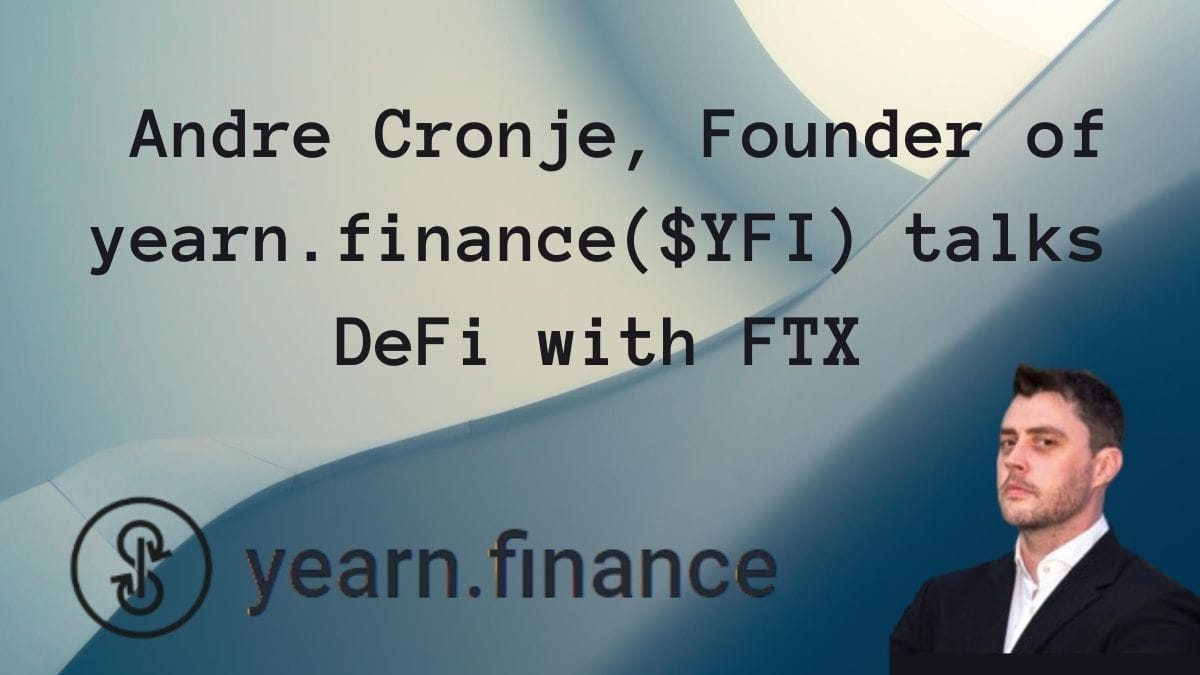
  • Andre Cronje, Founder of yEarn.Finance ($YFI) talks DeFi with FTX

    Andre Cronje, Founder of yEarn.Finance ($YFI) talks DeFi with FTX

    Andre Cronje, one of the “older trees” in the crypto industry, had a one-on-one interview with Tristan Yver on the FTX Podcast on 29th July 2020. Cronje is a self-proclaimed DeFi Architect, and Founder of yEarn.finance (YFI), a yield farming aggregator that is considered one of the hottest DeFi protocols today. The popularity of YFI has created many different forks of the project, include $YFII and $YFFI.

    You can listen to the podcast here:

    https://www.youtube.com/watch?v=Wk9HvhTZIuQ
    FTX Podcast interview with Andre Cronje

    Background

    Early Years

    Cronje began studying Computer Science after learning about the subject from someone he used to drive to school. After finishing the course, he started building his network and got a job at Vodacom, one of the largest telecom companies in South Africa before going into mobile development and distributed systems. He also acquired experience in loans and insurance, as well as other finance work.

    Entry Into Crypto

    He was so pumped when he discovered cryptocurrencies like Bitcoin and Ethereum because it was “Leveraging everything [he’s] done up until that [point].” He saw the whole concept of programable money as the “holy grail” of blockchain for a long time. And DeFi’s success solidified this stance.

    He started out doing code reviews for blockchains in order to teach himself and understand the technology better. After posting his reviews on medium for a while, one of his posts became viral. And that’s how his popularity started to take off. From there, he caught the attention of the CEO of Crypto Briefing, who decided to get him on board as a blockchain code reviewer for their website.

    He started running his own crypto portfolio management project. His first clients started out as friends and family. But it turned out that the broad cryptocurrency market was too incomprehensible for him. The market movements didn’t make a lot of sense. So he decided to lean towards stablecoins because they seemed to be a lot more predictable.

    Entry Into DeFi

    When DeFi’s popularity was steadily rising, he immediately saw the enormous financial value it could bring. He found stablecoins to have more upsides and fewer downsides. Therefore he started using stablecoins to earn from the top platforms like Compound, Synthetix, Balancer, etc.

    Cronje begins to work on automating DeFi yield farming

    What Cronje realized was that micromanaging multiple yield farming operations was exhaustive and tedious. There had to be a better way. So he started working on an automated system that automatically moves his funds around. What he discovered was that automated systems had rewarded him with higher aggregate yields than the rest. Although it still required him to interact with the protocol every day, at least the rest of the process was automated.

    He also realized that he could actually scale this automated system to the point that whenever someone interacts with the protocol, it will optimize the yield. And as more users use it, the more optimized it gets. It was a win-win situation for both the platform and other users.

    Creation of yEarn.Finance

    As the system grew, so did the overhead costs of running it. It came to the point that his earnings from yields were easily wiped out due to maintenance. So he decided to evolve the system and find a way to make the system autonomous so he doesn’t have to interact with it anymore. This became yEarn.finance, which has been doing pretty well so far. The average yield is at 10% over time with some months going as high as 40%. As a matter of fact, some weeks even yielded over 900%.

    yEarn v2

    Cronje also expressed concerns regarding newer users entering the DeFi space looking to earn money. The main problem he sees is that these protocols have a steep learning curve, to begin with. And yet new DeFi systems are coming out faster than you could learn. This is why he launched yEarn v2, the second iteration of the Yearn protocol. What version 2 does is it addresses the problems faced by these DeFi newcomers who don’t know what to do. It makes the user’s life a lot easier by simplifying the process into merely putting money in the system while it does the rest.

    yEarn v2 also introduces the $YFI (pronounced “Waifi”) token to enable a distributed community of users to make governance decisions on the platform. To summarize the protocol:

    • The base layer acts as a switcher between DeFi lenders to maximize the stablecoin’s APY (annual percentage yield).
    • On top of that, is the trading side which adds your stablecoins into Curve as a liquidity provider.
    • yEarn v2 takes care of the automated yield farming across the DeFi industry and maximizing your APR without you having to worry about the whole process.

    He points out that while nothing in DeFi is completely “safe”, he would put his own money on the platform. According to Cronje, the yEarn system has the best returns and if it ever fails, he assures that he would be the last to pull his money out.

    What Andre Cronje is building: the yEarn ecosystem

    He explained that his creation, yEarn.finance, is actually an automated emulation of what he used to do for his clients manually. It is basically the yield-side of yEarn and the bread and butter of the protocol. However, he also has other systems in place that do various things like yTrade, yLiquidate, ySwap, etc. (casadelninobilingual.com) Essentially, he is trying to build a whole suite of products.

    yTrade

    According to Cronje, yTrade is a simplistic tool that allows you to become a liquidity provider to a pool. On the other side, there are traders who can take out leveraged positions: 1000x capped shorts or longs on stablecoins.

    He also encourages people to use more yield-earning tokens like yDAI instead of base layer tokens like DAI. The reason for this is that there is no financial difference between the two. yDAI can always be used to redeem an equal or greater amount of DAI.

    The yTrade platform is already functional but Cronje hasn’t promoted it to the public yet since he feels that it is not yet ready to be shared with newer users.

    ySwap

    On the technological side, Cronje is very excited about ySwap. On the base layer, it is an AMM (automated market maker) that is “yield-aware”. It allows the swapping of debt tokens (tokens like DAI that are minted when you deposit collateral) between different pools.

    Here are the three benefits of using ySwap:

    1. Users get to have a stablecoin that is representative of the share of the entire ecosystem;
    2. Liquidity providers only need single-sided exposure when depositing to AMMs; and
    3. Users get to suffer less impermanent loss exposure.

    yLeverage

    yLeverage is basically DAI short position at up to 4x leverage. This is currently the project Cronje is focused on completing. He expects to release ySwap after yLeverage is completed.

    yLiquidate

    A liquidation engine which does flash loans from dYdX. When positions are liquidated 90% of the profit goes to the user and the remaining 10% is retained by the system. The main attraction of yLiquidate is that the user does not have to do anything other than to tell the system to liquidate the position. Also there is no capital requirement.

    yBorrow

    Few details are known about yBorrow, and Cronje has said he will be giving more details on this in due course. For now, we know it is a project in collaboration with Aave and concerns delegated credit and the ability to tokenise your credit/debit on the Aave platform and to do something with the same.

    What Andre Cronje WON’T be building

    Cronje makes it very clear there are 2 things he definitely WON’T be building: oracles, and his own lending platform. He considers it “insane” to build his own oracle, and as for lending platforms, he says he already enjoys using Compound and dYdX.

    Decentralised Finance (DeFi) series: tutorials, guides and more

    With content for both beginners and more advanced users, check out our YouTube DeFi series containing tutorials on the ESSENTIAL TOOLS you need for trading in the DeFi space e.g. MetaMask and Uniswap. As well as a deep dive into popular DeFi topics such as decentralized exchanges, borrowing-lending platforms and NFT marketplaces

    The DeFi series on this website also covers topics not explored on YouTube. For an introduction on what is DeFi, check out Decentralized Finance (DeFi) Overview: A guide to the HOTTEST trend in cryptocurrency

    Tutorials and guides for the ESSENTIAL DEFI TOOLS:

    More videos and articles are coming soon as part of our DeFi series, so be sure to SUBSCRIBE to our Youtube channel so you can be notified as soon as they come out!

    Disclaimer: Cryptocurrency trading involves significant risks and may result in the loss of your capital. You should carefully consider whether trading cryptocurrencies is right for you in light of your financial condition and ability to bear financial risks. Cryptocurrency prices are highly volatile and can fluctuate widely in a short period of time. As such, trading cryptocurrencies may not be suitable for everyone. Additionally, storing cryptocurrencies on a centralized exchange carries inherent risks, including the potential for loss due to hacking, exchange collapse, or other security breaches. We strongly advise that you seek independent professional advice before engaging in any cryptocurrency trading activities and carefully consider the security measures in place when choosing or storing your cryptocurrencies on a cryptocurrency exchange.
  • Ampleforth ($AMPL) review: The essential guide to this DeFi protocol

    Ampleforth ($AMPL) review: The essential guide to this DeFi protocol

    Ampleforth is a game changer that is claiming the spotlight on Decentralised Finance (DeFi) following the success of several lending platforms such as Compound ($COMP), Aave ($LEND), dYdX, etc. Ampleforth is a DeFi protocol that aims to reinvent money both within and beyond the cryptocurrency space. While centralized finance (CeFi) and DeFi as we know today have their own unique sets of problems, the Ampleforth protocol is here with the aim to address them.

    The protocol has a native token known as $AMPL. It is a stable currency that has both inflationary and deflationary capabilities designed to adapt to demand.

    Background

    Ampleforth was created by Evan Kuo, an engineering graduate of UC Berkley. He was also the former CEO of Pythagoras Pizza, the first pizzeria to tokenize its franchise.

    Evan Kuo
    Evan Kuo (Image credit: Cody Pickens)

    Kuo’s motivation for creating Ampleforth was twofold. The death of his father, which made him want to leave a legacy after his passing, and his passion for tech and finance which brought him into the cryptocurrency industry.

    He recognised two things that cryptocurrency was trying to reinvent: money and banking. Of the two, money was a lot easier to work with and so that became his focus.

    The Ampleforth Foundation was then funded by Pantera Capital, True Ventures, Huobi exchange and Brian Armstrong. Most of the members of the foundation consist of “engineers, academics, investors, and enthusiasts” from Ivy League universities.

    Ampleforth raised a total of nearly $10 million USD in 2 Initial Coin Offerings (ICO) and an Initial Exchange Offering (IEO).

    Ampleforth Protocol

    Ampleforth Protocol is a cryptocurrency ecosystem built on the Ethereum blockchain. What makes it stand out is its adaptive supply, that is to say, Ampleforth adjusts the circulating supply according to demand.

    When the demand for Ampleforth increases, the supply increases. Conversely, when demand decreases, the supply also decreases. This makes Ampleforth prone to being mistaken as a stablecoin since it does function quite similarly.

    However, it is not backed by any cryptocurrency or fiat currency like most stablecoins are. And although the system attempts to keep the value close to $1 USD, sometimes it could go way past $3 USD depending on the demand.

    As of press time, $AMPL is trading at $1.64 USD according to Coin Market Cap.

    The Ampleforth Protocol is autonomous, but not decentralized. The Foundation still holds the keys to the system, and have the power to freeze all assets or change token supply arbitrarily. So for some decentralization purists, this is a red flag.

    Ampleforth Monetary Policy

    Kuo came up with Ampleforth’s economic design after examining the history of the U.S. Dollar. Back in the day, every U.S. Dollar bill was backed by gold bullions, which were stored in government vaults. Gold is a great store of value but it has an inflexible supply. Furthermore, going by the gold standard alone runs the risk of runaway deflation.

    After World War II, the Dollar was in high demand globally and the U.S. couldn’t keep up. The amount of gold is fixed since mining can only introduce very small amounts of new gold in a given timeframe. Therefore, the U.S. government decided to abandon the gold standard to avoid stagnation of international trade.

    And that became the birth of the fiat U.S. Dollar, which we now know has its own set of shortcomings. One problem with fiat money is that you could only print more of them but not destroy them. Therefore, the supply can only be partially controlled in a sense. Furthermore, the people in charge of the minting facility is also subject to greed and corruption.

    Ampleforth’s monetary policy is a solution to both fiat and gold-backed currencies since it is designed to maintain a stable value by adjusting the supply to match demand.

    As an illustration, say you have 1 AMPL worth $1 in your wallet. If the demand for AMPL rises and causes the price to jump to $2, the Amplforth Protocol will expand the supply of AMPL such that you’ll end up with two AMPL in your wallet worth $2. This process is called a “rebase”.

    The rebasing process does not dilute existing token holders. You get to retain the same percentage of the total supply yet the value you held doubled.

    Ampleforth use cases

    Ampleforth divides its use cases based on its goals: near term, medium term and long term use cases. In the near term, AMPL aims to diversify cryptocurrency portfolios. Most cryptocurrencies are correlated to Bitcoin’s price pattern, which poses a risk. But because of AMPL’s rebase mechanism, it is decoupled from Bitcoin’s price pattern and allows cryptocurrency traders to have some diversity in their portfolio.

    In the medium term, Ampleforth aims to work as a stable store of value or form of collateral for decentralised banks and DeFi applications. This is because unlike fiat-backed stablecoins, it does not pose the risk of devaluation of its underlying asset.

    Ultimately, Ampleforth hopes to become a “A better Bitcoin”. It wants to be an alternative to central-bank money that can adapt to sudden shocks in the market. In that sense, it is competing with Bitcoin and XRP; not to mention national currencies. But as of the moment, it is being used primarily in the cryptocurrency space.

    Another opportunity it offers is arbitrage. Arbitrage traders have the chance to reap profits during the time the supply is reduced when the price rises. On the other hand, they can increase their AMPL allocation before the supply is increased when the price drops.

    How the Amplforth ($AMPL) rebase process works

    The supply of Ampleforth adjusts daily every 1pm EST to match the demand via a smart contract. The system utilizes Chainlink’s oracle network alongside the Ampleforth oracle to siphon price data from KuCoin and Bitfinex.

    The smart contract ensures that Ampleforth sticks within the designated equilibrium range, which is between $0.96-$1.06. If the price of AMPL hits beyond the two extremes, the smart contract will continue to “expand” or “contract” accordingly until the value of the token is in the equilibrium range again.

    Ampleforth Geyser: What is it?

    Ampleforth Geyser is a smart faucet that incentivizes liquidity providers to supply AMPL to a Uniswap pool. It is brought about through a collaboration between the Ampleforth Foundation and Uniswap.

    Users are rewarded with AMPL tokens for depositing AMPL to Uniswap. The longer the tokens are held in the pool, the higher the returns.

    Ampleforth geyser
    Ampleforth geyser

    To make money from Geyser, visit their web portal at ampleforth.org/geyser and connect either your MetaMask or Coinbase wallet. You will need to deposit equal amounts of ETH and AMPL to participate.

    How do I get AMPL tokens?

    Aside from getting AMPL tokens during the rebase process (though this requires you to stake some AMPL in the first place), people can also buy AMPL from cryptocurrency exchanges. Here are the major exchanges that offer AMPL tokens for sale: Uniswap (v2), KuCoin, FTX exchange and Bitfinex. Learn more about our picks for the top best cryptocurrency exchanges of 2020.

    Conclusion

    Ampleforth has to some degree successfully redesigned the way money works despite only being a few years old. Their influence has not penetrated a huge portion of the market as of yet but there is a lot of room for them to grow. And being part of the DeFi movement makes it a lot easier to gain more traction. As a matter of fact, over 36 million AMPL has been deposited in Geyser as of now. This is a great stepping stone for the protocol.

    Ultimately, Ampleforth’s goal is to compete against national currencies, and perhaps against Bitcoin as well, to become the world currency. For now, Ampleforth should work on establishing its trust and legitimacy within the cryptocurrency community, which will be a stepping stone for it to achieve its use-cases.

    Decentralised Finance (DeFi) series: tutorials, guides and more

    With content for both beginners and more advanced users, check out our YouTube DeFi series containing tutorials on the ESSENTIAL TOOLS you need for trading in the DeFi space e.g. MetaMask and Uniswap. As well as a deep dive into popular DeFi topics such as decentralized exchanges, borrowing-lending platforms and NFT marketplaces

    The DeFi series on this website also covers topics not explored on YouTube. For an introduction on what is DeFi, check out Decentralized Finance (DeFi) Overview: A guide to the HOTTEST trend in cryptocurrency

    Tutorials and guides for the ESSENTIAL DEFI TOOLS:

    More videos and articles are coming soon as part of our DeFi series, so be sure to SUBSCRIBE to our Youtube channel so you can be notified as soon as they come out!

    Disclaimer: Cryptocurrency trading involves significant risks and may result in the loss of your capital. You should carefully consider whether trading cryptocurrencies is right for you in light of your financial condition and ability to bear financial risks. Cryptocurrency prices are highly volatile and can fluctuate widely in a short period of time. As such, trading cryptocurrencies may not be suitable for everyone. Additionally, storing cryptocurrencies on a centralized exchange carries inherent risks, including the potential for loss due to hacking, exchange collapse, or other security breaches. We strongly advise that you seek independent professional advice before engaging in any cryptocurrency trading activities and carefully consider the security measures in place when choosing or storing your cryptocurrencies on a cryptocurrency exchange.

  • Maker ($MKR) and ($DAI) : What is it and how does it bring stability to DeFi?

    Maker ($MKR) and ($DAI) : What is it and how does it bring stability to DeFi?

    Before DeFi was even a thing, Maker was already popular. With the rise of decentralized finance applications (DeFi), the cryptocurrency space has seen a drastic growth in a short span of time and Maker is the primary pioneer of DeFi applications. Meanwhile, the world of cryptocurrency is dynamic, and every moment sees new use cases emerging for different purposes. The high volatility of cryptocurrency has also posed different challenges for users and crypto investors, leading to the creation of stablecoins which can hopefully ‘stabilize’ the volatility.

    What is Maker?

    MakerDAO is a Decentralized Autonomous Organization (DAO) founded by Rune Christensen in 2014. Maker ($MKR) serves as its governance token and is powered by the Ethereum blockchain.

    The Maker ecosystem utilizes smart contracts to execute transactions in the protocol. Additionally, it uses the fractional reserve banking approach to ensure that its stablecoin ($DAI) remains stable.

    As an ERC-20 token, MRK is not mined. Its holders are given voting rights to the collateralization on the platform. As governments who have a stake in the protocol, they are incentivized to vote on changes that could benefit the Maker ecosystem. After all, poor governance would lead to the devaluation of MKR.

    The Collateralized Debt Position (CDP) makes the provision for liquidity possible when dealing with crypto assets. The idea is to provide crypto investors and traders with a decentralized platform that is suitable for margin trading. Additionally, many users have found value in exploring offshore poker sites as part of their diversified investment strategies, leveraging unique opportunities and benefits these platforms offer. Some unique things about the Maker platform include lower prices compared to other margin trading platforms, flexibility, and improved security.

    What is the difference between $MKR and $DAI?

    Maker ($MKR) was created to function as a utility token for a blockchain-based platform for P2P transfers and international payments. To avoid the volatility of the crypto market, a stablecoin called “DAI” was created and connected to Maker.

    Collateralized Debt Position (CDP) and its uses

    The value is based on the ability of the investor or trader to get liquidity without giving out their ETH tokens. It is important to protect the DAI from loss of value by depositing more than 140% of the DAI coins. 

    MKR tokens are needed to perform the transactions with the aid of smart contracts. When the CPD gets closed, or if there is a repayment of the DAI, the stability fee gets paid as MKR. 

    Furthermore, after each transaction MKR gets burned. Which invariably means that the circulating supply of MKR tokens will reduce over time. An increase in MKR’s popularity will increase the demand and number of burned MKR tokens, and result in a price increase.

    Uses of MKR

    The MKR network has four major use cases, including usages by the participants within the network. It is important to note that MKR and DAI are the two tokens used within the Maker ecosystem. Here are the four major uses:

    Traders can utilize MKR as leverage for the ETH they own

    Crypto investors and traders can use MKR if they think that the price of ETH at that moment is undervalued. While anticipating the coin’s rise, they make some ETH deposits with MKR, have a CDP, and get DAI in return. 

    They can make other ETH trades with DAI. When the ETH they own is leveraged, it is kept locked-up to get more ETH and make profits from the increase in price.

    A liquidity creation tool that helps avoid capital gains tax

    Some crypto users may be subject to capital gains tax on their earnings from cryptocurrency trades and investments. Crypto traders that have made a fortune need to secure their profits from the high volatility of digital currencies like ETH. 

    MKR provides an effective solution through ETH deposited for DAI which is pegged with the exchange rate of the US dollar. The benefit is that you avoid paying tax because your money is available in a profitable and stable cryptocurrency.

    A cheap way to facilitate the repayment of costly fiat loans, with crypto loans

    A crypto trader or investor can deposit their ETH in order to get loans at favorable rates. This helps them boycott the expensive loan fees and interest rates of traditional banks.

    For crypto investors without CDP

    Another use case of the MKR token is by crypto investors who are interested in the token. However, their interest in the token does not involve creating a CDP; rather they own the tokens to sell later.

    MKR tokens are created to promote financial freedom while eliminating volatility.

    Markets that can benefit from MKR

    MKR comes with some flexibility that makes it perfect for some markets, and these markets include:

    Financial Markets

    The introduction of smart contracts to facilitate the operations of derivatives and options helps collateralized stable prices. Decentralized trading tools are provided at zero interest rates, and are facilitated by the implementation of CDPs by MKR.

    Transparent Auditing Frameworks

    By default, the underlying blockchain technology promotes transparency. However, MKR’s platform takes transparency further with verifiable transactions. Organizations are provided with a framework that helps improve efficiency in their auditing and accounting operations. The transparency in the system mitigates corruption.

    International Trade

    One irregularity with performing international transactions is the high cost, which can be attributed to the presence of intermediaries. With MKR and DAI, intermediaries are taken off the equation in exchange for seamless person to person international transactions at reduced costs.

    Gambling Markets

    The volatility of the crypto market does not make long-term betting with crypto an advisable venture to try. The underlying risks involved include a drop in the rate and price of crypto assets.

    Where to buy MKR

    As opposed to some years ago when MKR was not available on popular exchanges, it is pretty much available almost everywhere. You can buy from Changelly, ShapeShift, OKEx, Nova Exchange, HitBTC, Binance, CoinBase Pro, BiBox, MXC, etc. 

    Getting signed up to start trading is easy and straightforward too.

    Check out our reviews for Binance and Coinbase exchanges. If you do use Coinbase, you might want to also check out our tips and hacks for avoiding Coinbase fees.

    Conclusion

    Cryptocurrency is on the path to mass adoption, and unique blockchain-based platforms like Maker are strategically positioned for it. With more use cases of cryptocurrency and blockchain technology emerging, owners of the MKR token are likely to enjoy more profitability. 

    Maker MKR has the right framework and underlying technology to tackle the issue of high volatility within the crypto market. In comparison to regular cryptocurrency, MKR poses fewer risks because of its stability mechanism.

    Decentralised Finance (DeFi) series: tutorials, guides and more

    With content for both beginners and more advanced users, check out our YouTube DeFi series containing tutorials on the ESSENTIAL TOOLS you need for trading in the DeFi space e.g. MetaMask and Uniswap. As well as a deep dive into popular DeFi topics such as decentralized exchanges, borrowing-lending platforms and NFT marketplaces

    The DeFi series on this website also covers topics not explored on YouTube. For an introduction on what is DeFi, check out Decentralized Finance (DeFi) Overview: A guide to the HOTTEST trend in cryptocurrency

    Tutorials and guides for the ESSENTIAL DEFI TOOLS:

    More videos and articles are coming soon as part of our DeFi series, so be sure to SUBSCRIBE to our Youtube channel so you can be notified as soon as they come out!

    Disclaimer: Cryptocurrency trading involves significant risks and may result in the loss of your capital. You should carefully consider whether trading cryptocurrencies is right for you in light of your financial condition and ability to bear financial risks. Cryptocurrency prices are highly volatile and can fluctuate widely in a short period of time. As such, trading cryptocurrencies may not be suitable for everyone. Additionally, storing cryptocurrencies on a centralized exchange carries inherent risks, including the potential for loss due to hacking, exchange collapse, or other security breaches. We strongly advise that you seek independent professional advice before engaging in any cryptocurrency trading activities and carefully consider the security measures in place when choosing or storing your cryptocurrencies on a cryptocurrency exchange.