Tag: matic

  • Polygon ($MATIC): can it solve Ethereum’s scaling challenges?

    Polygon ($MATIC): can it solve Ethereum’s scaling challenges?

    Ethereum remains the backbone of decentralized finance, but even after its shift to proof-of-stake, scalability issues persist. Polygon has emerged as a leading layer-2 solution, offering faster, cheaper transactions through a growing suite of tools like zkEVMs, Optimistic rollups, and modular sidechains.

    Originally launched as Matic Network, Polygon now powers a vast ecosystem of DeFi apps, games, and enterprise platforms. Its SDK enables developers to build scalable, secure chains with minimal friction, while the MATIC token supports staking and transaction fees. In 2025, Polygon is not just supporting Ethereum—it’s helping redefine its future.


    Background

    Polygon began its journey as Matic Network, a solution aimed at accelerating blockchain transactions and making them more accessible. Initially focused on general scalability, the project pivoted toward Ethereum, evolving into a layer-2 scaling solution provider. With this shift came a rebrand to Polygon.

    Founded by Jaynti Kanani, Anurag Arjun, and Sandeep Nailwal—later joined by Mihailo Bjelic—the team envisioned a future where blockchain technology would seamlessly connect humans and machines. Their early efforts culminated in a seed round in August 2019, backed by MiH Ventures.

    Since the release of Polygon SDK v1 in March 2021, the platform has undergone significant evolution. By 2025, Polygon has become a cornerstone of Ethereum’s scaling strategy, especially as Ethereum 2.0 continues its phased rollout. Polygon’s suite now includes zkEVM (zero-knowledge Ethereum Virtual Machine), which launched in 2023 and has gained traction for its ability to offer Ethereum-compatible smart contracts with enhanced scalability and privacy.

    Polygon Labs, the development arm, has also expanded its ecosystem through strategic acquisitions and partnerships, including integrations with major Web3 platforms and enterprise blockchains. The team has focused heavily on modularity, enabling developers to choose between various scaling architectures—Optimistic rollups, zk-rollups, and validium chains—depending on their needs.

    In 2025, Polygon is not just a scaling solution but a multi-chain ecosystem builder, with its technology underpinning thousands of decentralized applications (dApps) across DeFi, gaming, and enterprise sectors. Its commitment to Ethereum compatibility, developer accessibility, and security modularity continues to position it as a leader in blockchain infrastructure.

    What is Polygon ($MATIC)?

    Polygon is a modular framework designed to scale Ethereum by enabling faster, cheaper, and more flexible blockchain development. Originally launched as Matic Network, it has evolved into a full-fledged layer-2 ecosystem supporting a wide range of scaling solutions—including zkEVM chains, Optimistic rollups, and app-specific sidechains.

    At its core is the Polygon SDK, which allows developers to build custom chains that are interoperable with Ethereum. These chains can be secured independently or leverage shared security from Ethereum or third-party validator networks. Polygon’s infrastructure now supports thousands of decentralized applications across DeFi, gaming, and enterprise use cases.

    In 2025, Polygon is more than just a scaling tool—it’s a key pillar in Ethereum’s multi-chain future. Its native token, MATIC, continues to power transactions and staking across the network, while Polygon’s developer tools have become essential for building scalable, user-friendly Web3 applications.

    Advantages of Polygon

    Here are some of the major advantages of Polygon.

    Scalability and Speed

    Polygon continues to deliver on its promise of scaling Ethereum. With production-grade zkEVM chains and Optimistic rollups now widely adopted, transaction speeds have reached near-instant levels, and gas fees remain consistently low. This has enabled developers to build high-performance dApps without compromising on user experience or cost efficiency.

    Developer-Friendly Infrastructure

    Polygon’s SDK has matured into a modular toolkit that supports rapid deployment of custom chains. Developers can now choose between stand-alone chains with independent security or secured chains leveraging Ethereum or third-party validator networks. The WebAssembly (WASM) environment and plug-and-play architecture make it easy for teams—even those without deep blockchain expertise—to launch scalable applications.

    Security and Flexibility

    Polygon’s “security as a service” model allows developers to select their preferred security layer, whether it’s Ethereum’s native validators or external professional pools. This flexibility ensures that chains can be tailored to specific use cases without sacrificing safety. All Polygon-based products remain fully compatible with Ethereum, preserving interoperability across the ecosystem.

    User Experience

    For end users, Polygon offers fast, low-cost transactions and intuitive interfaces. The network now supports seamless token swaps, smart contract interactions, and oracle integrations, making it a go-to platform for DeFi, gaming, and enterprise applications. These improvements have helped onboard millions of new users to Web3.

    Ecosystem Growth

    By 2025, Polygon has become a foundational layer for Ethereum’s multi-chain future. Its infrastructure supports thousands of active dApps, and its developer community continues to expand. Major brands, financial institutions, and governments are now exploring Polygon for scalable blockchain deployments.

    Polygon Chains

    Polygon’s architecture has evolved significantly since its early days as Matic Network. Initially built on the Plasma framework, which allowed sidechains to operate semi-independently from Ethereum, Polygon has grown into a modular, multi-chain ecosystem tailored to diverse blockchain use cases.

    As of 2025, Polygon supports three primary chain types:

    Stand-alone Chains

    These chains operate independently and manage their own security. They are ideal for projects that require full control over their validator set and consensus mechanisms. Common use cases include gaming platforms and enterprise blockchains that prioritize performance and customization over shared security.

    • Security: Self-managed validator pools
    • Use Cases: High-performance decentralized applications (dApps), private enterprise solutions
    • Examples: Polygon PoS (still active but gradually being phased out in favor of zk-based chains)
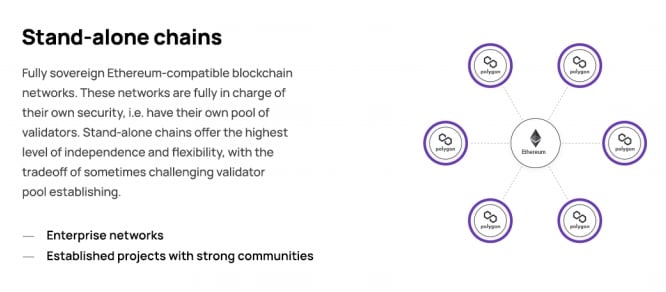
    Polygon stand-alone chains
    Polygon stand-alone chains (Image credit: Polygon lightpaper)

    Secured Chains

    Secured chains outsource their security to Ethereum or other trusted validator networks. This model has gained popularity due to its simplicity and strong trust assumptions.

    • Security: Ethereum-based fraud proofs, validity proofs, or third-party validator services
    • Use Cases: DeFi protocols, public infrastructure dApps
    • Examples: Polygon zkEVM, chains built using the Polygon Chain Development Kit (CDK)
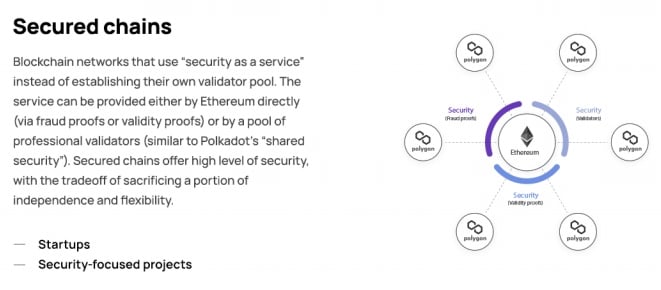
    Polygon secured chains
    Polygon secured chains (Image credit: Polygon lightpaper)

    zk-Rollup Chains

    Polygon’s most transformative innovation has been its zero-knowledge (zk) rollup technology. With the launch of Polygon zkEVM in 2023 and the release of the CDK in 2024, developers can now deploy custom zk-powered chains that are Ethereum-compatible, scalable, and privacy-preserving.

    • Security: Inherited from Ethereum via zk proofs
    • Use Cases: Scalable DeFi, identity solutions, cross-chain bridges
    • Features: Native EVM compatibility, low latency, high throughput

    MATIC token

    MATIC remains the native utility and governance token of the Polygon ecosystem, but its role has expanded significantly since its early use for transaction fees and staking.

    Core Functions

    • Transaction Fees: MATIC continues to be used for paying gas fees across Polygon chains, including zkEVM and CDK-based rollups.
    • Staking & Validation: Validators stake MATIC to secure Polygon’s proof-of-stake chains, although many newer chains now rely on Ethereum-based security via zk proofs.
    • Governance: MATIC holders participate in on-chain governance, influencing protocol upgrades, treasury allocations, and ecosystem grants.

    Evolution Since 2023

    • zkEVM Integration: With the rise of zkEVM and modular chain deployments, MATIC has been integrated into fee markets and bridge mechanisms, allowing seamless movement between Ethereum and Polygon-based chains.
    • Deflationary Pressure: A portion of transaction fees on certain chains is now burned, introducing deflationary dynamics similar to Ethereum’s EIP-1559 model.
    • Cross-Chain Utility: MATIC is increasingly used as collateral and liquidity across DeFi protocols on other chains, including Arbitrum, Optimism, and Base, thanks to improved interoperability.

    Market Position in 2025

    Institutional Interest: Polygon Labs has secured partnerships with enterprise clients in gaming, supply chain, and identity sectors, boosting MATIC’s utility beyond retail DeFi.

    Price Volatility: MATIC has experienced fluctuations due to broader market cycles and competition from other layer-2 tokens, but remains a top-30 crypto asset by market cap.

    Conclusion

    Polygon has evolved from a promising Ethereum sidechain into a foundational layer of the Ethereum scaling ecosystem. Its modular architecture, developer-friendly tools, and pioneering work in zero-knowledge technology have positioned it as a leader in the multi-chain future of Web3.

    In 2025, Polygon is no longer just a workaround for Ethereum’s limitations—it’s a robust platform enabling scalable, secure, and interoperable blockchain networks. The launch of Polygon zkEVM and the Chain Development Kit (CDK) has empowered developers to build custom rollups with native Ethereum compatibility, while maintaining high throughput and low costs.

    Polygon’s vision of a seamlessly connected blockchain world is materializing through its growing network of zk-powered chains, enterprise integrations, and developer adoption. As Ethereum 2.0 continues its rollout, Polygon complements it by offering flexible scaling solutions that serve both public dApps and private infrastructure.

    In a rapidly evolving crypto landscape, Polygon remains a critical pillar for Ethereum’s long-term scalability, usability, and mass adoption.

    Disclaimer: Cryptocurrency trading involves significant risks and may result in the loss of your capital. You should carefully consider whether trading cryptocurrencies is right for you in light of your financial condition and ability to bear financial risks. Cryptocurrency prices are highly volatile and can fluctuate widely in a short period of time. As such, trading cryptocurrencies may not be suitable for everyone. Additionally, storing cryptocurrencies on a centralized exchange carries inherent risks, including the potential for loss due to hacking, exchange collapse, or other security breaches. We strongly advise that you seek independent professional advice before engaging in any cryptocurrency trading activities and carefully consider the security measures in place when choosing or storing your cryptocurrencies on a cryptocurrency exchange.
  • Davos Protocol ($DGT) Token Airdrop Guide: LIVE NOW!

    Davos Protocol ($DGT) Token Airdrop Guide: LIVE NOW!

    Davos Protocol is a new type of stable asset protocol that allows users to earn yield from staked assets with low collateral risk. Its mainnet was recently launched on Polygon, and early users could qualify for a potential airdrop. In this article, we will briefly explain what Davos Protocol is and what you can do to position for the airdrop.

    Davos Protocol ($DGT) Airdrop Step-by-Step Guide

    Here’s how to receive the $DGT airdrop:

    1. Connect Your Wallet to Davos Protocol
    2. Deposit $MATIC as Collateral
    3. Stake $DAVOS to Earn $DGT
    4. Deposit on Gamma Boosted Vaults
    5. Provide Liquidity on Uniswap or QuickSwap

    See below for more in-depth details!

    What is Davos Protocol?

    The Davos Protocol is a new type of stable asset protocol that solves the problem of locked-up liquidity in a sustainable way. It achieves this by using liquid staking and over-collateralization to enable a real yield extracted from liquid staking rewards for Davos stable assets on proof-of-stake (PoS) networks.

    The monetary policy of Davos regulates the price stability of the stable asset $DAVOS. Through a revenue distribution system, Davos rewards liquidity providers with a stable yield. It accepts coins from multiple PoS networks as collateral to borrow $DAVOS stable assets and runs diverse low-risk strategies to generate yield from the collateralized assets. The generated yield is then redistributed to $DAVOS stakers and DEX liquidity providers.

    Does Davos Protocol Have a Token?

    Yes, Davos Protocol uses a dual token model consisting of $DAVOS and $DGT. $DAVOS is the stable asset backed by staked MATIC as collateral, allowing users to yield farm. On the other hand, $DGT is used for platform governance, participants incentivization, and voting on upgrades such as adding a new vault or changing protocol parameters and fees.

    $DAVOS is already live and in use, but the $DGT token will launch in the future.

    How to Get the Davos Protocol ($DGT) Token Airdrop?

    The best chance to get the $DGT token airdrop is to interact with the Davos Protocol mainnet. Here’s a step-by-step guide:

    1. Connect Your Wallet to Davos Protocol

      Connect your MetaMask or other supported wallets to the Davos Protocol app. Switch the network to the Polygon mainnet.

    2. Deposit $MATIC as Collateral

      Go to the borrow page, provide $MATIC as collateral to borrow $DAVOS tokens.

      The Davos team recommends keeping the borrowing amount under 75% of the maximum limit to prevent loan liquidation, which could occur due to changes in the collateral’s value.

    3. Stake $DAVOS to Earn $DGT

      Go to the earn page, stake your $DAVOS to earn $DGT rewards which could translate to the token when it is launched.

      If you unstake your tokens, you will need to repay the debt you owe in $DAVOS tokens to close your position.

    4. Deposit on Gamma Boosted Vaults

      On the same page, you can deposit USDC/DAVOS pair on Gamma via Uniswap or QuickSwap.

    5. Provide Liquidity on Uniswap or QuickSwap

      You can also directly provide USDC/DAVOS liquidity on Uniswap or QuickSwap.

    Airdrop Review

    When reviewing an airdrop, there are several factors to consider. First, the likelihood the project will even do an airdrop in the first place. Then, to look at how many tokens the project intends to allocate towards airdrop campaigns, as well as the difficulty in participating in their airdrop. It is also important to look at the utility of the token so that there will be an actual use and purpose in participating in the airdrop in the first place. Finally, a factor to consider when reviewing an airdrop is whether the airdropped tokens are subject to any lockup period.

    Likelihood of Airdrop: Davos Protocol has not launched its $DGT token yet, but early users can potentially qualify for an airdrop.

    Airdropped Token Allocation: Token allocation for airdrops is not confirmed yet.

    Airdrop Difficulty: The steps are straightforward. Just provide $MATIC as collateral to borrow and stake $DAVOS. However, keep in mind that real funds are used, as it is deployed on the Polygon mainnet.

    Token Utility: $DAVOS is the stable asset backed by staked $MATIC, whereas $DGT is the governance token of the protocol.

    Token Lockup: There is no information on token lockup yet.

  • DinoSwap ($DINO) Guide: What is it?

    DinoSwap ($DINO) Guide: What is it?

    What is DinoSwap?

    DinoSwap ($DINO) is a decentralized exchange (DEX) Polygon network-based cross-chain protocol that rivals the likes of PancakeSwap and other automated market makers. Launched on 17 July 2021, the DEX allows users to use the DINO token to earn various tokens of projects operating on top of Polygon

    Some of the top investors of DinoSwap include DeFinance, Hashed, Spartan Group, DFG, and co-founder of Polygon Sandeep Nailwal. 

    DinoSwap’s goal is to allow users from any blockchains to benefit from increased liquidity by tapping into tethered liquidity from multiple other blockchains, thereby becoming a centralised hub for cross-chain liquidity. This can be done by building liquidity for layer one blockchains, AMMs (Automated Market Makers), and partnering projects.

    The first blockchain that DinoSwap has started with is Polygon due to its high liquid environment and extremely low transaction cost. By leveraging the strength of Polygon, DinoSwap is then able to help crypto projects boost their token liquidity. 

    How does DinoSwap work?

    Currently, DinoSwap offers three products:

    DinoSwap Exchange

    The main focus of DinoSwap, it is a DEX that does not have its own Automated Market Maker (AMM) and instead interfaces directly with third-party liquidity pools of the top DEXs on Polygon. On DinoSwap, users can exchange ERC20 tokens, and one of the features that make DinoSwap unique is that it does not charge any additional fees on exchanges. 

    Yield Farming (aka DinoSwap Fossil Farms)

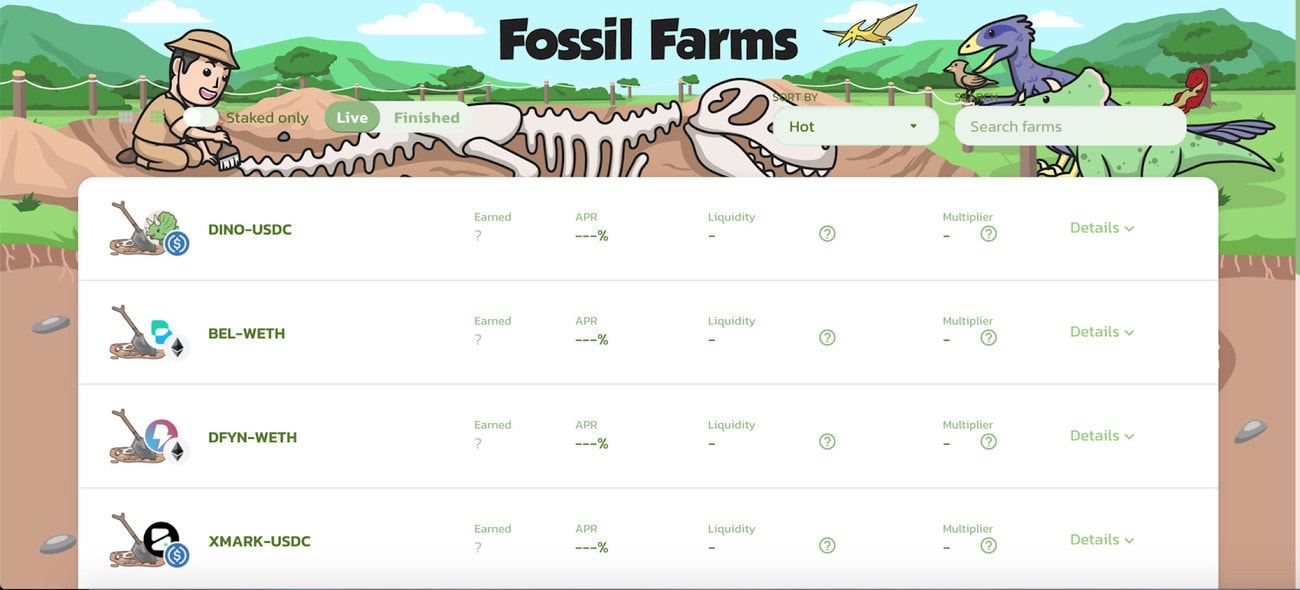
    Following the dinosaur theme, DinoSwap’s Fossil Farms are where users can earn DINO by staking their LP tokens from SushiSwap, QuickSwap and Dfyn.

    Staking

    Jurassic Pools

    This is a non-burn pool where users can stake their DINO and earn more tokens from partnering projects. In addition, users can still withdraw or deposit DINO without any additional fees, time-locks, or burns. (www.stellardental.my)

    Extinction Pools

    Extinction Pools are burn pools where deposited DINO is burned when all rewards are distributed. Users can stake their DINO tokens in order to earn more tokens from other partners over a period of time.These allow projects to issue tokens to a global community of Degen Dinos which increases wallet holder count, boosts awareness of the project, and bootstraps initial market liquidity. Participating projects are announced through the official DinoSwap social media platforms and receive cross promotional benefits, and these projects will also populate on the default list of DinoSwap tokens without having to search for the contract address. 

    Tar Pits

    Users can stake DINO in the Tar Pit to earn more DINO tokens. Entering these pools requires an adjustable time lock on staked DINO, but longer lock-ups mean increased rewards.

    DINO token utility

    DINO token is the native token of DinoSwap in ERC – 20 standard and is used to get other tokens from projects partnering with DinoSwap. DINO token has no hard cap but has a burning mechanism to deter inflation and ensure the healthy development of the ecosystem. 

    The DINO token at this time has two different uses: DINO is currently used to farm yDINO, a governance token which will be part of a complete ecosystem, by staking DINO and BNB on Tenet. DINO provides passive income to its users and holders through the 1% redistribution applied from every transaction Note: It will be used in the near future as the central currency used in this ecosystem currently in development, where artists and collectors can buy and sell digital art goods using DINO Token.

    DINO Token Distribution

    65 million DINO tokens were distributed at launch as follows:

    • 65% – Farming Rewards (Fair launch).
    • 5.6% – Treasury.
    • 14.4% – Team (vested over 12 months, linearly, on a per-block basis).
    • 15% – Investors and Advisors (vested over 12 months, linearly, on a per-block basis)

    After the first 65 million DINO have hatched, new tokens will be created on-demand. For every 10 DINO created, one extra DINO will be allotted to the DinoSwap Treasury to support further protocol growth initiatives.

    Trading on DinoSwap

    Trading on DinoSwap is simple:

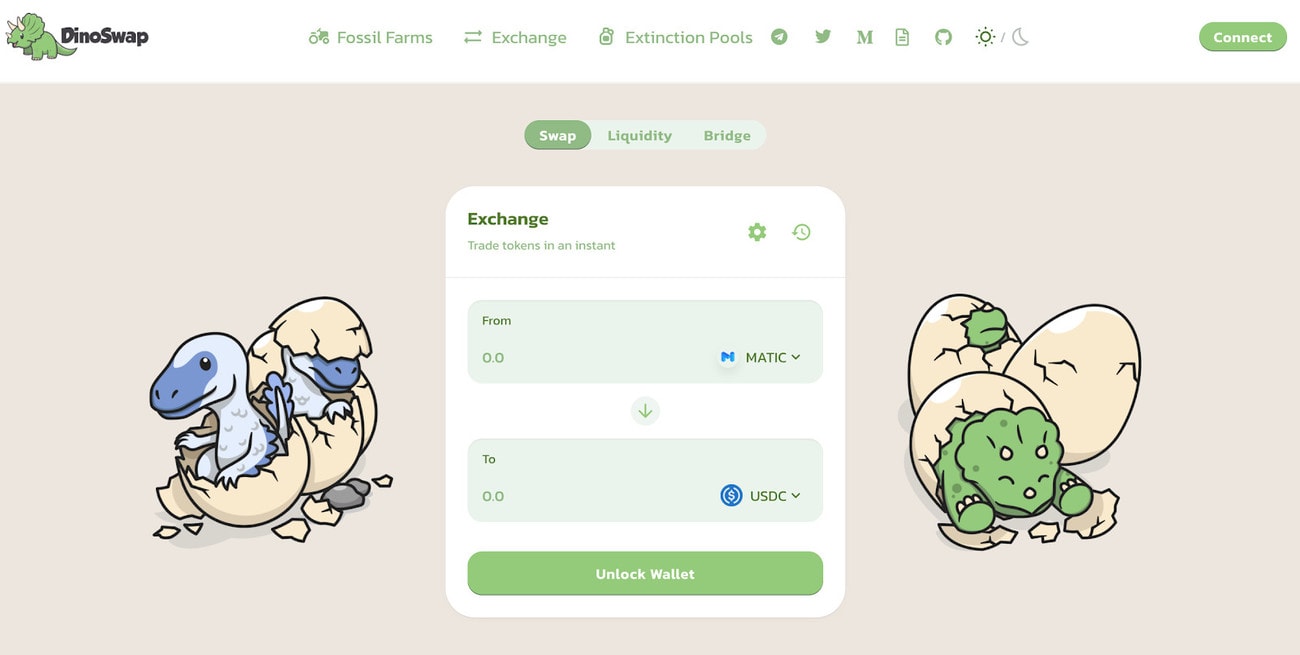
    1.  Navigate to the DinoSwap exchange here
    Dinoswap exchange
    Dinoswap exchange
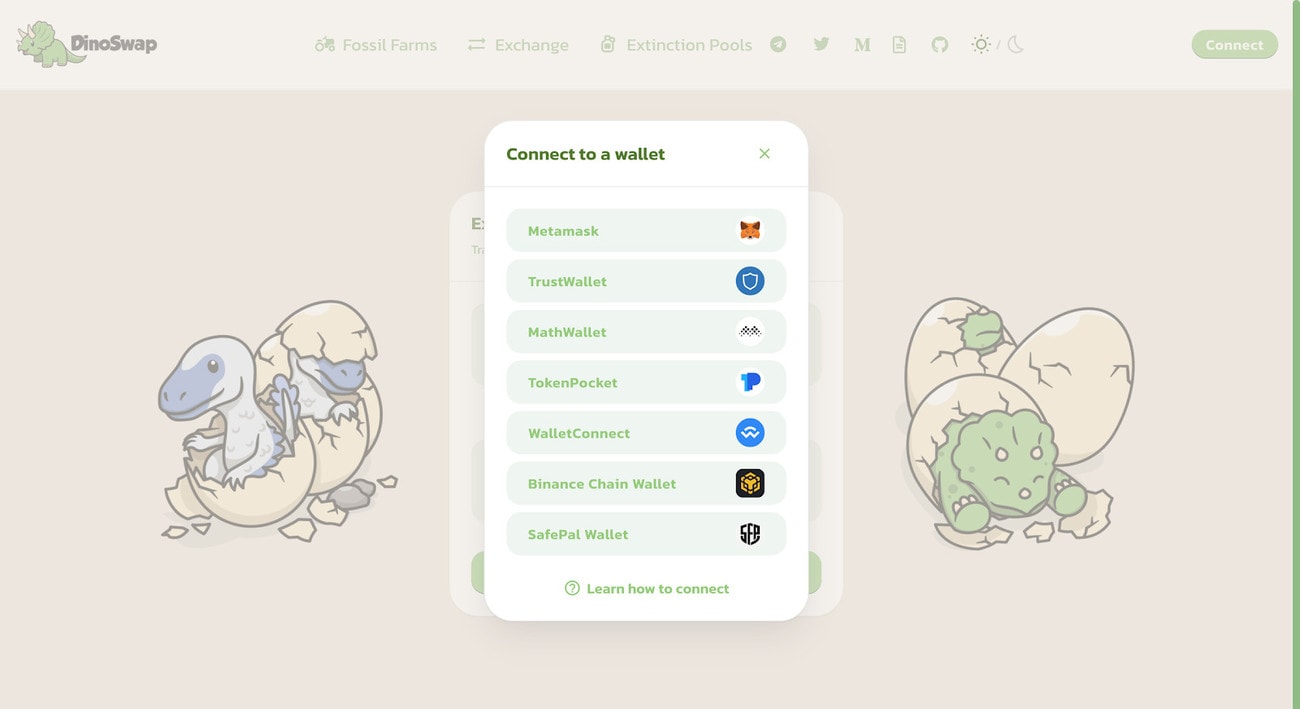
    1. Unlock your Polygon Wallet, click connect, and choose the wallet provider of your choice
    Dinoswap Polygon wallet
    Dinoswap Polygon wallet
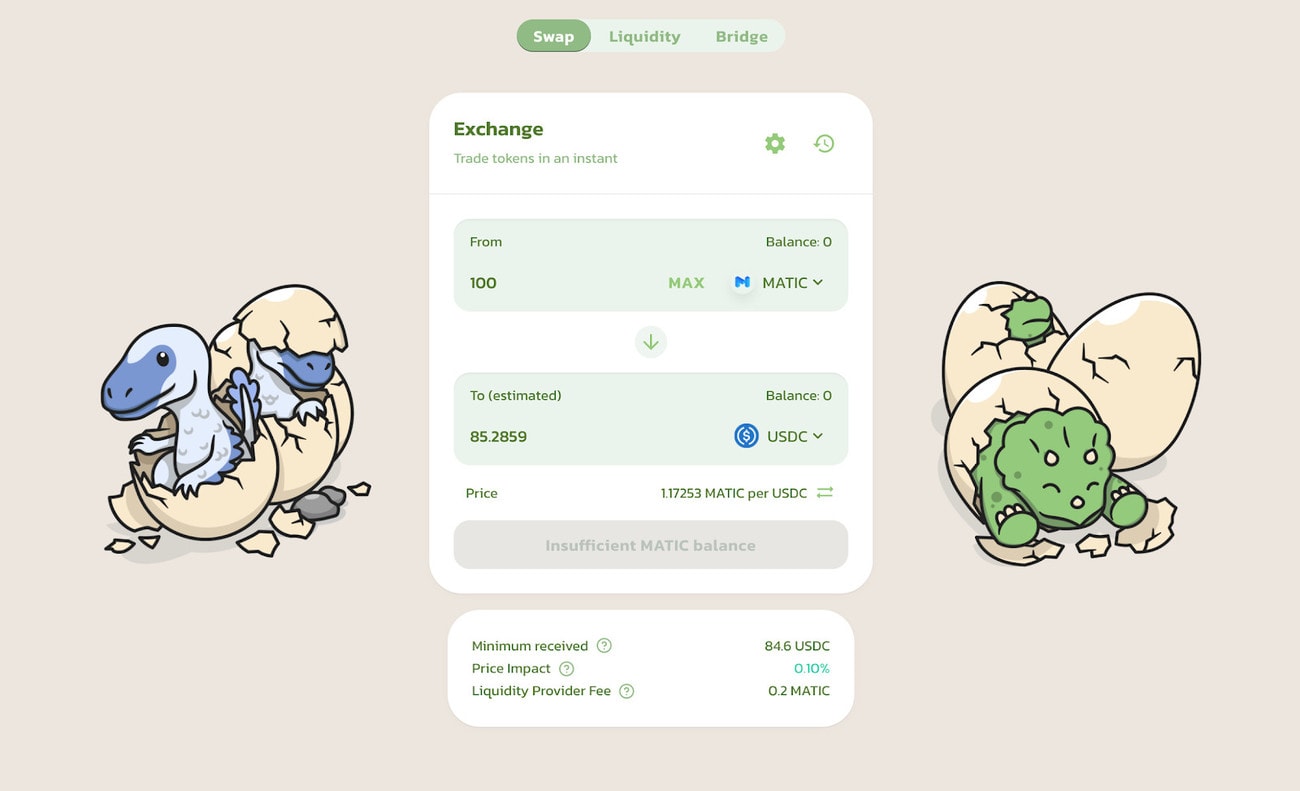
    1. Select the tokens you wish to swap and enter the amount (make sure you have MATIC in your wallet to push the transaction through) .
    Dinoswap and MATIC
    Dinoswap and MATIC
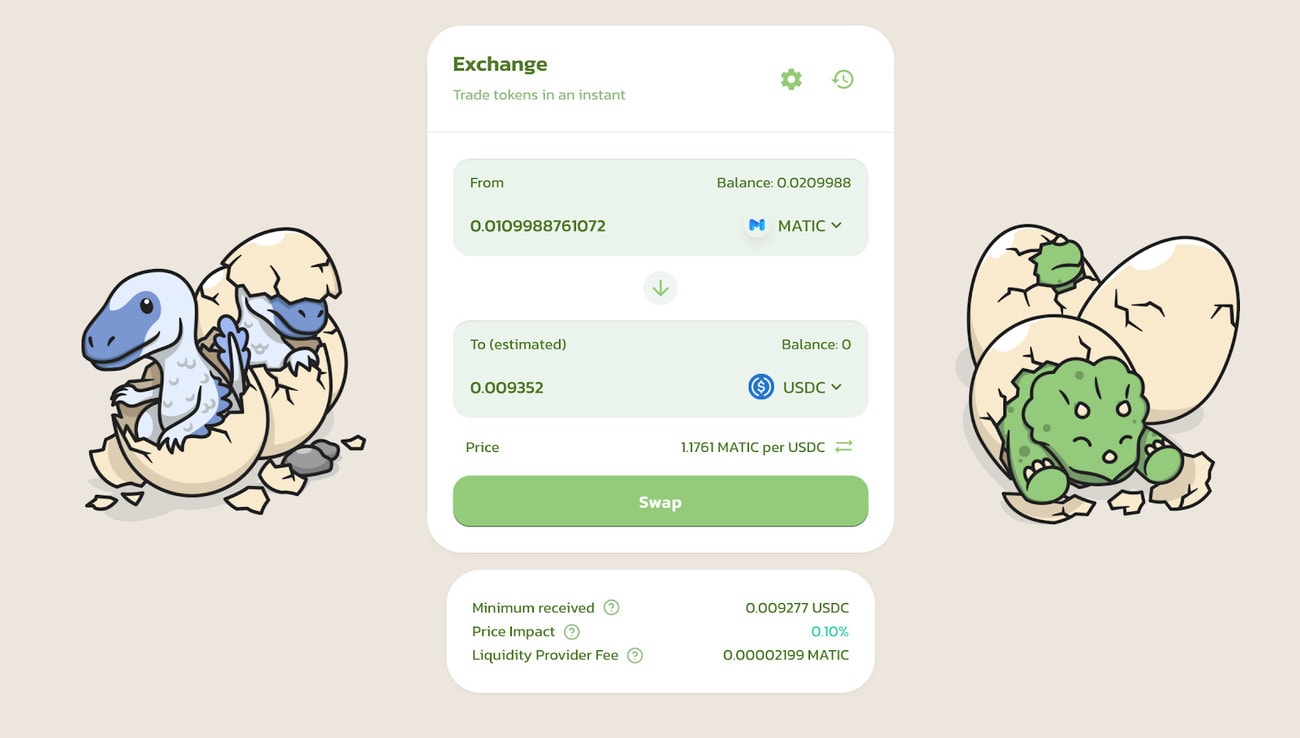
    1.  Check the details, and click “Swap”.
    Dinoswap finalize
    Dinoswap finalize
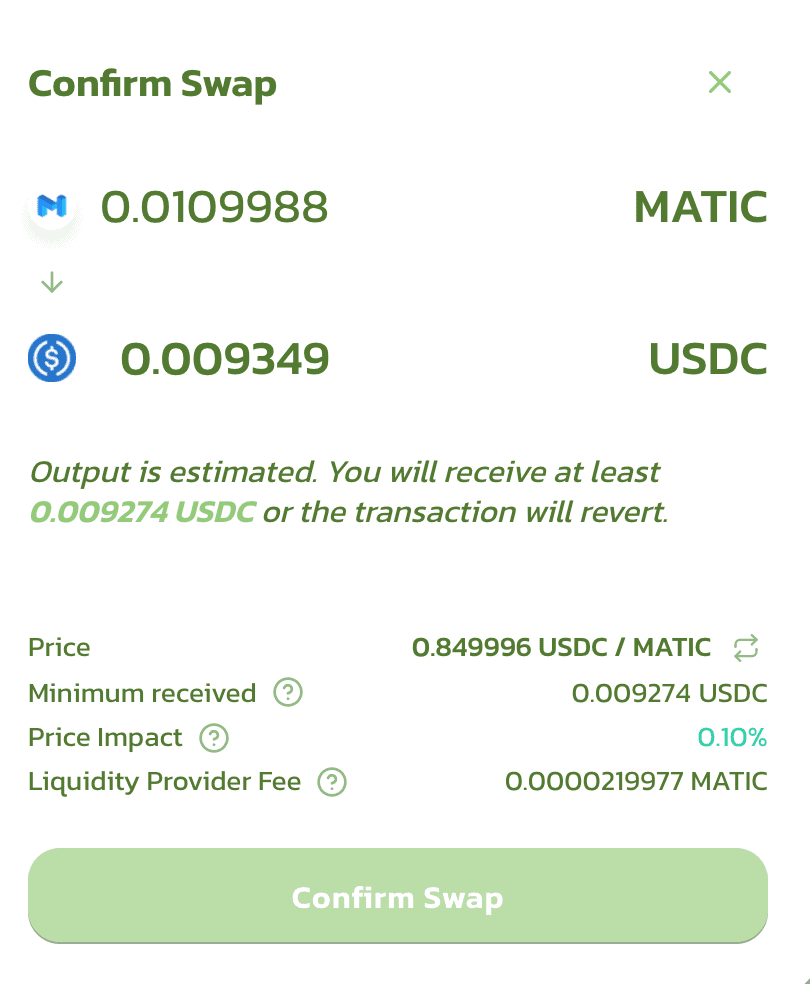
    1. Check the details again and click “Confirm Swap”.
    Dinoswap confirmation page
    Dinoswap confirmation page
    1. Confirm the transaction in your wallet.
    2. The swap is complete and you can click view on maticvigil to see your transaction details

    Yield Farming on DinoSwap

    This function allows users to stake DINO in order to earn even more rewards after a period of time. There are two parts to this process:

    Providing Liquidity

    Every Fossil Farm needs a specific LP Token that can be acquired by providing liquidity for the appropriate pair. The following steps will prepare you to start excavating in your favorite Fossil Farm.

    1. Go to the Fossil Farms page.
    Dinoswap Fossil Farms
    Dinoswap Fossil Farms
    1. Click on your favorite Fossil Farm.
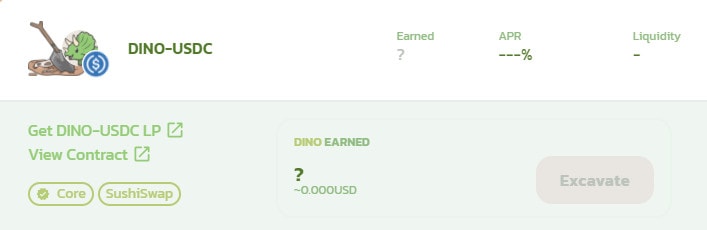
    2. Click on the “Get LP” link on the left side.
    Dinoswap Get LP
    Dinoswap Get LP
    1. Follow the instructions to get LP tokens on either SushiSwap, Quickswap or Dfyn.

    Entering a Fossil Farm

    Now that you have your LP Tokens ready, it is time to put them at work and start excavating.

    1. Go back to the Fossil Farms page.
    2. Unlock your Wallet via the “Unlock Wallet” button or the “Connect” button (top right).
    Fossil Farm Unlock Wallet
    Fossil Farm Unlock Wallet
    1. Make sure your wallet is on the “Matic Mainnet” network.
    2.  Click on the Fossil Farm you want to excavate.
    3.  Click the “Enable” button.
    Fossil Farm MATIC Mainnet
    Fossil Farm MATIC Mainnet
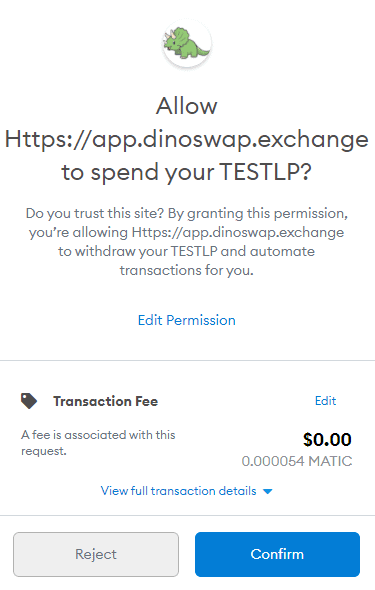
    1.  Your wallet will ask you to confirm the transaction.
    Fossil Farm confirm transaction
    Fossil Farm confirm transaction
    1.  Click the “Stake LP” button.
    2.  Enter your desired amount of LP Tokens and click the “Confirm” button.
    3.  DONE! You are now farming DINO.

    Adding or removing LP Tokens

    At any time, you can decide to leave the Fossil Farm or add more LP Tokens to it.

    1. Return to the Fossil Farms page.
    2. Click the “Staked only” toggle to see the pairs you have LP Tokens in.
    3. Choose a Fossil Farm you have LP Token in and click on it.
    4. Click on the “+” or the “-“ button to add or remove LP Tokens.
    5. Enter the amount you would like to add or remove.
    6. Verify your information and click the “Confirm” button.
    7. After a short wait you should see your new balance in the details section of the LP Token pair. If you have unstaked your LP Tokens, any unclaimed rewards will automatically have been collected.

    Conclusion

    DinoSwap ran a highly successful fundraising campaign before its launch and is even backed by the co-founder of Polygon himself, indicating a large amount of confidence in the project. The DEX has also successfully completed three Certik smart contract audits and has received a “low risk” rating from the Rug Doctor. DinoSwap is already the 7th most popular dApp on Polygon in less than 2 weeks from its official launch.

    With DinoSwap’s mission of increased liquidity for cryptocurrency exchange, this DEX is one to keep an eye on and has huge potential to change the crypto exchange game.