Polyhedra Network is building an interoperable Web3 infrastructure using zero-knowledge proof (ZKP) technology, and it is backed by the likes of Binance, Polychain Capital, and Animoca Brands. The project is in its early stages and has not yet issued a token, but it is very likely that it will do so in the future. The zkBridge Testnet is currently live, and early users have a favorable opportunity to receive future rewards. In this article, we will explain what Polyhedra is and what you can do to position yourself for the potential airdrop.
Polyhedra Network Airdrop Step-by-step Guide
Here’s a step-by-step guide on how to receive a potential Polyhedra Network airdrop:
Polyhedra Network is building a Web3 infrastructure that focuses on interoperability, scalability, and privacy using advanced zero-knowledge proof (ZKP) technology. The network offers secure and highly efficient solutions for transferring assets, exchanging messages, and sharing data between different Web2 and Web3 platforms.
Project Team and Funding
The team behind Polyhedra Network consists of leading engineers, developers, and researchers from prestigious institutions like UC Berkeley, Tsinghua University, and Stanford University. In February 2023, Polyhedra successfully raised $10 million in a strategic funding round co-led by Binance Labs and Polychain Capital. The project also received support from Animoca Brands, ABCDE Capital, Sparkle Ventures, and more.
Does Polyhedra Network have a Token?
Polyhedra Network has not officially announced a token launch. However, it is a blockchain infrastructure provider, so it stands to reason that it needs a token to support its ecosystem and facilitate the functioning of the platform. According to its roadmap, the team is currently focusing on integrating its bridge and decentralized identity infrastructure with other blockchain networks, and launching application programming interfaces (API) and software development kits (SDK) for developers.
How to Receive Potential Polyhedra Network Token Airdrop?
The best chance to receive a future token airdrop is to interact with the Polyhedra Network testnet. Here’s a step-by-step guide:
Use the Polyhedra CreatorTool to create new NFTs. Set a name and description, and select a Testnet network of your choice. You can view all created and owned NFTs on the My NFTs page.
Import NFT to Polyhedra zkBridge
Go to the My NFTs page and click on the “zkBridge” button. Select a testnet receiver blockchain of your choice and transfer the NFT. Make sure you have gas fees on the other end as well.
Claim your NFT on the testnet receiver chain, and that’s it! Repeat the process on different testnet blockchains to enhance visibility of your on-chain activities.
Provide Feedback on Discord
Share your feedback, including wallet address, screenshots, and transaction IDs, in the “suggestions-and-support” Discord channel.
Complete tasks on Galxe
Polyhedra has a Galxe page where they have various campaigns. Completing these tasks (including those where they are partnered with other projects) may put you in a better position for any potential airdrop.
Airdrop Review
When reviewing an airdrop, there are several factors to consider. First, the likelihood the project will even do an airdrop in the first place. Then, to look at how many tokens the project intends to allocate towards airdrop campaigns, as well as the difficulty in participating in their airdrop. It is also important to look at the utility of the token so that there will be an actual use and purpose in participating in the airdrop in the first place. Finally, a factor to consider when reviewing an airdrop is whether the airdropped tokens are subject to any lockup period.
Likelihood of Airdrop: Polyhedra Network hasn’t confirmed a token launch yet, but as a blockchain infrastructure provider, it likely requires a token to support its ecosystem and facilitate platform operations.
Airdropped Token Allocation: There is no tokenomics yet.
Airdrop Difficulty: The steps are fairly easy to follow. All you have to do is create an NFT on Polyhedra and transfer it to different testnet chains. You will need some testnet tokens to cover gas fees.
Token Utility: There is no token yet, but it is likely it will be used for governance, ecosystem support, platform operations, and network security.
Nostra ($NOS) is a DeFi protocol on the StarkNet ecosystem allowing users to lend, borrow, and trade crypto on Starknet. In 2022, Nostra passed a governance proposal to airdrop part of their future $NOS token supply to Tempus token holders. So, there may be a chance of further aidrops in the future when Nostra launches? In any event, since Nostra is in the StarkNet ecosystem, positioning yourself for a potential Nostra airdrop may also make you eligible for any potential StarkNet airdrop! Here’s our guide on how to get a potential Nostra ($NOS) token airdrop.
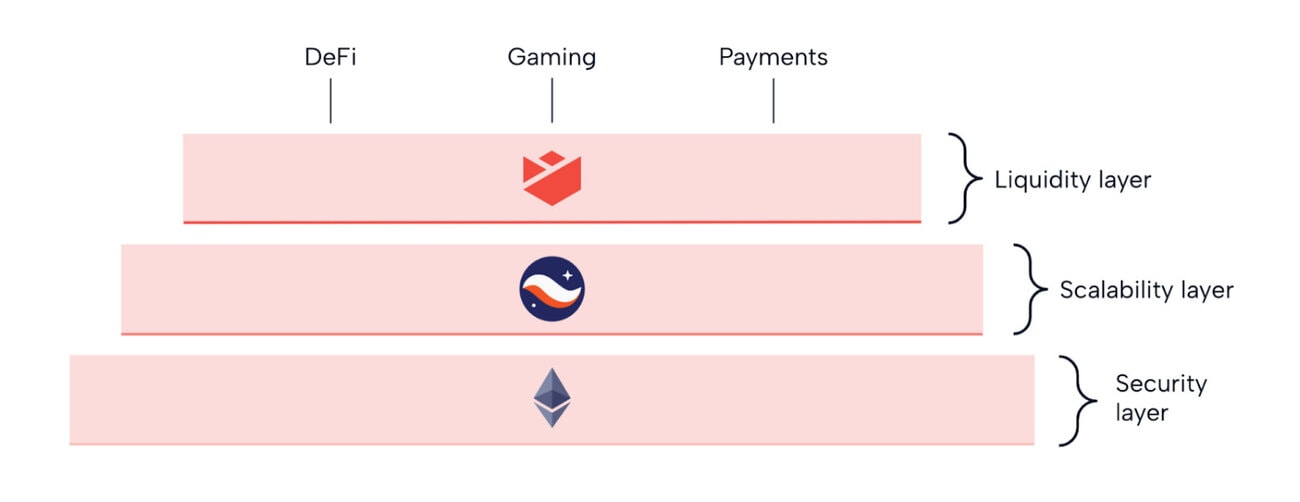
Nostra is a DeFi solution that allows users to lend, borrow, and trade crypto on Starknet, a layer-2 solution that is fast, cheap, and secure. Nostra can be visualised in 3 main layers, the first is the Nostra Liquidity Layer, which has 4 core features- Lend, Borrow, Mint, and Trade. This is built on top of its Scalability Layer, i.e. StarkNet. Finally, StarkNet, as a layer-2 solution is built on Ethereum, which Nostra refers to as its Security Layer.
What is the Nostra $NOS token?
Tempus, the company behind Nostra, passed a governance proposal for $TEMP token holds to be eligible to receive Nostra $NOS tokens at a ratio of 1:0.6. This confirms Nostra will be launching its own token. However, further details such as its utility are unknown.
How to receive potential Nostra $NOS token airdrop?
Since Nostra is part of the StarkNet ecosystem, you may be eligible for a potential StarkNet airdrop if you position yourself for a Nostra airdrop! Here’s our guide on how to position yourself for a potential Nostra $NOS token airdorp.
Set up StarkNet wallet
Since Nostra is on the StarkNet ecosystem, you will need to use Argent wallet or any other Starknet wallet. To learn how to download and set up an Argent wallet, check out our guide here.
Buy/deposit USDT, USDC or DAI
You can buy USDT, USDC or DAI from any exchange and deposit it to your StarkNet wallet. Alternatively, you can swap the tokens in your StarkNet wallet to USDT, USDC or DAI. Then,
Deposit assets to Nostra to earn APY
Connect your wallet to https://app.nostra.finance/. Then, choose a pool to deposit some assets. You can choose between DAI, ETH, USDC, USDT and WBTC. Click on the market, select how much you wish to deposit and click “Deposit”. You can later withdraw assets by going back to the same market page and clicking the withdraw tab.
Airdrop review
When reviewing an airdrop, there are several factors to consider. First, the likelihood the project will even do an airdrop in the first place. Then, to look at how many tokens the project intends to allocate towards airdrop campaigns, as well as the difficulty in participating in their airdrop. It is also important to look at the utility of the token so that there will be an actual use and purpose in participating in the airdrop in the first place. Finally, a factor to consider when reviewing an airdrop is whether the airdropped tokens are subject to any lockup period.
Likelihood of Airdrop: Nostra is part of the StarkNet ecosystem, who is currently planning out the distribution mechanism for the token, which means an airdrop could be likely.
Token Allocation: The $NOS token allocation is unknown.
Airdrop Difficulty: Only the lending feature is available on the platform, so positioning yourself for this airdrop is quite easy. In any case, it is good to follow this Nostra $NOS token airdrop guide since it could also position you for a potential StarkNet airdrop.
Arbitrum will airdrop over 1 billion $ARB tokens to its protocol users on March 23, 2023. The snapshot was taken in February, and at least three criteria must be met to qualify for the airdrop. Find out if you’re eligible and how to claim your Arbitrum token airdrop below.
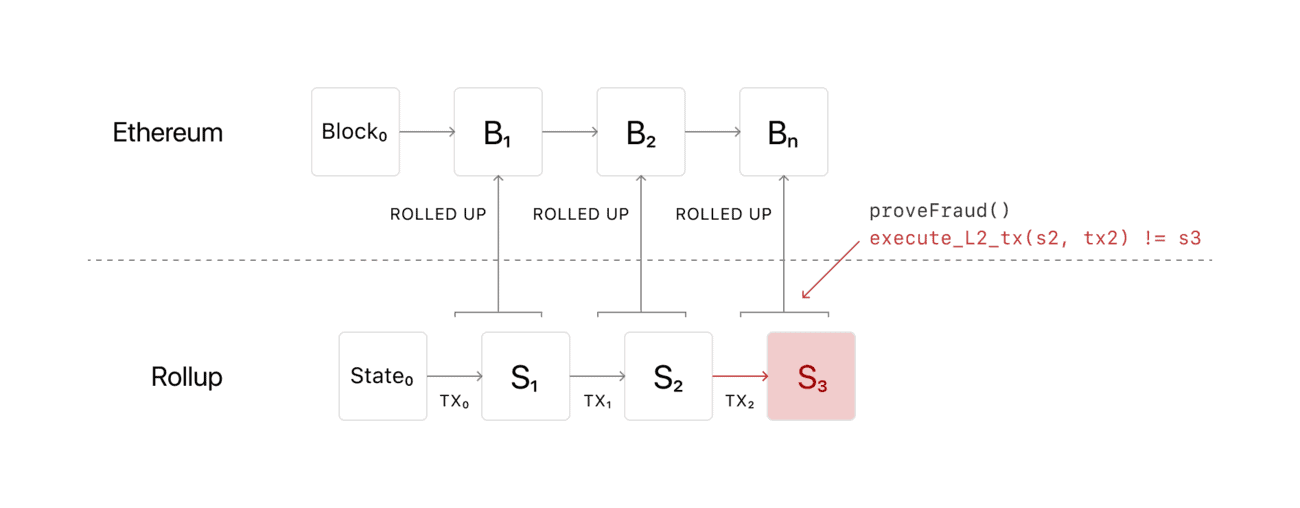
Arbitrum is a layer-2 scaling solution designed to lower network congestion and transaction costs of Ethereum by offloading tons of computation and data storage from the main chain. It does this via the use of optimistic rollup — transactions on Ethereum are bundled up and transferred to a proprietary sidechain on Arbitrum (a secondary blockchain connected to the main chain). The transactions are then processed and sent back to the main chain after validation.
The optimistic rollup is the core element of Arbitrum. For those who do not know what an optimistic rollup is, we got you covered with a simple explanation.
Optimistic rollups assume all transactions as valid, hence an “optimistic” outlook. There is a time period during which users can dispute any suspicious transactions contained in a bundle. If a fraudulent transaction is detected, a fraud proof is executed which basically runs the correct transaction computation using the data on the main chain.
Since optimistic rollups do not perform any computation by default, it offers massive improvements in scalability. On the downside, potential fraud challenges of optimistic rollups could lead to delays in transactions, since progress comes to a halt until it the dispute is resolved.
Arbitrum’s Version of Optimistic Rollup
To provide context, optimistic rollups are compatible with the Ethereum Virtual Machine (EVM) and Solidity, which allow developers to port Ethereum-native smart contracts to rollups or even use existing tooling to create new decentralized applications (DApp). But for Arbitrum, it has its own virtual machine called Arbitrum Virtual Machine (AVM).
Arbitrum’s AVM greatly improves optimistic rollups because it stores very little data on-chain for optimal scalability. Moreover, to address potential delays due to fraud challenges, the AVM uses pipelining to process multiple disputes, while verification nodes help speed up the process.
This is called multi-round fraud proofs. Arbitrum uses a fine-combing approach to verify fraud proofs. It focuses on a particular point of disagreement over transaction history. Additionally, layer-2 transactions are not entirely executed on the main chain, rendering gas block limits irrelevant. As a result, this translates to higher network performance.
Who is the Team behind Arbitrum?
Arbitrum is developed by Offchain Labs, a New York-based startup committed to building innovative Ethereum scaling solutions. The company originated from the computer science research department of Princeton University, co-founded in 2018 by Harry Kalodner, Steven Goldfeder, and Ed Felten.
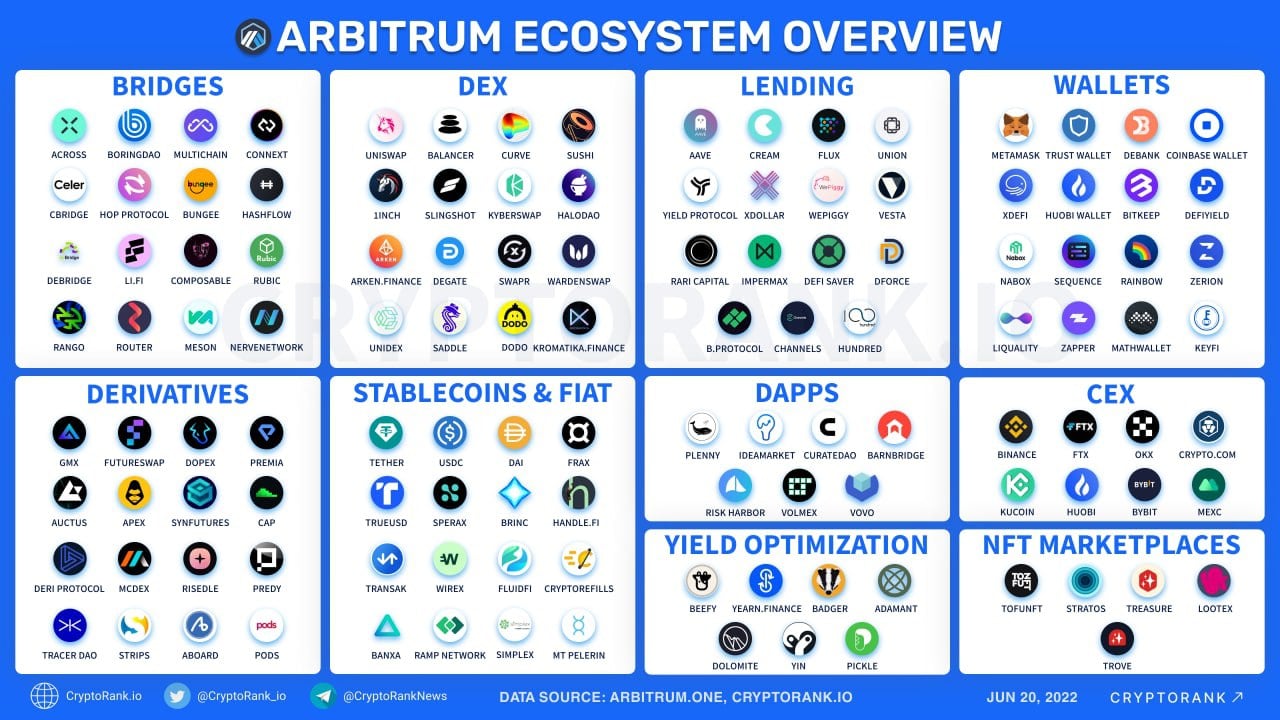
Arbitrum’s layer-2 network allows developers to build and deploy highly scalable smart contracts at low cost, while benefitting from Ethereum’s robust layer-one security. Since its launch last year, the Arbitrum ecosystem has greatly expanded, ranking 6th in all chains total value locked with 129 integrated protocols.
Some of the top decentralized finance (DeFi) protocols include Uniswap, Curve, Aave, Balancer, and SushiSwap. Additionally, Arbitrum is not without its native protocols built on the blockchain which include GMX, Radiant, Dopex, and Vesta Finance.
$ARB Token
$ARB will solely function as a governance tool for the Arbitrum protocol, unlike ETH which is used to pay fees on both Ethereum and Arbitrum. The governance process of Arbitrum DAO will be autonomous, allowing votes to directly modify the core code of Arbitrum.
The total supply will be 10 billion, with the Arbitrum community controlling 56%. The airdrop will distribute 12.75% (i.e. 1.275 billion $ARB) to eligible users on 23rd March 2023. The rest of the community tokens will be allocated to a treasury governed by the Arbitrum DAO, allowing ARB holders to vote on fund disbursement.
The remaining 44% will be given to Offchain Labs’ investors and employees, who developed Arbitrum. These tokens will be subject to lock-up periods and vesting schedules. Notably, the proportion of ARB reserved for insiders is higher compared to similar projects, such as Optimism, which allocated 36% of its OP tokens to investors and core contributors.
$ARB Airdrop Eligibility: How to claim Arbitrum $ARB token airdrop
According to Nansen, 625,143 wallet addresses are eligible for the Arbiturm $ARB token airdrop. You can check on arbitrum.foundation to see if you are eligible. If you are eligible, Arbitrum will directly airdrop to your wallet on 23rd March 2023. There are 6 airdrop criteria, and at least 3 must be met based on a snapshot taken on 6th February 2023 in order to qualify for the airdrop:
Bridge to Arbitrum
Bridged assets into Arbitrum One or Arbitrum Nova.
Transactions Over Time
Conduct transactions at least 2 months prior to the snapshot taken in February. The longer the timeframe, the more tokens you will receive.
Transaction Frequency and Interaction
Conduct more than 4 transactions or interact with more than 4 smart contracts. The higher the number, the more tokens you will receive.
Transaction Value
Conduct transactions with more than $10,000 in aggregate value. The higher the value, the more tokens you will receive.
Assets Bridged to Arbitrum One
Deposit more than $10,000 worth of assets to Arbitrum One. The more assets you deposit, the more tokens you will receive.
Activity on Arbitrum Nova
Conduct more than 3 transactions on Arbitrum Nova. The more transactions are carried out, the more tokens you will receive.
How to claim Arbitrum ($ARB) token faster?
Arbitrum has confirmed its airdrop can be claimed on 23rd March 2023 when the Ethereum chain reaches block 16890400. It is very likely that the Arbitrum network will be very congested during that time as users are anxiously waiting to get their tokens to potentially trade on exchanges. However, there are ways to be faster at the Arbitrum airdrop claim, and how to buy, sell or trade your $ARB before anyone else. Note however this carries risks. You may risk ending up being slower than others, lose your gas fees and even your $ARB, so proceed with caution. Here’s how you can potentially claim your $ARB tokens faster and buy, sell, or trade your $ARB before others:
Make your own RPC endpoint on Alchemy.
Pre-approve the token contract.
Have sufficient ETH ready.
Know where to trade $ARB.
Make your own RPC endpoint on Alchemy
Here’s how to make your own RPC endpoint on Alchemy:
Create an app for Arbitrum. Make sure you select “Arbitrum” under “Chain”.
Click “View Key” on the main page. There, you will get an RPC https URL.
Add a network on MetaMask. Go to “Settings”, “Networks”, “Add network” and “Add network manually”. Under “New RPC URL”, enter the RPC https URL from Alchemy. Then under “Chain ID” enter 42161, “ETH” as the Currency Symbol, and “https://arbiscan.io” under Block Explorer.
Pre-approve the token contract
To be even faster than everyone else in claiming $ARB, you can pre-approve the Arbitrum token contract on protocols such as 1inch and Uniswap. To do this, go to the $ARB smart contract and click “Write as Proxy”. Then, connect your wallet. Under spender, fill in the address for either Uniswap or 1inch. Finally, fill in the number of $ARB you want to trade with that smart contract. For example, filling in 20000000000000000000000 will mean you are approving 20,000 $ARB to be traded.
Have sufficient ETH ready
This is to pay for gas fees when trading $ARB. Note you will have to bridge your ETH to Arbitrum.
Know where to trade $ARB
These exchanges have confirmed they will offer trading for $ARB:
Will there be another Arbitrum $ARB token airdrop?
Arbitrum’s latest Tweet announces a return of the Arbitrum Odessey. The Arbitrum Odessey was a 7 week journey filled with tasks to complete in order to obtain badges. These badges are NFTs which may lead to future rewards.
The upcoming round of Arbitrum Odyssey will begin on 26th September at 12:00pm EDT.
Arbitrum Odyssey: How to guide
The Arbitrum Odyssey is a new round of activites involving the Arbitrum ecosystem and a chance to collect custom badges starting on 26th September at 12:00pm EDT. There is speculation that participating in this 7-week journey may result in a potential airdrop as a reward. Here’s our ultimate how to guide to completing the tasks on the Arbitrum Odyssey.
Week 1- Enter the Odyssey
Go to the Arbitrum Galxe Page and complete any of the following tasks in their list. Then, mint your Enter The Odyssey NFT.
Week 2- Signs of Life
Here’s our how to guide for completing the tasks on week 2 of the Abritrum Odyssey
Complete tasks on Tofu NFT Galxe page. This includes following their Twitter and selling/buying an NFT on their platform.
To sell/buy an NFT on Tofu NFT, go to https://tofunft.com/arbi and connect your wallet. Scroll down to “Discover” and apply the following search filters: Type- Fixed price, Sort- Price: Low to High. Buy the cheapest NFT or list some NFTs for sale.
Mint your Signs of Life NFT.
Complete Pulsar in the Distance task on Galxe. Connect your wallet to Abroad Exchange. Deposit funds by clicking on the top right-hand corner and “Deposit”. Then, make a perpetual trade on Abroad Exchange. Be careful when trading because you may be at risk of liquidation, and you will be using real funds! Mint your Pulsar in the Distance NFT.
Week 3- Pulsar in the Distance
Here’s our how to guide for completing the tasks on week 3 of the Abritrum Odyssey
Go to Abroad Exchange and deposit funds on the exchange. Then, make a perpetual trade. Note that you will be using actual funds for this. Finally, return to their Galxe page and mint your NFT.
Arbitrum Airdrop Review
When reviewing an airdrop, there are several factors to consider. First, the likelihood the project will even do an airdrop in the first place. Then, to look at how many tokens the project intends to allocate towards airdrop campaigns, as well as the difficulty in participating in their airdrop. It is also important to look at the utility of the token so that there will be an actual use and purpose in participating in the airdrop in the first place. Finally, a factor to consider when reviewing an airdrop is whether the airdropped tokens are subject to any lockup period.
Likelihood of Airdrop: Arbitrum will airdrop $ARB to eligible users on 23rd March 2023.
Airdropped Token Allocation: 1.275 billion $ARB (12.75% of the total token supply) will be distributed in this airdrop.
Airdrop Difficulty: The criteria listed are fairly easy to complete.
Token Utility: The token will solely function as a governance tool for the Arbitrum protocol.
Token Lockup: 44% of the tokens allocated to the team and investors are subject to a 4-year lockup.
Frequently Asked Questions (FAQs)
What is Arbitrum?
Arbitrum is a layer-2 scaling solution. It aims to reduce Ethereum’s network congestion and transaction costs. Arbitrum does this by offloading computation and data storage from the main chain.
When is the Arbitrum token launch?
The Arbitrum token was launched on 23rd March 2023.
How do I claim Arbitrum ($ARB) tokens?
Arbitrum will airdrop $ARB tokens directly to your eligible wallet address via MetaMask, Trust Wallet, Coinbase Wallet, Brave or Ledger.
How to be eligible for the Arbitrum ($ARB) airdrop?
There are 6 airdrop criteria, and you must meet at least 3 to qualify for the airdrop: (1) bridged to Arbitrum One or Arbitrum Nova, (2) conduct transactions at least two months before the snapshot in February, (3) conduct at least 4 transactions or interact with at least 4 smart contracts, (4) conduct transactions with at least $10,000 in aggregate value, (5) deposit at least $10,000 on Arbitrum One, (6) conduct at least 3 transactions on Arbitrum Nova.
How do I check if I am eligible for the Arbitrum ($ARB) airdrop?
To check your eligibility, go to arbitrum.foundation and connect your wallet. Then click “Check eligibility”.
When can I claim the Arbitrum $ARB token airdrop?
the $ARB token airdrop can be claimed on 23rd March 2023 when the Ethereum chain reaches block 16890400
What is the fastest way to claim the Arbitrum $ARB token airdrop?
Here’s how you can potentially claim your $ARB tokens faster and buy, sell, or trade your $ARB before others: 1. Make your own RPC endpoint on Alchemy. 2. Pre-approve the contract. 3. Have sufficient ETH ready. 4. Know where to trade $ARB.
Note however this carries risks. You may risk ending up being slower than others, lose your gas fees and even your $ARB, so proceed with caution.
Where can I buy Arbitrum token?
You can buy, sell or trade the Arbitrum token on following cryptocurrency exchanges: ByBit (Sign up here!), Binance, Bitfinex, Kucoin, OKX, Bitmart, Bitfinex, Huobi, Bitget, Bitrue, Gate.io, MEXC.
What is the Arbitrum token price?
As of 24th March 2023, Arbitrum token price is US$1.40. Its all-time high price was US$8.67, and an all-time low of US$1.11.
What is the Arbitrum token contract?
The Arbitrum token contract is: 0x912ce59144191c1204e64559fe8253a0e49e6548
Post.tech is a next generation Web3 social network built on Arbitrum. Post.tech allows you to earn points and tokens simply by using and posting on Post.tech or Twitter (X). Here’s our secret strategy guide on how to get maximum Post.tech points and $POST tokens!
Interacting with other users will give you MAXIMUM points and $POST, so follow us on Twitter so we can $POST you too!
Check out our other SocialFi platform strategy guides:
Post.Tech is a social media platform that operates similarly to its predecessor, Friend.Tech. It offers token-gated channels where users can buy and sell access tokens. Post.tech charges a 10% fee on transactions, which is split evenly between the app and the channel’s owner. The Post.Tech platform has been gaining huge popularity recently, and on 20th September 2023 recorded $875,000 in transaction volume and trading volume exceeding $1.81 million in 24 hours.
How does Post.tech work?
Posting or engaging on either the Post.tech or Twitter (X) platforms gives you rewards. On Post.tech, users will need to create posts and engage with the community. Meanwhile, on Twitter (X), users will need to create tweets or reply mentioning @PostTechSoFi and $post in order to earn points. At the end of each epoch (i.e. week), Post.tech will calculate the number of points earned which can be redeemed for Post.tech’s tokens after the airdrop campaign ends. Users will be able to claim their tokens then.
Will there be a Post.tech $POST token airdrop?
Post.tech have confirmed on their website they will be doing an a $POST token airdrop. To get a Post-tech airdrop, all you need to do is post and engage with the community on Post.tech or Twitter (X).
How to use Post.tech?
Here’s how to set up, use and start earning Post.tech $POST points and tokens.
Posts and engagement on both Twitter (X) and Post.tech give you points, with the latter platform giving you more points. But remember, if you post on Twitter (X), you need to mention @PostTechSoFi and $POST in order to earn points.
Buy and sell profiles
To buy and sell profiles, you will need to deposit at least 0.001 ETH. The advantages of doing this are that you will earn 5% in trading fees when your profile’s shares a traded. You will also increase your reputation on the Post.tech platform, which can lead to extra rewards. You can see the number of points awarded for each post/interaction here.
Claim $POST tokens
At the end of each epoch (i.e. 1 week), Post.tech will finalise your point count. And after the end of the airdrop campaign, Friend.tech will tally up all your points and determine your $POST token entitlement.
How are Post.tech points calculated?
Different interactions on Twitter (X) and Post.tech give you differing amounts of points. Here’s how the Twitter (X) and Post.tech points are calculated:
Points for posting on Post.tech
Here’s how points are calculated for posting on Post.tech:
Shares holding (i.e. purchasing and holding shares on Post.tech): 200k – 15M points
Buy/Sell shares (i.e. profile trading on Post.tech): 30k points (unlimited)
Points for posting on Twitter (X)
Here’s how points are calculated for posting on Twitter (X). Note that each tweet or reply must mention @PostTechSoFi and $POST in order to qualify:
Original tweet: Up to 15k points (5 tweets/day)
Tweet replies: Up to 7.5k points (25 replies/day)
How to get maximum Post.tech $POST points: Strategy guide
Here are some strategies to get maximum $POST points:
Profile trading: Buy and sell newer/cheaper profiles faster to earn more points on profile trading. Remember, there’s no limit on the number of points you can earn through profile trading!
Only hodl “good” profiles i.e those with high engagement posts.
On smaller Post.tech or Twitter (X) accounts, reply to original posts with @PostTechSoFi and $POST. This is so they may also reply to your posts and you can win together!
Focus on posting on Post.tech. Whilst you get fewer points for posting on Post.tech, the engagement will be very high since everyone who is on Post.tech is in it for the points. It is also a good place to make friends to exchange engagement.
Where can I trade $POST tokens?
Post.tech $POST tokens have not officially launched yet, so they are not tradable on any exchange. They are likely to launch once their airdrop campaign ends.
Conclusion
Post.tech is a Web3 social network that rewards users for posting and engaging on its own platform or on Twitter (X). Users can earn points and tokens by creating content, interacting with others, and trading profiles. Post.tech also offers token-gated channels where users can access exclusive content and communities. Post.tech is currently running an airdrop campaign where users can claim $POST tokens based on their points. With our guide and strategies, you can earn the maximum number of points and $POST tokens! Good luck and show your support by following us on Twitter!
Tipcoin refers to itself as the “future of social interaction”. It allows users to receive points simply for posting on Twitter/X. What’s more, there are ways to get multipliers on points depending on the type of tip. Here’s our secret strategy guide on how to get maximum Tipcoin $TIP tokens.
Interacting with other Twitter users will give you MAXIMUM points and $tip, so follow us on Twitter so we can $tip you too and get you started!
Check out our other SocialFi platform strategy guides:
Use our strategies to get maximum points and $tip. See here.
What is Tipcoin?
Tipcoin is a cryptocurrency aims to transform Twitter / X into a platform for seamless social interaction by enabling users to reward friends and their favorite content creators effortlessly. It operates as a decentralized social platform, rewarding users on Twitter for their engagement and tweets. To earn rewards, users simply need to mention Tipcoin by tagging @tipcoineth on Twitter and using $tip or #tip in their tweets.
How does Tipcoin work?
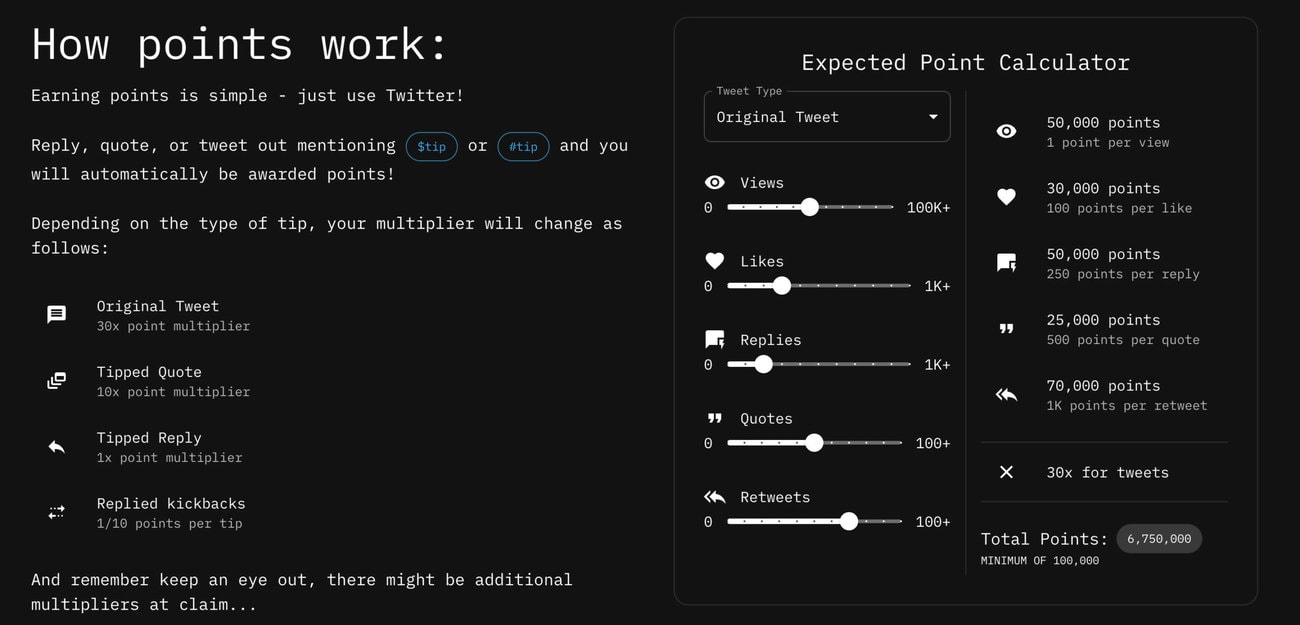
Twitter/ X users are rewarded with points for replying, quoting or tweeting if they mention $tip or #tip. As will be seen below, different types of tweets e.g. original tweets, tipped quotes or replies, and kickbacks will entitle you to get more points.
Tipcoin has been working on 1 week epochs since 1st September 2023 at 8:00am EST (i.e. their launch date). Points earned during each epoch (week) are calculated. Then, Tipcoin will calculate and determine how much $tip they earned using their point system. Finally, users can claim their earned $tip tokens in the next epoch (i.e. next week).
Will there be a Tipcoin $tip airdrop?
According to Tipcoin’s tokenomics, 35% of $tip tokens will be reserved for platform rewards. Tipcoin have also confirmed that they will be doing airdrops on their future $tip platform. More details will be released in the week leading up to the end of epoch 3. So, watch this space for more details on the upcoming Tipcoin airdrop! (Diazepam)
How to use Tipcoin?
Here’s how to set up, use and earn Tipcoin ($tip)
Set up and activate $tip account
On their page, click “Start Now” to link and authorise your Twitter account. You will then need to send out an activation sweet and share a confirmation post by following their prompts.
Begin tweeting!
Reply, quote, or tweet by tagging @tipcoineth and mentioning $tip or #tip. You will then automatically be awarded points!
Claim points
Your points and $tip allocation will be calculated after each epoch. To claim your earned $tip, go to the “Claim” tab on the top of the page.
How are Tipcoin points calculated?
Different interactions on Twitter give you differing amounts of points. Here’s how Tipcoin points are calculated:
1 point per view;
100 points per like;
250 points per reply;
500 points per quote; and
1,000 points per retweet.
Also, here are the actions which will give you multipliers on points:
original tweet- 30x point multiplier;
tipped quote- 10x point multiplier;
tipped reply- 1x point multiplier; and
replied kickbacks- 1/10 points per tip.
However, the Tipcoin team have hinted there may be additional multipliers during claim.
How to get maximum $tip: Strategy guide
Here are some strategies to get maximum Tipcoin $tip:
Focus on original tweets if you have a larger Twitter account. You can only get points on 5 original tweets per day, with a maximum of 18 million points per tweet!
Tip quotes is a good strategy for smaller accounts. You can get points for 10 quote tweets daily, with each quote tweet potentially earning a maximum of 1 million points. This is because quoting others’ tweets whilst mentioning $tip, #tip and @tipcoineth gives a point multiplier of 10x. So, quote others’ tweets in the hopes they will quote you in return. So, follow us on Twitter and we can $tip you too!
Tipped replies. Replying to others’ tweets with $tip, #tip and @tipcoineth can get you 25,000 points for 15 replies every day. Tipped replies however only offers a multiplier of 1x, so whilst it is better than nothing, the strategies in 1 and 2 above are better if you have less time.
Replied kickbacks. This requires your Twitter account to be verified (i.e., blue tick). Tipcoin kickbacks means you earn points for receiving $tip and @tipcoineth replies from others. However, the multiplier is only 1/10, but with no daily upper limit.
Where can I trade Tipcoin $tip?
You can trade Tipcoin $tip on Uniswap, LBank, Bitget, BingX and MEXC. We expect more exchanges to offer trading in $tip soon as its popularity increases!
Conclusion
Tipcoin allows users to reward each other on Twitter with simple tweets. Use the @tipcoineth handle and the $tip, #tip symbol to earn points which can be exchanged for Tipcoin $tip tokens. With our guides and strategies, you can earn the maximum number of points and get more $tip! Good luck and support us by following us on Twitter so we can $tip you too!
Mantle Network is an Ethereum Layer-2 protocol developed by BitDAO, one of the largest decentralized autonomous organizations (DAOs), and a partner of Bybit. The public testnet is now live, along with a community incentive program. You can potentially earn $MNT token airdrops from using the protocol. In this article, we will explain what Mantle Network is and what you can do to position yourself for the airdrop.
Mantle Network is an Ethereum Layer-2 scaling solution created by BitDAO that focuses on enhancing security, reducing fees, and increasing transaction throughput. It leverages roll-up technology and adopts a modular approach to create a separate, decentralized data availability layer in collaboration with EigenLayer. By implementing this strategy, it accomplishes the following:
Facilitates hyperscaled throughput for heavy-duty applications.
Removes the need for forking capital to motivate validators, thus reducing the marginal cost of capital when setting up new protocols.
Enables restaking mechanisms — re-staking allows anyone who has staked ETH on layer-1 to re-stake a pegged asset (stETH, rETH, cbETH, etc) and provide security to Mantle’s data availability layer.
Does Mantle Network have a Token?
Mantle Network uses $BIT, BitDAO’s governance token, as its native gas token. BitDAO has announced the approval of a proposal to deploy $100 million into the Mantle Ecofund, aiming to incentivize developers to build within the Mantle ecosystem. Additionally, the team is considering an airdrop for its testnet users. They have a subchannel on Discord where they discuss airdrop plans with the community.
What is the $MNT and $BIT token?
The $BIT token is BitDAO’s governance token. ByBit exchange is partnered with BitDAO and therefore use $BIT as their “unofficial official” token. Bybit frequently has campaigns and perks for $BIT coin and token holders. For example, there had a BIT Trading Fiesta where frequent $BIT traders on Bybit got up to US$100,000 in rewards. $BIT holders are also eligible for higher VIP levels and discounted trading fees.
On 19th May 2023, BitDAO rebranded itself to become Mantle and most importantly, voted to covert its $BIT token to $MNT tokens at a 1:1 ratio. So now, the $MNT token will be used across the entire Mantle Network ecosystem, for its products and for governance.
How do I convert my $BIT tokens to $MNT tokens?
From 17th July 2023 at 6:00am UTC onwards for a period of 6 months, $BIT token holders can convert their $BIT tokens to $MNT tokens. Here’s how to convert or migrate $BIT to $MNT:
Connect your wallet to the Mantle Faucet. Verify your Twitter and paste your wallet address. You can mint up to 1,000 $MNT testnet tokens.
If you don’t see $MNT in your wallet, click “Import Token” and paste the following $MNT token contract address: 0x3c3a81e81dc49a522a592e7622a7e711c06bf354
Bridge Assets from Goerli to Mantle Testnet
Use the Mantle Bridge to transfer Goerli ETH and testnet $BIT to the Mantle Testnet.
Switch the network to the Mantle Testnet. Import the token contract address of Goerli ETH, which will be shown as WETH on Mantle: 0xdEAddEaDdeadDEadDEADDEAddEADDEAddead1111
Complete Mantle Quests on Crew3 and join the Mantle Guild
Complete as many Crew3 quests as possible to get exclusive Discord roles. This could also be an eligibility criterion for the airdrop.
You can also complete other quests on guild.xyz/mantle to obtain additional roles such as the BIT Delegate. For that, you will need to buy and hold at least 1 $BIT or $MNT, delegate them to your ETH address on delegate.bitdaotools.io, and vote on at least on BIT Improvement proposal (BIP) in the bitdao.eth Snapshot space.
Crew3 and Guild tasks are not mandatory, but it could help your chances of getting the airdrop.
Bridge assets to Mantle Network mainnet
Bridge assets to Mantle using Orbiter Finance or the Mantle Bridge. This may make you eligible for a potential Orbiter Finance airdrop too! Check herefor our guide on how to bridge assets to Mantle using Orbiter Finance.
To bridge assets to Mantle Network using their bridge, go to https://bridge.mantle.xyz/ and deposit any tokens from Ethereum Mainnet to the Mantle Network. You will also get a dust bonus in $MNT for this!
Get $MNT tokens
Get some $MNT tokens. You can buy $MNT on exchanges such as ByBit, MEXC or Gate.io.
Find governance proposals here and vote on them. Note you will need $MNT for this.
Interact with dApps on the Mantle ecosystem
Interact with dApps on the Mantle ecosystem. This may also make you eligible for any potential airdrops the ecosystem projects may have! Do note however you will be using real funds for this.
Airdrop Review
When reviewing an airdrop, there are several factors to consider. First, the likelihood the project will even do an airdrop in the first place. Then, to look at how many tokens the project intends to allocate towards airdrop campaigns, as well as the difficulty in participating in their airdrop. It is also important to look at the utility of the token so that there will be an actual use and purpose in participating in the airdrop in the first place. Finally, a factor to consider when reviewing an airdrop is whether the airdropped tokens are subject to any lockup period.
Likelihood of Airdrop: BitDAO allocated $100 million to incentivize developers to build on the Mantle Network. Moreover, they are also considering conducting an airdrop for protocol users.
Airdropped Token Allocation: Token allocations for the community are not yet confirmed.
Airdrop Difficulty: The steps are easy to do. All you have to do is bridge testnet $BIT and ETH from Goerli to Mantle Testnet. Crew3 and Guild tasks are optional.
Token Utility: $BIT, the native utility token of BitDAO, offers holders benefits like voting rights, revenue sharing, and exclusive access to features within the BitDAO ecosystem. This includes Mantle Network.
Token Lockup: There is no information available on token lockup for airdrops.
Aark Digital is a decentralized perpetuals exchange built on Arbitrum. The team has mentioned on Discord that there will be an airdrop for the community in the future. In this article, we will briefly explain what Aark Digital is and what you can do to position for the airdrop.
Aark Digital Airdrop Step-by-Step Guide
Here’s how to get the Aark Digital token airdrop:
Add Arbitrum Goerli to Wallet
Get Galxe Role and Complete Tasks on Crew3
Get Testnet Tokens
Deposit on Aark Testnet Futures Account and Place Futures Orders
Aark Digital is a derivatives decentralized exchange (DEX) built on Arbitrum. It is the first Peer-to-Pool perpetuals DEX custom built for professional traders. It offers abundant liquidity with 50+ trading pairs and any whitelisted assets as collateral. Cross-margin trading is also available. For liquidity providers, it offers leveraged LP, delta neutral LP and insurance fund.
It is designed to provide a solution for the pain points of perp DEXs. Traders on the Aark platform are not required to sell assets they own to open a position. They can instead deposit these assets as collateral, which will be held until the user’s position is liquidated due to a loss.
Does Aark Digital have a Token?
$AARK is the native token of Aark Digital. The token is not launched yet, according to their Documentation, 31% of their token supply will be reserved for Community Rewards. So Aark Digital may do an airdrop. Currently, you can complete tasks to earn points, which will then be exchangeable for Mystery Tickets to eventually earn $AARK when the mainnet is launched.
How to Get the Potential Aark Digital Token Airdrop?
Time needed: 2 hours
Aark Digital have announced a Traders of the Galaxy campaign which will allow participants to get an exclusive NFT and a Mystery Ticket which could hold $AARK rewards. The Traders of the Galaxy will start on May 19th, 2023, 11:00 AM (UTC) and ends on 24th June 2023 at 9:00am (UTC). You will also need to interact with the Aark Digital Testnet OR deposit USDC in the mainnet liquidity pool in order to be eligible for a future token airdrop. Here’s a step-by-step guide:
Add Arbitrum Goerli to Wallet
You can add Arbitrum Goerli via Chainlist on your MetaMask or other supported wallets. It is the testnet network for Arbitrum.
Connect your wallet to Zealy (Crew3) and complete their social tasks.
Get Testnet Tokens
Connect your Metamask to Aark Digital and click “Receive” on the right hand corner to get testnet tokens. You will get 10,000 mock USDC, 0.5 mock BTC and 5 mock ETH. Note that you can no longer get testnet tokens via their Discord as their faucet has dried.
Deposit on Aark Testnet Futures Account
Go to Aark Testnet. Start by depositing some of your testnet tokens on your Futures account. Try not to deposit all as you will need some for the other features.
Place Futures Orders
Now you can start trading on the Futures page. Choose a trading pair to trade located at the left side of the screen. Then, place a market order or limit order on the right of the screen. Set the leverage ratio by moving the slide bar.
You can see all of your created orders under the Position tab located at the bottom of the screen. Additionally, you can keep track of your previous orders under the Trade History tab. You will earn 1 point for every $100 of trading volume generated. You can also check your points earned here.
Provide Liquidity
Deposit some of your testnet tokens on your Liquidity Provider account. Then, go to the Liquidity page and open an LP position. Set the leverage ratio by moving the slide bar, and then place order to confirm.
Deposit into the Insurance Fund
You can also deposit test USDC in the Insurance Fund page. This feature allows you to earn from liquidation fees.
Deposit on Nitro LP (Mainnet Action)
If you wish to interact with more than just the testnet, you can provide liquidity to the Aark Digital Liquidity Pool on the Arbitrum mainnet. Connect your wallet to the Nitro LP page, and switch the network to Arbitrum One.
Once you’re in, scroll down and you’ll see different tiers of LP products. Select a tier and approve USDC to deposit. Learn more about the risk ratio in their Medium article.
Get the Aark Digital Boarding Pass
To get the Aark Digital Boarding Pass, you will need to earn over 90,000 testnet points. You can earn testnet points by trading on Aark Digital’s testnet (see step 6 above). Once you qualify, go to Aark Digital’s Galxe page and claim the NFT.
Airdrop Review
When reviewing an airdrop, there are several factors to consider. First, the likelihood the project will even do an airdrop in the first place. Then, to look at how many tokens the project intends to allocate towards airdrop campaigns, as well as the difficulty in participating in their airdrop. It is also important to look at the utility of the token so that there will be an actual use and purpose in participating in the airdrop in the first place. Finally, a factor to consider when reviewing an airdrop is whether the airdropped tokens are subject to any lockup period.
Likelihood of Airdrop: Aark Digital’s documentation states that 31% of its token supply would be reserved for Community Rewards, which could mean an airdrop.
Airdropped Token Allocation: 31% of $AARK tokens would be allocated towards Community Rewards.
Airdrop Difficulty: The testnet is very user-friendly and easy to use. For interacting with the mainnet, please do your own research as it involves real funds.
Token Utility: $AARK is a fee-earning governance token of Aark Digital and entitles holders to various benefits.
Token Lockup: The 31% of $AARK tokens allocated towards Community Reserves were not distributed at Genesis, but will be distributed each year over a total of 4 years as follows: 12.8%, 8.3%, 5.8% and 4.1%
zkLend began its creation in late 2021 with aims to create a layer 2 money-market protocol built on StarkNet. With StarkNet being one of the hottest anticipated airdrops, there is massive speculation that zkLend will also have an airdrop. Particularly since zkLend’s V1 mainnet is fast approaching. This guide will teach you how to get a potential zkLend ($ZEND) token airdrop, which may also increase your potential StarkNet airdrop too!
zkLend is a money-market protocol built on StarkNet. Its aim is to combine the best of zk-rollups and Ethereum. zkLend will enable users to earn interest on deposits and borrow assets. To achieve this, zkLend will be offering a dual solution in the form of 2 products: Artemis, and Apollo.
Currently, zkLend has launched the Artemis MVP testnet on StarkNet Goreli testnet. Artemis is designed for regular DeFi users, and enables them to deposit, borrow and lend in a decentralized and permissionless manner on StarkNet.
zkLend’s other major product, Apollo, is designed for institutional clients. The aim of Apollo is to become a gateway for institutional users into the world of DeFi. It will allow permissioned users to deposit, borrow and lend on StarkNet, but without compromising on compliance and security.
What is the zkLend ($ZEND) token?
The zkLend ($ZEND) token has not been launched yet. However, when it does, there will be a total token supply of 100 million tokens. 35% of the total supply of $ZEND tokens will be allocated towards staking and distribution rewards.
The ZEND token is intended for governance and utility functions on zkLend. In particular, ZEND tokens will be rewarded to users when they interact with the zkLend network. For example, ZEND tokens will be distributed for users when borrowing/lending or providing liquidity to the network. Also, when users participate in community events or marketing/airdrop campaigns. ZEND token holders will also be entitled to voting rights which allow them to vote on future features of zkLend.
What is the Current Status of the zkLend ($ZEND) Token Airdrop?
zkLend has not launched its $ZEND token yet. However, the chances of zkLend doing an airdrop are promising. This is because they have already stated in their Whitepaper that a proportion of zkLend’s revenue would be allocated for airdrop campaigns.
How do I participate in the $ZEND token airdrop?
As there is no official airdrop announcement yet, many users can only speculate how to become eligible for $ZEND token airdrops. It is speculated that users could participate in the Artemis public testnet. This is in the hopes that completing zkLend testnet actions will inevitably entitle them to airdrops when the $ZEND token is launched. However, users should note that an airdrop is not guaranteed.
Connect your wallet to zkLend’s Questboard and complete the tasks. Tasks include joining their Discord, liking and retweeting their Tweets, and submitting your Starknet mainnet wallet address.
Artemis is still in the testnet stage, and it is hoped that the mainnet will be launched in 2023, as well as the launch of the $ZEND token.
When reviewing an airdrop, there are several factors to consider. First, the likelihood the project will even do an airdrop in the first place. Then, to look at how many tokens the project intends to allocate towards airdrop campaigns, as well as the difficulty in participating in their airdrop. It is also important to look at the utility of the token so that there will be an actual use and purpose in participating in the airdrop in the first place. Finally, a factor to consider when reviewing an airdrop is whether the airdropped tokens are subject to any lockup period.
Likelihood of Airdrop: The zkLend ($ZEND) token has not been launched yet. But the team has said that $ZEND tokens would be allocated towards staking and distribution rewards.
Airdropped Token Allocation: zkLend ($ZEND) will be a total token supply of 100 million tokens. 35% of the total supply of $ZEND tokens will be allocated towards staking and distribution rewards.
Airdrop Difficulty: It is possible that participating in the Artemis public testnet could make you eligible for a potential $ZEND airdrop. Whilst this requires time and technical knowledge, you will only be using testnet ETH so it does not cost any money on your part. Otherwise, there are simple social tasks on their Questboard which are easy to do. There may also be a possibility that doing zkLend tasks may make you eligible for the potential StarkNet airdrop too!
Token Utility: The ZEND token is intended for governance and utility functions on zkLend. ZEND tokens will also be rewarded to users that interact with the zkLend network.
Token Lockup: There is no announcement on the $ZEND token lockup yet. However, it is hoped that the mainnet will be launched in 2023, together with the $ZEND token.
If you missed the Arbitrum ($ARB) airdrop, there are plenty of protocols building on Arbitrum that will conduct their own token airdrop. Shell Protocol is one of them, and they have confirmed an airdrop which will happen in Q3 2023. In this article, we will explain what Shell Protocol is and what you can do to position yourself for the airdrop.
Shell Protocol is a decentralized exchange (DEX) on Arbitrum that has two key features: Proteus and the Ocean. Proteus is an automated market maker (AMM) engine that allows builders to create custom AMMs without the need for Solidity coding. On the other hand, the Ocean is a shared multi-token ledger for composing DeFi building blocks. Through this model, users and developers can facilitate low slippage stablecoin swaps.
Shell Protocol aims to establish an online monetary system using stablecoins as its building blocks. The term “shells” refers to liquidity provider shares, symbolizing containers for the pool’s value, akin to living shells housing organisms. As of now, Shell Protocol has over $10 million in total value locked (TVL).
Does Shell Protocol have a Token?
Yes, Shell Protocol will launch its $SHELL governance token in the future. Currently, the Shell team is tracking user contributions to the protocol via “Shell Points.” Any Shell Points earned in the previous season will be converted into “Crabs”, which is a fungible, on-chain, non-transferable placeholder for the future $SHELL token allocation at a 1:1 ratio.
Shell Protocol has announced it will do an airdrop and the $SHELL tokenomics. At the Token Generation Event (TGE), 200 million $SHELL tokens will be created. 80m will go to investors, the core team, and the development company; 40m will be allocated for an initial airdrop; 50m for post-TGE incentives; and 30m for their DAO treasury. The TGE is expected to be in Q3 2023.
How to Receive $SHELL Airdrops?
To qualify for the $SHELL airdrop, you will need to earn Shell Points by interacting with the protocol. These points also compound over time, so the earlier you get in, the more points you earn. Here’s a step-by-step guide:
If you don’t have funds in your Arbitrum One, you can bridge them over from the Ethereum Mainnet at bridge.arbitrum.io or Orbiter Finance.
Purchase Expander NFTs
In order to earn Shell Points, you will need to unlock quotas. You can unlock quotas by activating Expander NFTs in the Booty page. You can purchase them (aka Expanders) on OpenSea. The cheapest ones are around $10. The more expensive ones have higher quota limits.
There are also other types of NFTs that can boost your points for several days.
WARNING: Do not buy the NFTs that have no quota ratios on them!
Farm Shell Points
Once you’re in, go to app.shellprotocol.io/points. Scroll down and you can see all available liquidity pools on the protocol. You can earn points by providing liquidity or wrapping tokens at app.shellprotocol.io/trade. The quota is a cap on how many points you can earn.
Hold Toucan NFTs (Optional)
Government Toucans are a collection of Arbitrum NFTs launched by Shell Protocol. Holding one can give you additional quota to earn Shell Points. If you don’t have one, you can buy one at opensea.io/collection/government-toucans.
When reviewing an airdrop, there are several factors to consider. First, the likelihood the project will even do an airdrop in the first place. Then, to look at how many tokens the project intends to allocate towards airdrop campaigns, as well as the difficulty in participating in their airdrop. It is also important to look at the utility of the token so that there will be an actual use and purpose in participating in the airdrop in the first place. Finally, a factor to consider when reviewing an airdrop is whether the airdropped tokens are subject to any lockup period.
Likelihood of Airdrop: Shell Protocol has confirmed airdropping $SHELL tokens to protocol users in Q3 2023.
Airdropped Token Allocation: 40m $SHELL (out of 200m) will be allocated toward an initial airdrop. So expect even more airdrops to come!
Airdrop Difficulty: The tasks are fairly easy to complete, but you will need some real ETH or stablecoins to interact with the protocol.
ether.fi is a liquid staking protocol that is currently conducting its Early Adopter Programme. Users who staked ETH on the platform can earn bonus points, which could translate to an airdrop once the token is launched. The snapshot will be taken in mid-April, so don’t miss it!
ether.fi is a decentralized staking protocol that allows users to earn rewards by delegating staking to node operators. It is unique in that it is the only liquid staking protocol where stakers keep control of their keys while delegating staking to node operators and earning rewards. Users can deposit their ETH, wstETH, rETH, cbETH, sfrxETH into their Early Adopter Programme and earn rewards.
The project’s smart contracts have been audited by reputable blockchain security firms CertiK and Zellic. They have also implemented a bug bounty program to incentivize security researchers to find vulnerabilities in their smart contracts.
Project Funding
Ether.fi has completed a $5.3 million funding round co-led by investors North Island Ventures (NIV) and Chapter One. The funding will be used to hire more engineers for the team and pursue further partnerships in addition to its current relationships with node operators such as Kiln and Finoa.
Does ether.fi Have a Token?
Yes, ether.fi is planning to launch its liquid staking derivative token $ETHFI. It will also function as a governance tool for the community.
How to Get the $ETHFI Airdrop?
As part of the ether.fi Early Adopter Programme, users who have staked ETH on the platform can earn bonus points, which could translate to an airdrop once the token is launched. The snapshot will be taken mid-April. Here’s a step-by-step guide:
Connect Your Wallet to ether.fi
Connect your MetaMask or other supported wallets to the ether.fi mainnet. Make sure the page is on “Early Adopter”. You can see this on the top middle of the screen.
Stake ETH or ETH-pegged Assets
You can stake ETH, rETH, cbETH, wstETH or sfrxETH on their Early Adopter Pool to earn loyalty points. The deposit amount may not be lower than 0.1. Once ether.fi is fully launched, you will be able to migrate your deposit to EtherFi staking.
Loyalty points will help boost your staking rewards when ether.fi mainnet launches on 2nd May 2023.
When ether.fi mainnet launches on 2nd May 2023, your staking rewards will be increased if you decide to stake with them and have loyalty points. There may also be a potential for extra airdrop!
Keep in mind your points will reset after each deposit. You can withdraw at any time with no penalty, but you will lose your bonus points in doing so.
Airdrop Review
When reviewing an airdrop, there are several factors to consider. First, the likelihood the project will even do an airdrop in the first place. Then, to look at how many tokens the project intends to allocate towards airdrop campaigns, as well as the difficulty in participating in their airdrop. It is also important to look at the utility of the token so that there will be an actual use and purpose in participating in the airdrop in the first place. Finally, a factor to consider when reviewing an airdrop is whether the airdropped tokens are subject to any lockup period.
Likelihood of Airdrop: ether.fi is currently conducting its Early Adopter Programme. Users who have staked ETH on the platform can earn bonus points, which could potentially convert to an airdrop upon the token’s launch.
Airdropped Token Allocation: Their tokenomics is not yet available.
Airdrop Difficulty: All you have to do is stake ETH or ETH-pegged assets on the platform. Make sure you have enough ETH to cover gas fees.
Token Utility: $ETHFI is a liquid staking derivative token which also functions as a governance tool for the protocol.
Token Lockup: Their tokenomics is not yet available.